April 23, 2026 |
“Do you feel like something awful is about to happen?” At the start of every therapy session, when answering this final question, I always scribble a ring around the same option: “Strongly Agree”. The defeatist within me always wins.
I felt this sense of impending doom more acutely last summer. A new episode of my long-running series – Depressive – had just dropped. Honestly, don’t bother streaming it, nothing fucking happens. Basically, I needed the psychological strength of a hydraulic crane each morning to yank me out of bed. Disaster felt as inevitable as, I imagine, The Rapture does for doomsday cults. So I slept all day to try to stop time.
Thankfully, at the end of last year, I dug myself out of the hole and began living again. But even though I had returned to a functioning state, I still dodged hope. When I think about it, I have always viewed hope with deep suspicion. I’ve seen it as a symptom of naivety; believing that everything will be alright, I felt, was the kind of schmaltzy affirmation that lifts you into the realm of blissful happy-clappy ignorance. It’s what you feel on ecstasy. But wait until the comedown hits! That’s real life, my friend. Wake up and smell the coffee. Or don’t bother.
In trying to feel better about this miserable outlook, I have long subscribed to a theory called depressive realism. Proposed by psychologists Lauren Alloy and Lyn Yvonne Abramson, it states that those of us with persistent low moods actually see the world more accurately. Yes, that’s right, I thought. Sure, you can wear a pair of oversized, rose-tinted sunglasses. But if you really look at what’s going on, pessimism is the only rational approach. It’s you that’s broken, not me.
Something strange, though, has happened recently – I’ve started feeling hopeful. Even writing something so positive makes me feel like I’ve just started dishing out bumps of cacao powder at a Free Hugs stall at Burning Man. After all, it makes absolutely no sense; we are living in a time where hope is illogical. A genocide in Palestine has taken place in front of our eyes. The 1.5°C global warming limit is now a mirage. The cost-of-living crisis has left 24 million people in the UK below minimum living standards. AI slop is threatening creativity. Nigel Farage is the bookies’ favourite to be the next Prime Minister, supported by a growing far-right mob. Across the pond, Donald Trump has desecrated what it means to be human.
It’s why it’s still so easy to feel powerless. Any blue-sky-thinking is hard when there’s so much brain fog. So despair sets in. For years, in the late 2010s and early 2020s, this kind of nihilism was the ethos du jour – it became trendy to take a cold detachment and listen to the Red Scare podcast on full blast. God might have been dead, but Nietzsche wasn’t. It’s always cooler to be a pessimist than an optimist. Not caring is chic.
Aside from the fleeting highs of so-called dopamine dressing after the pandemic, fashion, also, was all about despair. Runways brought apocalyptic visions of mud wrestling, digital clones and evil robots thanks to the likes of Balenciaga and Rick Owens. And the internet began to take a darker turn, churning out overprocessed garbage that has been premasticated and regurgitated for our endless displeasure. Many of us had become ‘Doomers’, treading water and waiting for the fire to arrive.
But there’s been a change in the atmosphere. It seems that people are getting fatigued by this endless despondency. When the loss of meaning, ironically, loses all meaning itself, there’s a search for actuality. It’s why, recently, I have found reasons to imagine a better future. I guess I’ve been hope-pilled. Again, if I was reading this last year, I’d probably have stopped at this point, icked out by such positive thinking. But stay with me, please.
Let’s take politics. Zack Polanski, the charismatic new leader of the Green Party, has pledged to ‘Make Hope Normal Again’ – I am now, along with more than 170,000 people, a card-carrying party member. A recent YouGov weekly tracker has the Greens polling at 16 per cent – almost the same as Labour or the Conservatives. In the US, powerhouse campaigner Zohran Mamdani has realised a new kind of American (or, at the very least, New York) Dream based on two words that Trump previously impeached: socialism and democracy. “Tonight we have spoken in a clear voice: hope is alive,” Mamdani roared in his victory speech. Whether it’s jumping on the mic at queer raves or guesting on online talk show SubwayTakes, the new NYC mayor hasn’t just made hope viable again, he’s made it sexy, too.
There are some tentative reasons to be hopeful when it comes to fashion, too. After a few threadbare showings, London Fashion Week has been given a new lease of life thanks to Laura Weir’s direction. “The overall mood at spring/summer 2026 was uplifting and optimistic – a true turning point for the city,” Mytheresa’s chief buying officer Tiffany Hsu told Vogue. From Conner Ives’s statement-making Protect The Dolls tees to Tolu Coker’s memorable upcycling, there was a buoyant attitude on show (and I’m not just talking about Harri’s inflatable latex designs).
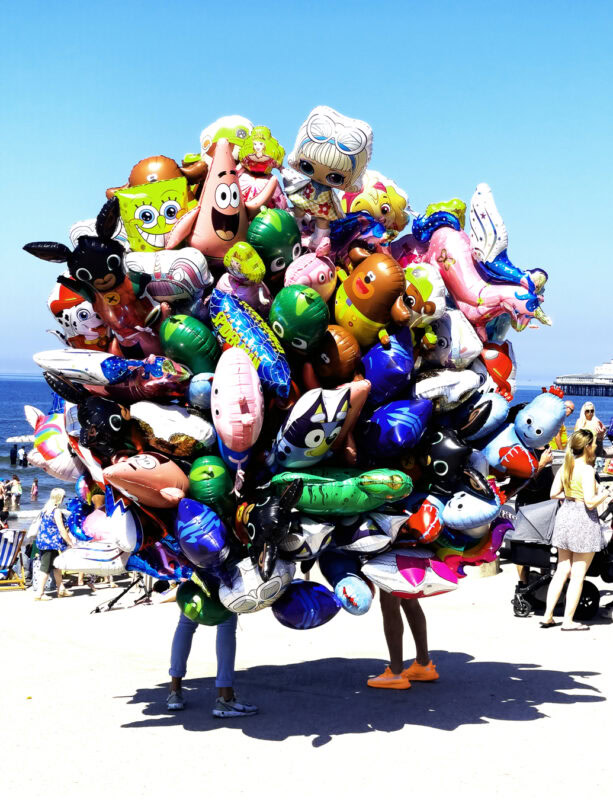
‘XR toot toot Fiesta’, Blackpool, 2022
Online, too, there’s been a backlash towards the constant churn of AI content. “Is hopecore the last gasp of a less-toxic internet?” asked Kieran Press-Reynolds earlier this year for American GQ, celebrating the “green shoot of positivity in a swamp of internet sludge”. (I refuse to call it hopecore, though; even that is too much for me right now.)
And anyway, more young people are going offline for good. According to the BSI (British Standards Institution), 47 per cent of 16-25-year-olds would rather grow up in a world without the internet. Deactivating has become a valiant status symbol. “The offline world is coming, I think,” singer-songwriter Murkage Dave recently wrote on Instagram. “Maybe the generation of kids who have grown up with influencers as parents will rebel against the internet.” No wonder the print revival is on. And don’t listen to the whole “performative reading” thing, it’s a useless pejorative. It shows people want something tangible and meaningful.
To even hold a thimbleful of hope IRL is, of course, an extreme privilege. If you’re one of the billions of people living in conflict or poverty, optimism is a chimera. It’s also a precarious approach to take. Having your hopes up makes them vulnerable to come crashing down. It’s much easier to expect the worst and be surprised if something turns out alright than gamble your emotions. But the fact that people in unthinkably nightmarish situations do still find reasons to hope and dream shouldn’t make us feel guilty, but inspire us to put our own issues into context. And expecting doom doesn’t always mean you avoid disappointment – just think of how those poor Rapture preppers felt in September when the world didn’t end, huh?
Of course, hope isn’t a solo project. The myth of prioritising individual action has faded. While flying less or adopting a plant-based diet is an admirable necessity, we can’t suck up the 3.3 billion tonnes of CO2 in the atmosphere with a paper straw. The burden should be on those in power – and through collective action, we have the ability to call them out. According to a 2024 Oxfam report, the wealth of the world’s billionaires could, by 2030, meet the 1.5°C goal of the Paris Agreement. These magnates hold the keys to creating a safer world, but they’re using them to lock away their fortunes instead (or do bumps of ket, if you know who we mean). There are clandestine systems in play that we will never, ever, be able to comprehend.
But collective work is genuinely making a difference. Pressure on the Israeli government, from grassroots movements across the globe, contributed to the eventual ceasefire in Gaza. Kneecap have just announced their biggest ever headline show, in London. And collective boycotts have had a tangible effect on the likes of McDonald’s and Starbucks.
Don’t think hope is passive, either. It’s a catalyst for action. “You won’t be active unless you hope that your action is going to do some good. So you need hope to get you going, but then by taking action, you generate more hope. It’s a circular thing,” wrote conservationist Jane Goodall, who passed away in October. Hope can galvanise change in a very real way. Fear can motivate, too, but it also creates a toxic dependency.
Maybe, then, there is some space for a kind of optimistic realism – where rational thought, direct action and reasonable hope combine together into a perpetual stew. Or perhaps I’m totally delusional. I can hear the exceptionally valid criticisms (THE WORLD IS BURNING, REMEMBER? TRUMP IS STILL PRESIDENT? THE CREATIVE INDUSTRIES ARE UNRAVELLING?) being fired my way. God, yeah. Hope is hard. But Rebecca Solnit, author of Hope in the Dark: Untold Histories, Wild Possibilities, has a good comeback. “It is not the belief that everything was, is or will be fine. The evidence is all around us of tremendous suffering and destruction,” she wrote in 2016. “The hope I am interested in is about broad perspectives with specific possibilities, ones that invite or demand that we act.”
Either way, at the very least, I now recognise things might turn out okay if we use hope as a force for meaningful change. Obviously, I’ll never totally shake the feeling that chaos is around the corner. But, perhaps, in a future therapy session, I’ll circle “Neither Agree Nor Disagree” in answer to the question of whether I feel that something awful is about to happen. And that, as my therapist would say, is good enough.
Photography by James Stopforth. Taken from 10 Magazine Issue 76 – CREATIVITY, CHANGE, FREEDOM – out NOW. Order your copy here.