May 15, 2026 |
My daughters are very specific about their partings. Wiggly, squint and off-centre won’t do: they have to be precisely in the middle. You might think that ‘the middle’ is fairly easy to locate. Surely it’s what God gave us noses for: not to smell the heady fragrance of a rose in bloom, but to guide teenage girls in parting their hair dead straight. Or not. Many attempts later, the parting is, apparently, “still wonky”. Over and over and over it they go, searching for a symmetry that doesn’t exist, forever a brushstroke out of reach. Outside, the world awaits their paean to the perfect parting.
Perfectionism is a blessing and a curse. Without perfectionism, there would be no Sistine Chapel, no Water Lilies, no Virgin of the Rocks (the painting, not the cocktail). Had Prince not been such a perfectionist, Purple Rain wouldn’t be the album that it is, and I wouldn’t have spent every night of June 1985 crying myself to sleep while listening on my shitty headphones to The Beautiful Ones, angsting over a boy who seemed to hurt me every time even though he wasn’t even beautiful.
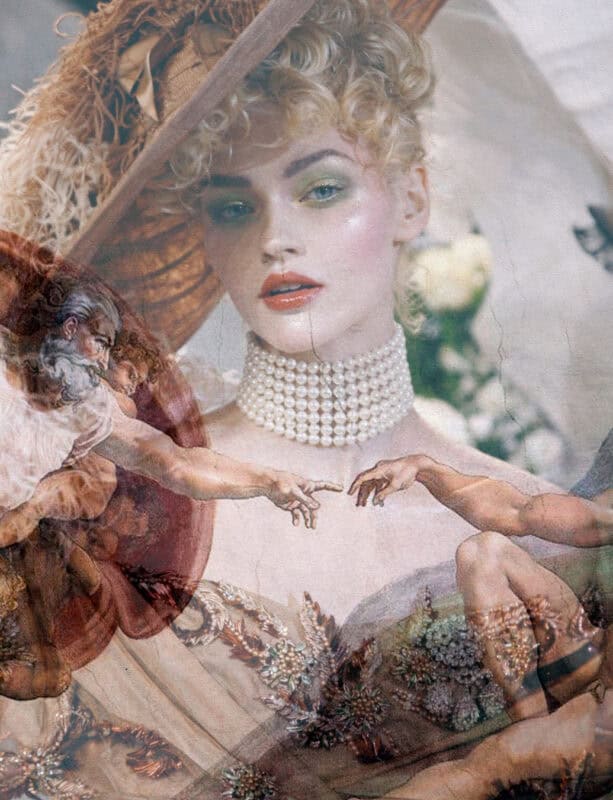
Whether Prince woke up and chose to devote his life to music, or whether music chose him, is really something only Prince can know. His long-time sound engineer Susan Rogers once said he would have been a great general in the army, as “he had extraordinary self-confidence, coupled with extraordinary self- discipline and tempered with a really self-critical eye”. His bandmate and wingman Morris Hayes described him as “a consummate workaholic, always trying to raise the bar for himself and for us”.
These descriptions of Prince seem brutally familiar. They could apply to several people in my life, despite none of them ever having written a magnum opus such as Sign o’ the Times or Purple Rain. Maybe they seem familiar to you, too. Maybe they describe your bestie, your partner, your offspring or yourself. Perfectionism walks among us, as the golden thread that drives us to be great.
I am not a perfectionist, because I don’t have the time. And when I did have the time, I didn’t have the inclination. Pragmatism is the enemy of perfectionism, because to be a perfectionist is to sacrifice everything else in life at the altar of your goal. While it’s hard to be a perfectionist, it’s arguably harder to love one, for being a perfectionist means often being late, usually being preoccupied and never being satisfied (Maybe Prince was just like his mother? Definitely Prince was just like his mother).
As Philip Larkin wrote, “Man hands on misery to man / It deepens like a coastal shelf / Get out as early as you can / And don’t have any kids yourself” – unless you teach them early on in life that 70 per cent is usually enough.
Striving for 100 per cent is never not a world of pain, yet if you want to achieve greatness, it can surely be the only goal. Those who create great art, great music, great food, great cinema, great literature and great fashion probably didn’t wake up, shuffle to their desks and decide to dial in a solid 50 per cent. One of the few benefits of ageing is the crystallisation of memory into clear categories that eluded you in the fizz of youth, and when I think of the most memorable fashion shows I have ever seen, there’s no question that the designers gave every last vestige of themselves to their endeavour.
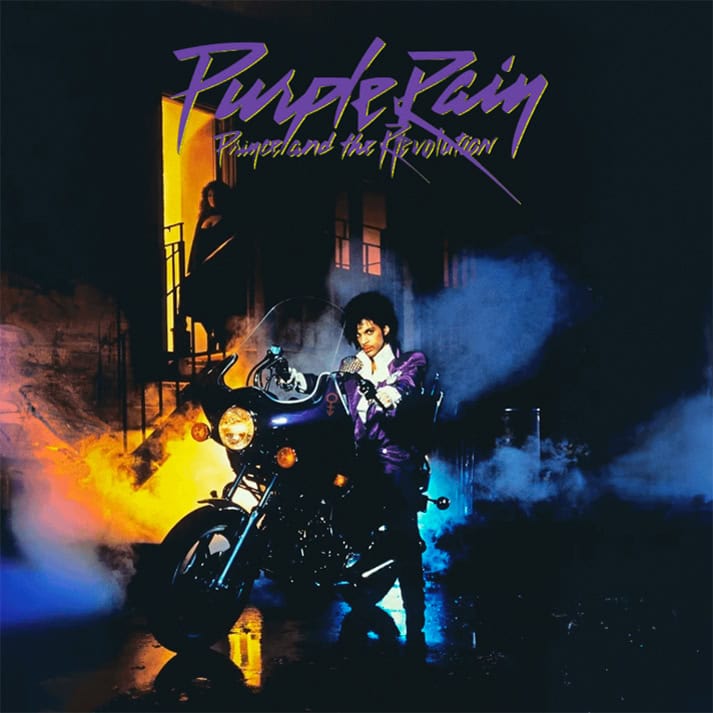
Prince’s 1984 album ‘Purple Rain’
I’m not going to overthink this (because I’m not a perfectionist), but purely off the top of my head, the most perfect fashion shows I’ve ever seen are: 1) Dior couture at the Palace of Versailles, AW07 (a Galliano fever dream of restrained excess); 2) Hussein Chalayan at London Fashion Week, AW00 (the coffee table dress!); 3) Louis Vuitton’s LV Express collection, Paris, AW12 (a Marc Jacobs classic, probably more perfect for its set and staging than its clothes, though the embellished jeans he showed still have a lot to answer for some 15 years later); 4) Miuccia Prada, SS00, Milan (a benchmark for how modern women dress); and 5) the Comme des Garçons show, Paris, where Rei played When I Need You by Leo Sayer, a song I thought I hated and that is indubitably cheesy, but it brought me to tears because the clothes were so soaringly, stupidly perfect.
I wasn’t going to cheat by Googling, but I couldn’t remember the season of this Comme show so I searched ‘Comme des Garçons Leo Sayer’, which yielded nothing, and so I asked every writer’s nemesis, ChatGPT. If anyone thinks they’re a perfectionist, it’s ChatGPT, that cocky hive mind which purports to sift through every fact on the internet. Well screw you, ChatGPT, because on the question of this particular query, you drew a blank too. You even went so far as to trawl the dinosaur that is archival print media (“magazines, fashion-critique essays, academic analyses”, as you described them) and yet you still failed to find a result.
With the sort of arrogance that only an AI language model could summon, you concluded that, “the lack of mention strongly argues against that song ever being used.” I’m not 100 per cent sure, but I’m 70 per cent sure that some 10 reader out there will recall the show. In the meantime, I find it both apposite and beautiful that that Comme des Garçons show can still somehow shimmy under the online radar, resisting AI’s greedy digital grasp.
These collections, by these designers, were so perfect that they are seared into the memory in the way that great art can lodge itself for a very long time. I wonder whether the designers will all die happy. Maybe perfectionists never do. And while I’ve made my peace with not being one – with never creating great art, a great feature, or even a particularly great sentence – I do ponder what lies directly below perfection. Is it, de facto, mediocrity? Surely there can’t only be two choices in life: the agony of perfectionism or the pointless, dreary fug of mediocrity?
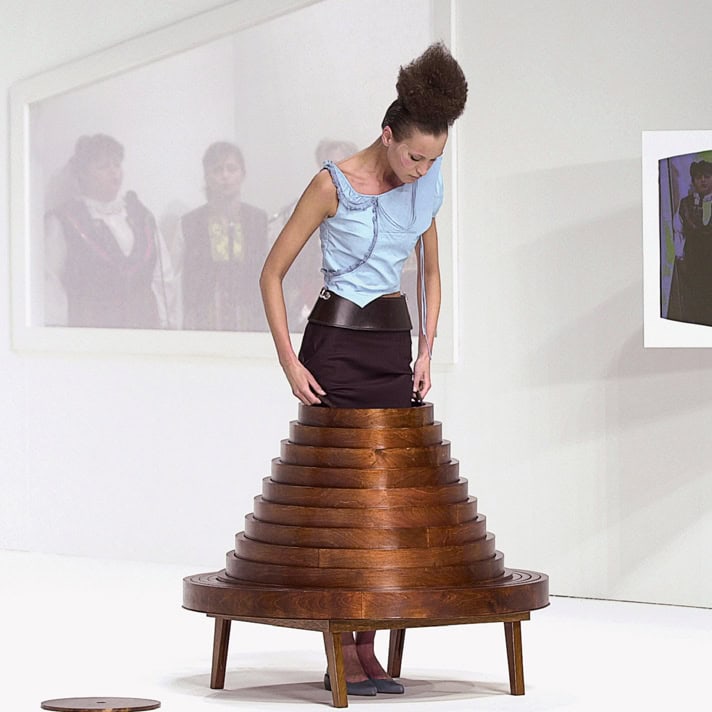
Hussein Chalayan’s wearable furniture (AW00)
It stands to reason that a large part of the universe’s creative output has always been mediocre, but these days, it’s hard not to be concerned that we’re drowning in meh. I blame social media. Before, people could go about their mediocre business and nobody noticed much. Now, mediocrity is continually documented, collated and served up by the algorithm, whether you asked for it or not. The basic, unrelenting need for fresh content usurps any concerns about quality control, leaving those unlucky enough to stumble upon it flailing in a stream of bad jokes by unfunny comedians, hot takes by cold intellects, horrendous OOTDs (outfits of the day), plates of food that look bogging, art your toddler could have drawn and music you wouldn’t play to your cat.
The human ability to present mediocre things as rare and precious objets/insights never ceases to surprise me. Did we always, as a species, have such a low bar? Or have standards slipped? The Temu-fication of creativity is a modern tragedy. Just as worryingly, the one arena where standards haven’t slipped – beauty – is now governed by such ridiculously unachievable levels of perfectionism that it’s a wonder every woman with a smartphone hasn’t gone mad.
Or maybe they have. I consider myself to be relatively sane, but I’m finding it harder than ever to judge whether I look good for my age, or instead, like a shrivelled crone. “God hath given you one face, and you make yourself another,” said Hamlet to Ophelia. Well, if only Shakespeare had lived long enough to witness Kris Jenner. As facelifts, lip flips, blepharoplasties, jaw reductions, fat grafts and cheekbone shaving become more widespread, or at least seem to be thanks to the drumbeat of social media, it’s getting more challenging to keep a healthy perspective.
Unless you are young and naturally beautiful, whatever that means, it’s hard not to look in the mirror and conclude that you have a very mediocre face. Yet while mediocrity runs rife and unfettered in almost every other aspect of life, suddenly, having a mediocre face just won’t do. Not in a world that sets such great store by beauty; when influencers are flogging face masks to three-year-olds; when girls grow up learning that how they look is so much more valuable, as a commodity, than who they are.
Perfectionism is a worthy, lofty goal in every other way than when it comes to our looks. Self-improvement is a healthy pursuit to some extent, but like everything, it’s a matter of degree. We shouldn’t obsess over our faces and bodies, wishing them better, paying to make them so, feeling wretched when they fail to capitulate. We all turn to dust in the end. We can try to look immortal, but we never will be. Maybe that’s the best argument of all for pursuing whatever form of art we choose to: that even if it’s mediocre, it will still outlive us. Nobody is perfect. Everything in nature is flawed. That’s what makes us beautiful.
Collage by Daren Ellis. Taken from 10 Magazine Issue 76 – CREATIVITY, CHANGE, FREEDOM – out NOW. Order your copy here.