June 3, 2026 |
There’s no shortage of creative talent spilling out of fashion studios around the world. Most of it comes from a handful of fashion schools whose professors and practitioners are responsible for hand-picking and nurturing the graduates who will help to shape an industry equipped for an increasingly uncertain future. It’s challenging. The professors we talked to for this feature – from Antwerp to Johannesburg – share similar concerns, such as fashion degrees not being sufficiently funded or taken seriously, despite the industry’s importance both culturally and economically. They worry about students losing the ability to touch, in a literal sense, having information overload and not having spaces to express their creativity after they graduate. And there is also the issue of finance.
A master’s in London costs between £30-40,000 per year once you factor in the fees, living costs and materials. That’s why the Royal College of Art introduced a one-year master’s course in 2023. Some academic institutions in Europe are more accessible. The University of Vienna, the Royal Academy of Fine Arts Antwerp and the Berlin University of Applied Sciences, aka HTW (Hochschule für Technik und Wirtschaft), are all free or you’ll pay minimal fees to attend, with extraordinary educators and practitioners at the helm. Imagine! At HTW, you could be taught by Professor Hussein Chalayan. At the University of Vienna, Prof Craig Green will be guiding you through your fashion design tutorials.
“My area of specialty is innovation, sustainability and cultural identity,” says Chalayan, who has been at HTW Berlin since 2019 teaching across its BA and MA courses. “Right now, there are great state universities in Europe,” he says. “Lots of students who don’t have money deserve a place but can’t afford to study. The best art, music and fashion never came from money.” In London, the course leader for MA Fashion at Central Saint Martins, Fabio Piras, says: “The struggle is part of artistic practice.” But he questions why the industry isn’t more supportive of the education of the talent it ultimately benefits from. CSM’s MA course currently has just five scholarships, down from 12 pre-Covid.
As an academic myself, responsible for the BA Fashion Communication Journalism pathway at Central Saint Martins, I can vouch for the fact that working in creative education is an education in itself. Despite the 16 years that Liliana Sanguino, of the Parsons School of Design, has spent at the forefront of fashion education, she is still learning. As a Colombian who has built a career in London and now New York, and who collaborates with Indigenous trans communities in Colombia, she says she needs “a definition of fashion that is wide enough to hold all these worlds. I encourage students to do the same: to question, to expand and to define fashion through their own perspective, culture and lived experience. Without that, creative education risks producing designers who can replicate existing systems but not imagine new ones.” Here, Anke Schlöder, who’s an educator on fashion’s creative front line, has her say.
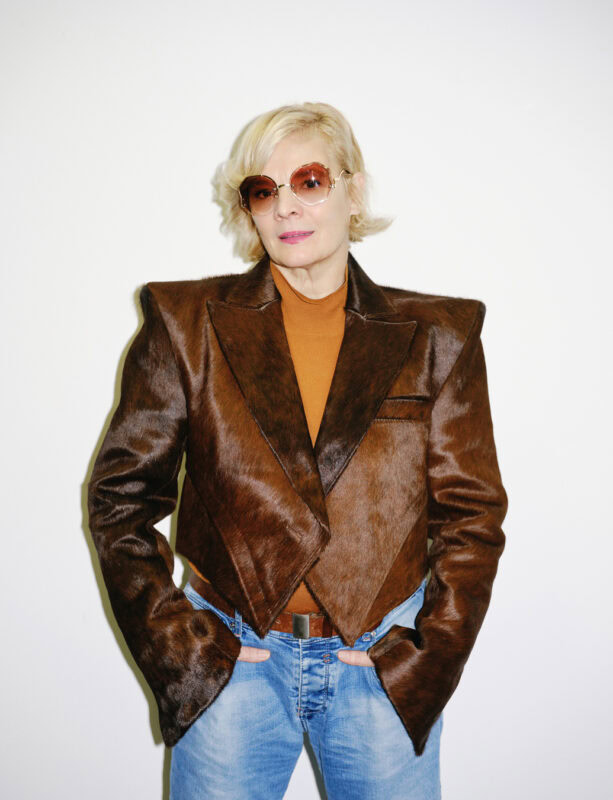
“The focus is on deeply exploring one’s own personality. The aim is to explore this with emotional depth and sincerity, and then translate it into creative work, which in turn are reflected in a unique collection” – Anke Schlöder
Anke Schlöder, professor at HTW Berlin’s fashion design department
Anke Schlöder founded her own label in Madrid in 1994, before presenting her collections at Madrid Fashion Week. In 2009, she was appointed at HTW, where she focuses on creative identity and has developed new fashion show formats including HTW’s Fashion Magazin, which presents the best final projects in an editorial under the artistic direction of photographer Joachim Baldauf. She is on the board of Platte.Berlin, which empowers the new generation of designers, and has collaborated with the new platform for emerging fashion talent Berlin Curated and the magazine XIER, which she publishes in collaboration with Baldauf.
What is the aim of your course?
To provide practical and comprehensive preparation for a wide range of careers in the global fashion industry. We teach creative, technical, theoretical and business management skills in order to develop innovative products and realise design visions. Our spacious studios, laboratories and workshops, which are the best equipped in Germany, provide the ideal foundation for this.
How many students on average are in a cohort?
We accept 40 students twice a year for the summer and winter semesters in the bachelor’s programme and 20 students once a year in the master’s.
While on the course, do your students develop an aesthetic, style or way of designing or thinking?
What I look for most is their willingness to take risks and try things out in all directions. In my creative identity course, the focus is on deeply exploring one’s own personality. The aim is to do this with emotional depth and sincerity, and then translate it into creative work, which in turn are reflected in a unique collection.
From your perspective, what are the key challenges facing creative education?
Berlin’s art and higher education institutions are suffering from massive budget cuts by the Senate, which threatens the quality. and range of fashion education. In general, the problem is that fashion is not considered a cultural asset in Germany. Although great importance is attached to well-made clothing and innovative materials, the creative, experimental part of fashion and its forms of expression are often not appreciated or recognised. As a result, money is mainly invested in areas where the focus is on technology and economics, and cuts are made first in the creative sectors. This makes creative work extremely difficult and with it, of course, creative education and innovative teaching concepts.
What are your hopes for your students as they graduate?
I would very much like my students to find their creative identity and signature style. Find their niche without having to compromise too much and remain authentic. Work in a solution-oriented and sustainable manner and offer quality. Gain as much experience as possible in companies – paid, of course – so that they can specialise later on, because the study time is too short to learn all the skills. I think the most important experiences are gained through learning by doing, and making mistakes is part of that. Not believing that they have already achieved everything just because Lady Gaga’s stylist borrows one of their outfits for a performance and that went viral on social media. That they do not lose their passion and dedication in a fashion industry that is currently undergoing extreme change.
Photography by Bastian Thiery and production by Sonya Mazuryk. Jacket by UNVAIN. Taken from 10 Magazine Issue 76 – CREATIVITY, CHANGE, FREEDOM – out NOW. Order your copy here.