May 6, 2026 |
Dorothy Parker’s favourite scent was tuberose. As her biographer noted, she was a “tense” and “wary” woman. I can’t see an obvious connection between Ms Parker and the perfume, unless it is the otherness of tuberose she liked. Or that it related to her time in Hollywood. The species is native to Mexico and has a heady and intoxicating perfume. It’s perhaps the most heady of all perfume notes. Even Wikipedia notes it is “overwhelming”. It is also a flower of California (as Mexico is not far from the Golden State) if you know the woozy Los Angeles of David Lynch, Raymond Chandler and Dorothy Parker.
The Frédéric Malle perfume Carnal Flower is my partner’s favourite so it lingers in our bedroom. Before I studied it, I knew it as dark, sparkling notes in the background of my life. I thought it was faintly goth – creepy flowers against the night. And every time I asked “What is that?” the answer was “Carnal Flower”.
The perfume was released in 2005 and is the work of Dominique Ropion, who also created Givenchy’s Ysatis and Malle’s Portrait of a Lady. Despite its name, Carnal Flower may not be all that ‘carnal’. The perfume has dry aspects and many chaste, green and starched notes. And while I love vast amounts of ‘powder’ in a perfume, Carnal Flower has the most delicate touch. Which is probably the modern taste.
The perfume is said to have been inspired by Candice Bergen in the 1971 film Carnal Knowledge. Bergen is also the aunt, by marriage, of Frédéric Malle, the founder of Editions de Parfums Frederic Malle. I watched the film. The first part is set in the 1940s among freshmen at Smith and Amherst colleges in Massachusetts. And it is ever so preppy. Jack Nicholson wears a duffle coat. Art Garfunkel, Nicholson and Bergen dance to Glenn Miller in woollen items and the sex is awkward. There is a lengthy scene where Garfunkel struggles to get his hand on Bergen’s breast. Any perfume inspired, even in part, by Bergen would play down excess.
In contrast, the vintage tuberose scent Fracas by Robert Piguet is a more physical perfume. I was studying Fracas in Selfridges when another customer reached for the sample bottle, removed the cap and vaulted backwards with a velocity more suited to the world of athletics than a department store. Yes, Fracas has a strong presence, but I would not run from its great cloud. Where Carnal Flower appears (to my understanding) to play down the drama of the tuberose, Fracas amplifies all floral notes. There is a vast amount of jasmine in it. Vast.
The original Fracas dates from 1948 and there is a pleasant nostalgia about it; a feeling for an imagined Paris. Carnal Flower is a modern perfume and it doesn’t riff on the same pictures. I love the faint trace of powder in it, but it’s faint. It is barely a memory. Malle listed or described the notes as “melon, tuberose, white musk and milky”. The perfume writer Victoria Belim-Frolova has an accurate and sensitive interpretation.
“Carnal Flower unfolds like a roll of raw silk, warm and smooth, with the coconut lending a milky sweetness to the sumptuous flowers.”
There is one more tuberose to consider. Marc-Antoine Barrois’s Aldebaran was one of the show- (and traffic-) stopping releases of 2025. It’s not as long-lasting (on my skin) as Carnal Flower but opens with a more dramatic hit of the exotic. I need to spend more time with this perfume but it is a little avant-garde – I think I detected a ‘meaty’ note, but I am not certain. It works in the social media moment where a perfume should hit hard, hit fast and get out.
Carnal Flower is a long-lasting perfume. You will enjoy it if you like to study a perfume and enjoy the traces of tuberose in its long, nuanced fade. Perhaps its great play is to hold a wild flower in such an intricate setting. A demon wrapped in wisps. I would have ended on that thought but Ropion agreed to answer a few of my questions. To recap, he created Ysatis when he was 27 and has co-composed many great and successful perfumes including Flowerbomb, Alien, Pure Poison, Amarige. The list is long. His words are a poetic introduction to the creative energy of perfume.
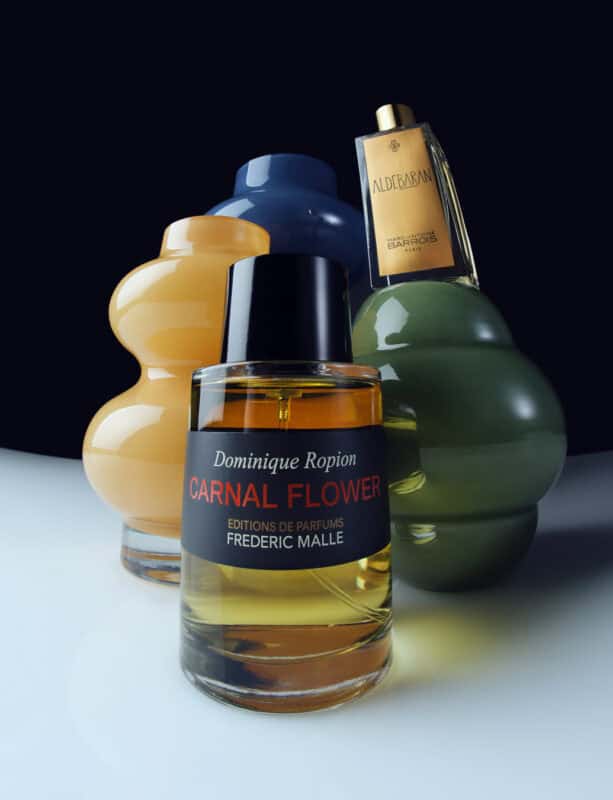
from top: Aldebaran by Marc-Antoine Barrois, Carnal Flower by Frederic Malle from Selfridges
Is there a great difference between tuberose and Carnal Flower?
The tuberose is a fascinating flower, opulent, white and complex. Its natural scent is a balance of green freshness and creamy, almost lactonic softness, with a subtle animalic undertone. When I created Carnal Flower, I didn’t aim for a literal copy of the flower. I wanted to renew the genre, to illustrate and even détourne [divert] its character. The perfume is not figurative; it’s an interpretation. We amplified its solar aspect and surrounded it with other accords to make it feel contemporary, rather than a strict reproduction of nature. So yes, there is a difference: Carnal Flower is a vision of tuberose, not its mirror image.
What are the distinctive accords in Carnal Flower?
The heart of the perfume is, of course, tuberose, but treated in a way that feels airy and luminous rather than heavy. Around it, I built a green, almost mentholated freshness to contrast with its creamy sensuality and added touches that evoke sunlight. The originality lies in this tension: it is a flower often considered decadent and nocturnal, reimagined as radiant and modern. It’s not a soliflore [single flower]; it’s a composition that plays with contrasts, freshness and voluptuousness, innocence and carnality.
Were there any difficulties in creating this perfume? Were there any problems that were interesting to solve?
The main challenge was balance. Tuberose is a powerful, almost tyrannical note, it can dominate everything. We wanted to avoid the cliché of an overly heavy, heady tuberose while preserving its identity. That meant many trials, adjusting proportions by infinitesimal amounts, until the formula ‘walked the tightrope’, as I like to say. It was a technical and aesthetic exercise: amplifying certain facets, softening others and ensuring the perfume felt like a living, breathing creation rather than a caricature.
Frédéric Malle says the perfume uses “tuberose absolute in a very high concentration”. Can you tell us anything about how you chose the source/supplier that you use?
We worked with an exceptional tuberose absolute from LMR [Laboratoire Monique Rémy], now part of IFF [International Flavors & Fragrances]. This house is renowned for its expertise in natural raw materials and sustainable sourcing. The absolute we used was further refined through molecular distillation to enhance its purity and olfactory qualities. This process allows us to highlight the most beautiful facets of the flower while ensuring consistency and compliance with international standards.
Is there anything you would like to add about any of the other ingredients?
Anything perhaps that someone buying the perfume might like to know? I would mention the green notes that give Carnal Flower its freshness; they’re essential to its architecture. They create space around the tuberose, like light filtering through foliage. And then there are the almost milky undertones that whisper of skin and intimacy. These details matter because they make the perfume more than a floral statement – they make it a story. When you wear Carnal Flower, you’re not just wearing tuberose, you’re wearing an interpretation of desire, light and nature.
Notes:
You Might as Well Live: The Life and Times of Dorothy Parker (1970) by John C. Keats
Carnal Knowledge (1971), directed by Mike Nichols, starring Jack Nicholson, Ann-Margret, Candice Bergen and Art Garfunkel
Taken from 10 Magazine Issue 76 – CREATIVITY, CHANGE, FREEDOM – out NOW. Order your copy here.
TUBEROSE
Photographer RIKKI WARD
Text TONY MARCUS
Fashion Assistant GEORGIA EDWARDS
Production ZAC APOSTOLOU