August 30, 2026 |
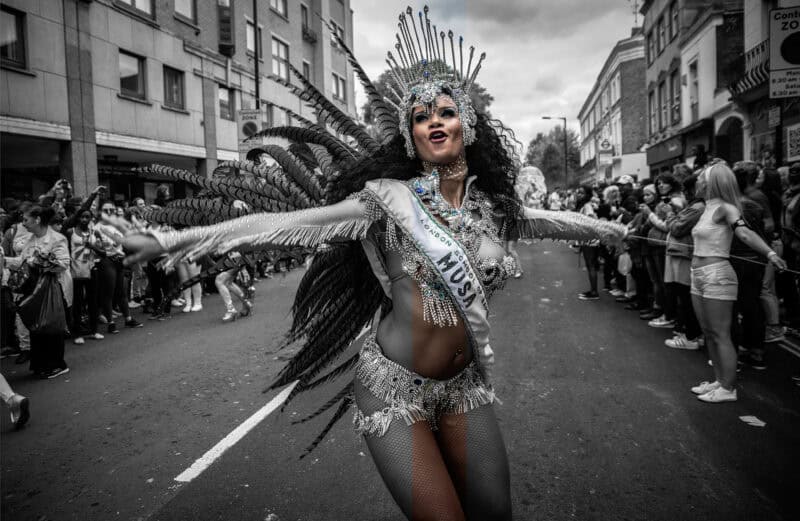
Samba queens shimmy alongside towering sound systems, their feathered costumes swishing through the streets as the sounds of reggae, jungle and garage pulse through the crowds. The air is thick with the irresistible aroma of jerk chicken and the dancers are fuelled by rum and coke. It is a vibrant tableau that has become synonymous with Notting Hill Carnival.
Held annually over the August bank holiday, the street festival celebrates the culture and heritage of the Afro-Caribbean diaspora, drawing in huge crowds each year to come together, dance, eat and champion community.
However, while today it presents a gleaming scene of technicolour ensembles and beaming smiles, the spirit of the protest that started it all still beats beneath the drums. In the summer of 1958, Notting Hill became the scene of a wave of brutal racial violence. Racist mobs armed with knives targeted Black residents, attacking their homes and businesses across the west London neighbourhood.
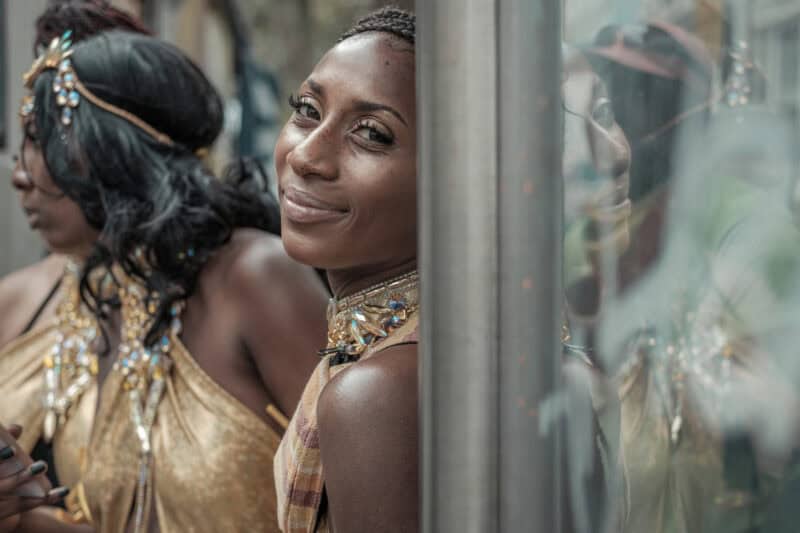
Photography by Wayne Crichlow
Against this backdrop, Trinidadian-born journalist and activist Claudia Jones sought to create a space for solidarity. The following year, she organised a Caribbean carnival at St Pancras Town Hall, laying the foundations for what would eventually become one of Britain’s most celebrated street festivals. Its inception arrived in 1966.
This year marks the 60th anniversary of Notting Hill Carnival. To commemorate the milestone, photographers Wayne Campbell and Wayne Crichlow have released Carnival of Resistance, a new photobook tracing the event’s rich history through a collection of images captured over the past 15 years.
Both photographers have attended the carnival since their youth, bringing a deeply personal connection to their documentations. The book blends together two distinct photographic perspectives. Campbell’s striking black-and-white images, punctuated by carefully isolated flashes of colour, sit alongside Crichlow’s raw and unfiltered street photography, capturing the humanity of the carnival as it unfolds.
We caught up with the pair to discuss their new book, the enduring legacy of Notting Hill Carnival and what the celebration means to them today.
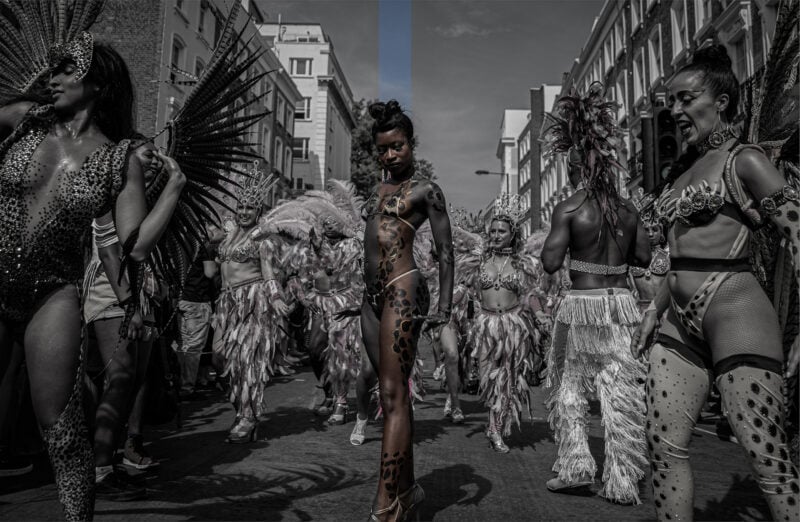
Photography by Wayne Campbell
1. What inspired the book?
Wayne Crichlow: Carnival of Resistance really grew out of years of photographing Notting Hill Carnival and realising that I was building something much bigger than a collection of individual photographs. I kept returning because there were always new stories revealing themselves – in the people, the music, the costumes, the sound systems, but also in the smaller moments happening around all of that. Over time I became increasingly conscious that beneath the celebration was another story – one of resistance, migration, community and the determination of Caribbean people to claim space and express themselves. Carnival of Resistance became a way of bringing those layers together. The joy and spectacle are there, of course, but so too are the people, history and cultural significance that can sometimes be overlooked.
Wayne Campbell: For years, I have been capturing images at the Notting Hill Carnival. It is an event I have always loved, both as a spectator and as an entertainer working in front of and behind the camera. After producing my third photography book, creating this collection felt like a natural and necessary next step. I realised I was sitting on a vast, unique archive of images collected over decades, and combined with my professional experience as a book publisher, I knew I had the tools and the duty to bring Carnival of Resistance to life.
2. What’s your earliest memory of Notting Hill Carnival?
Crichlow: My relationship with Carnival goes back long before I started photographing it. One of my strongest early memories is actually being on stage there in 1992 as part of Closer Than Close, the group I was in at the time. We performed on the Kiss FM stage at Horniman’s Pleasance. Music was my creative language then. In some ways I’ve simply changed instruments. Music was once how I told stories; today it’s predominantly through photography.
Campbell: My earliest memory takes me straight back to standing under the Westway flyover, completely immersed in the heavy bass of the Mastermind Roadshow and Rapattack sound systems. I remember thousands of people jumping up in unison as Public Enemy’s hip-hop anthem Rebel Without a Pause echoed through the concrete. The sheer, collective energy of that crowd in that specific moment is something I will never forget.
3. What does Notting Hill Carnival mean to you?
Crichlow: Carnival is joy, resistance, memory and freedom occupying the same space. As someone born and raised in East London to Caribbean parents, I see it as part of a much bigger British story. It represents what the Windrush generation and those who followed them brought to this country – music, creativity, style and culture – but you cannot separate that from the struggles they faced.
Something I’ve come to understand through documenting Carnival is that Carnival isn’t just two days in August. What the public sees over that weekend is the culmination of an entire year of dedication, creativity and work. I photograph the sound systems being constructed in the streets, piece by piece, before those huge stacks of speakers eventually come alive. I’ve documented the stage at Horniman’s being built in preparation for Panorama on Saturday. I’m there as food is being prepared and as shops and premises are boarded up in anticipation of the enormous crowds that are about to arrive. These moments fascinate me because you’re witnessing the work behind the spectacle: concentration, repetition, exhaustion, anticipation and community. All the things that have to happen before most people would even say Carnival has begun.
When I think about Notting Hill Carnival, I don’t just think about a parade or a weekend. I think about a living culture that people work all year to create, preserve and pass on – and my role is to make sure those stories, including the ones people don’t normally see, are recorded.
Campbell: To me, Notting Hill Carnival represents resistance and heritage. It is a living monument to survival, cultural pride, and community triumph. While younger generations might view it primarily as a massive street party, for those who understand its roots, it is a profound celebration of identity and defiance.
4. Do you have a favourite photograph of the event you have taken over the years?
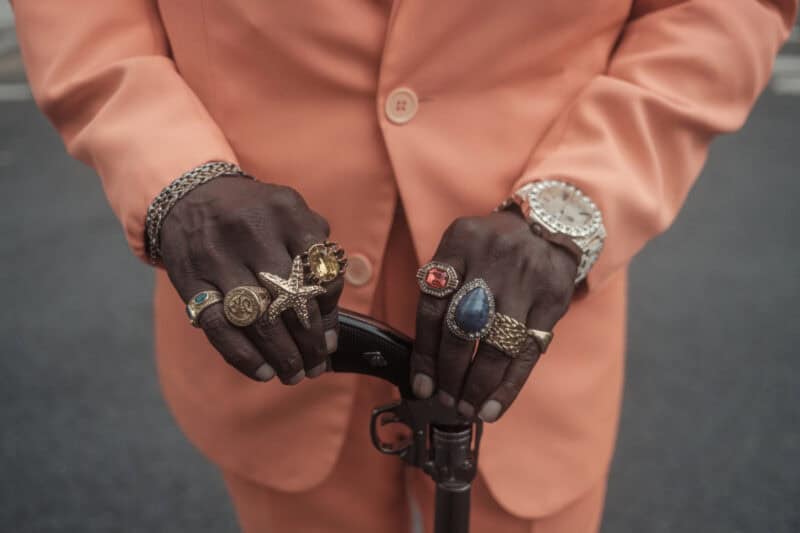
Crichlow: Jama is one I continually return to. It’s a close-up image of his hands holding a walking cane, with a gun forming the handle. You don’t see his face, yet the image still says so much about character, attitude and presence. There are tones of defiance in it. The gun-shaped handle immediately changes the reading of what might otherwise be an ordinary detail, and for me it carries some of that broader spirit of Carnival – resilience, resistance and a refusal to be invisible.
Reflections is another favourite, but for very different reasons. That’s what I love about photographing Carnival. The images that stay with me aren’t always the loudest or most spectacular. Sometimes it’s a gesture, an object, a detail or a fleeting moment that contains a much bigger story.
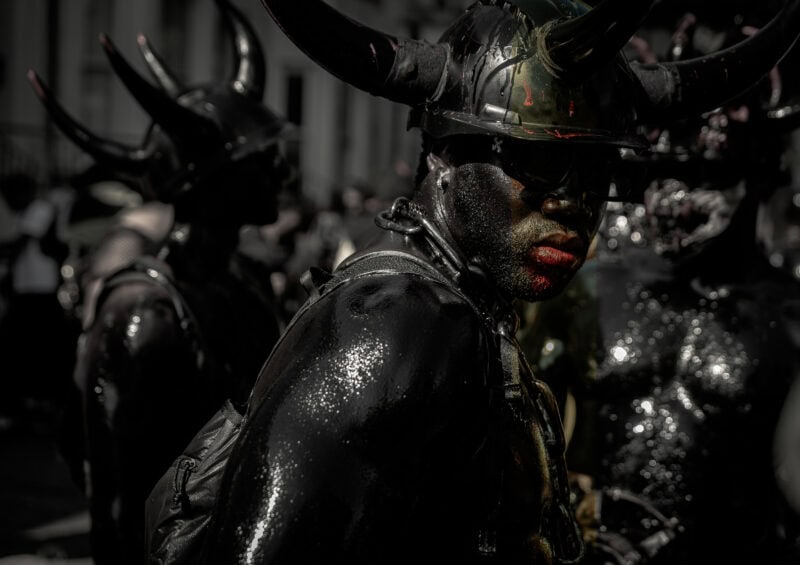
Campbell: Yes, there are two specific images that perfectly encapsulate my entire Carnival experience. The first is titled Poise, which captures a woman standing with her hands at her sides in full, breathtaking Mas costume. The second is called Jab Jab, featuring a man covered in oil and wearing a horned helmet. The sun is in his face and all I see a profound, striking sense of strength. I also see history, and raw human dignity in both of those images.
5. What is the message you wanted to share with the book?
Crichlow: One of the most important things for me is preservation. We are documenting a culture and the stories of a Caribbean community that has contributed enormously to modern Britain. Those stories need to be recorded, valued and passed on, particularly as the generations who established so much of this culture grow older.
Carnival should never be understood simply as a party. It grew out of resistance and communities that experienced racism, exclusion and hostility, yet created something extraordinary in the streets of London. Resistance doesn’t always have to look like confrontation. Sometimes resistance is dancing. Sometimes it’s music. Sometimes it’s simply occupying public space and saying: we are here, our stories matter and our culture matters.
But there’s another message I’d like people to take away from the book: tell your own stories. Use a camera, use your phone, use whatever you have. Photograph your family, your community, your traditions and the ordinary moments around you. The things that might seem everyday to us now can become incredibly important records of who we were.
Campbell: I want people to understand that there is so much more to the Notting Hill Carnival than just rum and wine. It is Europe’s largest street festival, and it was born directly out of political and cultural resistance. This celebration speaks volumes about the resilient generation that fought to make it happen, and the incredible cultural legacy they have left behind some 60 years later.
6. What are your thoughts on the scrutiny that Notting Hill Carnival receives each year? What impact do you hope to have on this with your book?
Crichlow: Every year there is a familiar conversation around crime, policing and whether Carnival should continue in its present form, and that can very quickly overshadow everything else that happens there. That doesn’t mean problems shouldn’t be discussed honestly. Any gathering of that scale presents challenges. But those conversations need context and proportion.
Part of what photography can do is provide another perspective. Look beyond the headlines and you see families, elders and children. You see musicians and sound-system culture. You see extraordinary craftsmanship. You see generations sharing traditions, friendships, creativity and an enormous sense of community. Our book can’t tell the entire story of Carnival, nor should it try to. But it can challenge the idea that Carnival can be reduced to the negative headlines that appear each year.
Campbell: From a purely commercial perspective, the Notting Hill Carnival is incredibly successful – it generates massive amounts of revenue for the local authority and the city. However, there is a frustrating, gaping financial disparity. The Mas bands, sound systems and performers who pour their hearts, souls, and hard work into the event see very little of that wealth. The money collected from vendors and major traders somehow fails to make its way into the pockets of the actual creators who generate the culture.
I hope it forces people to look past the superficial stereotypes of a wild street party. When readers open this book and engage with these powerful images, I want them to look deeper. I want them to realise that this Carnival has a revolutionary history – one that is built on something far more substantial than just jerk chicken and rum punch.
7. What’s your favourite thing about documenting the festivities?
Crichlow: The unpredictability. I don’t go into Carnival with a checklist of photographs I need to make. I put myself into the environment, walk, observe and respond to what happens around me. You can turn a corner and suddenly find an extraordinary scene – someone dancing, a child watching a masquerader, an interaction between strangers, or a quiet moment happening while thousands of people move around them. Those moments can’t really be planned.
Campbell: Without a doubt, it’s the people. I love capturing the overwhelming sense of community, unshakeable pride, and collective hope that fills the streets. Documenting this event means documenting living history, and I feel incredibly privileged to preserve these fleeting moments for the future.
Photography by Wayne Campbell and Wayne Crichlow.