November 4, 2026 |
Olivier Saillard wonders about the term ‘DNA’ with regard to fashion. “DNA reminds me of criminology,” says the fashion historian and curator, who then laughs in his good-natured way. “Heritage is prettier, and so is finding the spirit of a house.” To his mind, the interest in it came in the 1990s with the idea of artistic directors and the image curation of fashion houses. “Heritage gives weight,” says Saillard. Although Yves Saint Laurent was the first living couturier to decide to archive his work – “It was really Pierre Bergé [who did it],” notes Saillard of the YSL co-founder – Karl Lagerfeld acted as “a great professor”during his Chanel years of 1983 to 2019. “He taught others how should it be done.”
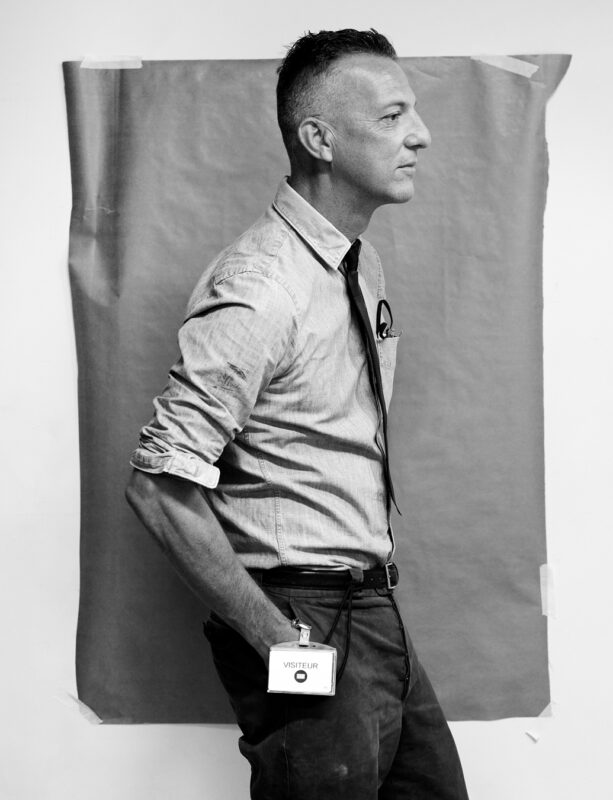
Olivier Saillard
The late German designer knew Gabrielle Chanel’s work inside out and behaved like a translator. “Let’s not forget: great authors need great translators to rewrite their words,” Saillard continues. He is also insistent that “to break down the culture of a fashion house” it’s essential to know every element. “In that regard, Karl and Azzedine Alaïa weren’t dissimilar because both possessed huge knowledge,” he says.
The same could be said for Saillard. When asked to name his five favourite fashion moments, he reels off Madame Grès’s Matisse-type cut-out gown; Alaïa’s chiffon dress using a 1930s technique; Jean Paul Gaultier’s Toulouse-Lautrec AW91 collection; Yohji Yamamoto’s all-white wedding collection; and an LBD by Cristóbal Balenciaga, who “was such a master”. Saillardis standing at the Foundation Azzedine Alaïa, where he’s been the director since 2017, accompanying an acquaintance around his Azzedine Alaïa and Christian Dior, Two Masters of Haute Couture exhibition. It opened more than five months ago but Saillard hasn’t lost his fervour. Dressed in his uniform of denim shirt, ink-blue chinos and J.M. Weston fireman-type boots, he talks softly, weaving his particular spell around each design and sharing the technique and aspects of Monsieur Dior’s influence on Alaïa. His joy is contagious because he both engages and listens. Small wonder that his performance partner-in-crime Tilda Swinton refers to his “astute sense of moment, of precision and… unquenchable vava voom”. And small wonder that Carla Sozzani, the president of Foundation Azzedine Alaïa, invited Saillard to join her.
“You’re the best in the field and Azzedine deserves the best,” she told him in November 2017. Few would disagree. Still, it was a challenge. After seven years of running the Palais Galliera, Saillard had just become J.M. Weston’s artistic director and the foundation was opening its first show in March 2018. “We had to rush, but I knew Olivier was up to it,” recalls Sozzani. “There’s his devotion to Azzedine not just as a couturier but also as a collector.” To Saillard’s surprise and delight, he discovered that Alaïa had collected 20,000 looks by his fellow designers, starting in 1968. “What’s most touching about Azzedine is the patrimoine [heritage] that he created,” he says. “He was this Tunisian couturier, coming from a modest background, who was buying 900 Madame Grèsdresses, 250 Paul Poiret outfits…Imagine what his collection brings to France and the fashion world? No other fashion designer from the 20th or 21st century collected like Azzedine.”
And no one else quite compares to Olivier Saillard. Since he turned the Musée de la Mode in Marseilles on its head in1995, he has remained one of the fashion world’s innovators. He’s a raconteur whose story telling ways pushed away the cobwebs and charged up institutions like the Palais Galliera as well as curating revolutionary exhibitions like Madame Grèsat the Musée Bourdelle (2011), the Alaïa retrospective Couture, Sculpture at the Villa Borghesein Rome and Jeanne Lanvin at the Galliera (both 2015), and the recent Christian Dior double act at both the Foundation Azzedine Alaïa and La Galerie Dior. The latter has welcomed more than 200,000 visitors since December 2025. Saillard’s authenticity and passionate expertise guided us, allowing two exhibitions that demonstrate the complicity between Dior and Alaïa, two geniuses of couture,” says Dior’s communications director Olivier Bialobos. There are also Saillard’s live performances, which began in 2012, which weave clothes of historic interest together with live narrative. They have starred the likes of actors Tilda Swinton and Charlotte Rampling, and fashion muses like Christine Bergström. “I recount a moment within the history of fashion and give it another form,”he says. A case in point is Repertoire no 1: Yves Saint Laurent 1971, The Scandal Collection, which he performed with Paloma Picasso this March. She had initially inspired the late Saint Laurent and shown at Saillard’s Living Museum of Fashion performances at Foundation Cartier. “With these shows, he’s invented a form of his own,” says Picasso. “They put fashion into movement, not making it staid.
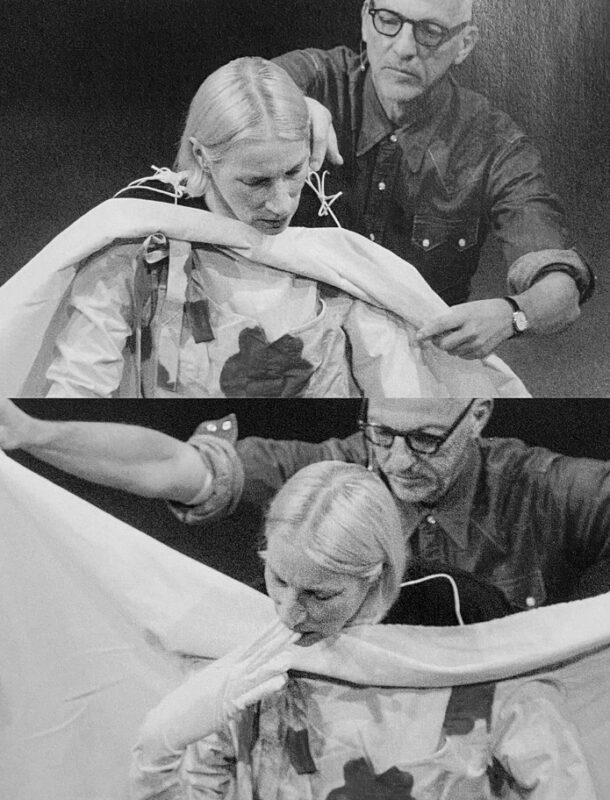
Kristina de Coninck in ‘Le Musée Vivant de la Mode’, a live performance created by Saillard in March 2026
It was after watching Saillard’s performance about his mother, Moda Povera V: Les Vêtements de Renée, at the Grand Palais last year that the newly opened Foundation Cartier offered him carte blanche for 12 days. Saillard often refers to Renée Saillard as his muse. “Throughout my childhood, my mother was very encouraging and had that ‘go for it’ attitude,” he says. A feisty redhead who brought up six children, she suddenly began her career as a taxi driver at the age of 50 and was adamant that “culture mattered more than money”.
“She had that philosophy, ‘You make money, you lose money, and it’s not that life-threatening’, but culture was everything.” The family lived simply in Pontarlier, a town near the Swiss border that was nicknamed ‘little Siberia’ due to its cold climate. “My ears would freeze,” he says. Saillardand his school friends used to gather at the large local library. “There wasn’t the internet, and the bibliothèque municipale had a terrific ambience,” he says. “I still dream of climbing up the stairs and recalling that particular smell of books, covered in transparent plastic.”Saillard caught attention by becoming a fully fledged punk rocker. It was during this period that he corresponded with the couturier Christian Lacroix, who remembers his “very black sketches that had a hint of Mugler and Gaultier. Olivier was only 17 but I remember being struck by his courage, tenacity and daring to go against the grain.”
We have moved upstairs to Saillard’s office, where framed black-and-white photos of the Alaïa years – think Naomi Campbell and clients like Tina Turner – contrast with the Dickensian atmosphere. Every single surface is covered with items like rectangular administrative boxes, loose press clippings, stacked catalogues from recent exhibitions and records of ground breaking performance art pieces like Embodying Pasolini. (2021, with Tilda Swinton). “If I have a shortcoming, it’s saying yes to everything,” says Saillard. Curiously, there isn’t a computer in sight. Instead, he relies on his black leather Smythson notebook. “It’s my hard disc,” he declares, opening it up and patting the signature blue pages, which are meticulously filled with his spiky black handwriting. “Because I have lots of different projects, I create a daily to-do-list,” he says.
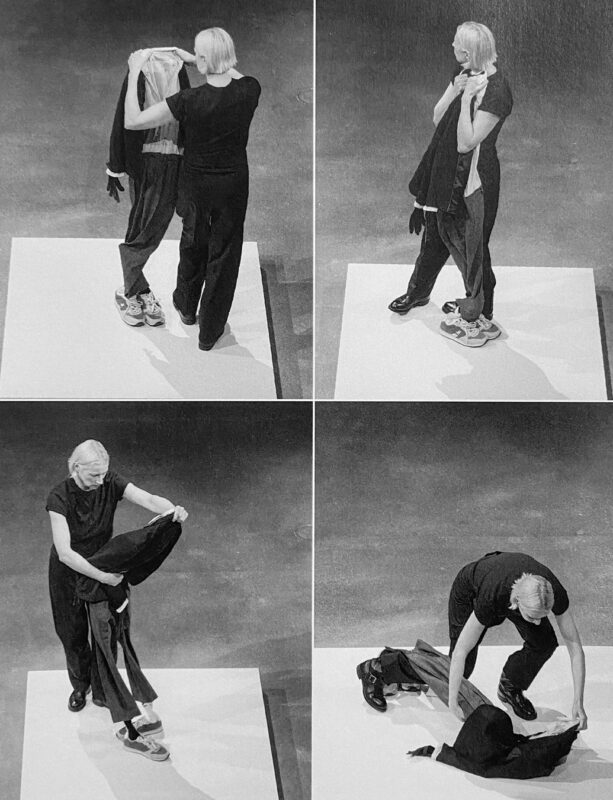
Kristina de Coninck in ‘Le Musée Vivant de la Mode’, a live performance created by Saillard in March 2026
Stuck on the wall opposite is Saillard’s pièce de resistance: the white cardboard model with plans of his recent Dior exhibitions at La Galerie Dior and Foundation Azzedine Alaïa. Peering closer, it’s evident that all the teeny dresses are actual cut-outs, exquisitely rendered by Saillard. “Yes, I’m a monsieur who has fun with dolls,” he can’t resist teasing. “Actually, the decoupage process is both enjoyable and practical because I can place everything and then play around. Saillard is the antithesis of the fashion curator who organises everything digitally and then leaves the mounting of the show to others. “I find that completely bizarre,” he confesses. “Part of the pleasure is mixing it all together, seeing what dress suits another and making changes.”
Nor does Saillard understand curators who decide on a show by looking at photos. “I go and see the clothes, pull them out and place them on the mannequin,” he says. Finding one, followed by another, tends to create a snowball effect. “Then I bring all the clothes together and see if the party works,” he says with confidence. “The danger of some fashion curators is talking with their minds before talking with the clothes. The clothes always speak for themselves.”
Thinking back over his exhibitions, Madame Grès, La Couture à L’Oeuvre (2011) at the Musée Bourdelle remains Saillard’s best memory. “There was an intimacy, a poetry and a dialogue between the place and her extraordinary body of work,” he says. Wildly successful, it was one of those presentations that Parisians saw three or four times. “What was great about Madame Grès is I didn’t have a sponsor breathing down my neck,” he says.“But it was also my least expensive project, coming in at €90,000 [£78,000].” In Saillard’s opinion, Madame Grès was a professional game-changer. “The luxury brands understood that you could achieve something simply and effectively,” he reasons.
If Saillard has one professional regret and personal sadness, it concerns the late couturier Claude Montana. “I was running the Palais Galliera and we simply didn’t have the money to buy [model] Danielle Luquet de Saint Germain’s considerable Montana collection,” he says. “It’s a huge loss for the fashion world that there aren’t Montana archives – really, it’s an injustice – because his designs had a true force and his Lanvin couture collections [1990-92] exemplified a modernised discipline.
Saillard was also intrigued by Montana’s mauvais garçon, i.e. bad boy, reputation. “As a creator, Claude was Romanesque – drugged, sexual, as well as having that ring of death above his head,” he says. “He wasn’t unlike the fashion world’s Caravaggio.” Saillard then brightens up. “Perhaps I’ll do a performance about Montana even if there aren’t clothes,” he says. “Now that’s something to think about.”
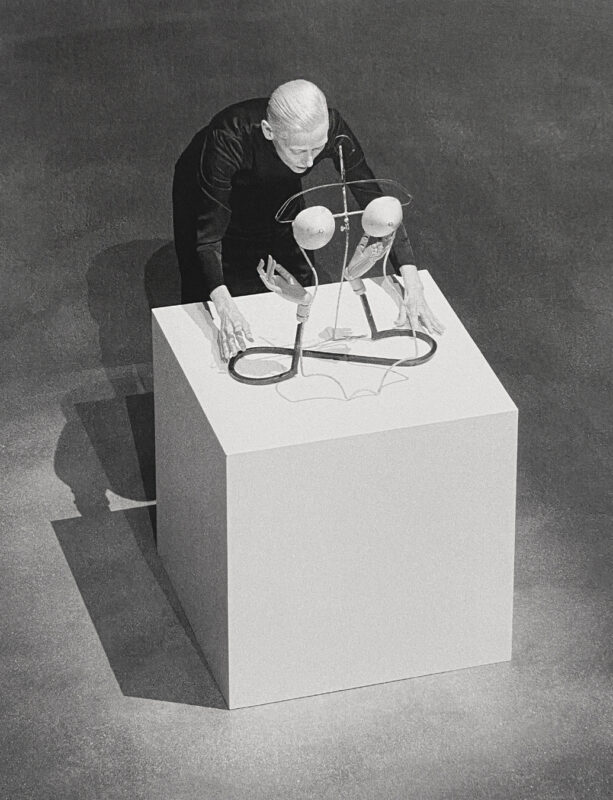
Tilda Swinton in ‘Mannequins du Silence’, March 2026
Photography by Gabriele Rosati. Taken from 10 Men Issue 64 – FUTURE, LEGACY, HERITAGE – out NOW. Order your copy here.