April 27, 2026 |
Five years ago, Leonard Baby broke from obscurity into the New York art scene by posting his jewel-like paintings of charged moments, borrowed from vintage movies, on Instagram. Concealing his public identity, he cultivated an air of mystery as gallerists flocked to show his work and collectors scrambled to buy it.
Last year, however, he abandoned the subject matter that made him known, turning inward instead to render the painful realities of his hyper-religious, conservative upbringing and reflect on the persecution of femininity and queerness within those environments.
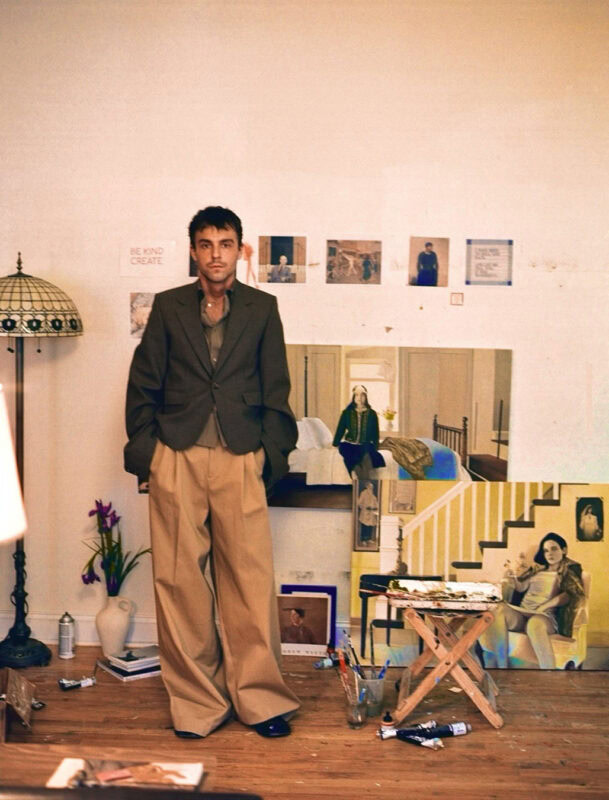
Leonard Baby in his studio; photography courtesy of Half Gallery and Leonard Baby
Video-calling with Leonard Baby across an eight-hour time difference – sunny in Los Angeles, where he’s travelled from New York for a wedding; raining in London (naturally) – I feel compelled to ask whether ‘Baby’ is actually his last name. He confirms it isn’t. When he was growing up, his uncle, a folk painter, insisted he use a pseudonym. “His name’s Scott Stanton, but he’s always gone by Panhandle Slim,” says Leonard. “I was against it, but impressionable. He sent me a list of maybe 20 names, and Leonard Baby was one. Over time, though, it’s become spiritual and meaningful.”
Indeed, I suggest that some of his works offer a childlike awe, an early fascination with the mysterious magic of adult objects in domestic environments: the elegant designs of labels in a bar cabinet; the ritual of laying place settings for a dinner party; glinting boxes of cosmetic products and shirts, ties, pearl necklaces and quilted handbags out of reach. “I’d say that my paintings come from a melodramatic, ‘baby’ perspective, like an adult person who can’t emotionally pull themselves together,” he muses.
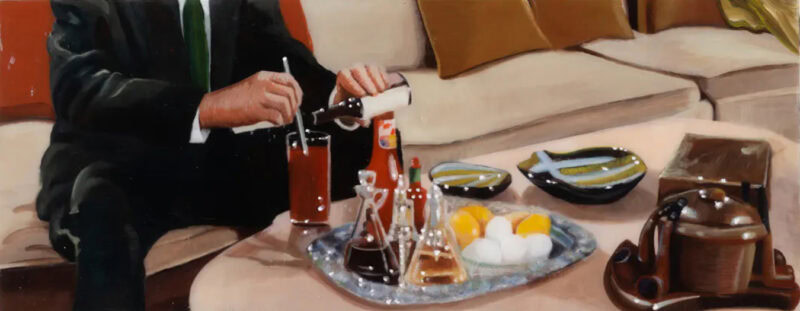
‘You’ll Come Around To It’, 2023
Leonard’s work focuses on a particular kind of familiar, nostalgic and dreamlike mid-century American aesthetic, one depicted in television shows like Mad Men or the chintzy-luxe home interior of Julianne Moore’s character, Charlotte, in Tom Ford’s A Single Man. In a similar vein, his paintings carry this underlying tension that beauty is close to darkness; they invite projection, prompting viewers to consider what narrative might be unfolding beyond the frame. “I want my work to have this Disney-like sheen over it, a weight and melancholy that, in the end, is just melodrama,” he says. “The melodrama of adult life mixed with the childhood perfection of Walt Disney: an eerie combination.”
I note that, as a queer person, it is interesting that he is drawn to these largely heteronormative scenes that are often aspirationally inaccessible to such minorities. “What’s playing out in these movies is often toxic male-female dynamics, but I’ve personally found that those tropes of masculinity and femininity oftentimes translate into same-sex relationships – toxic masculinity feels like such a reductive term, but it still very much exists in queer culture.”
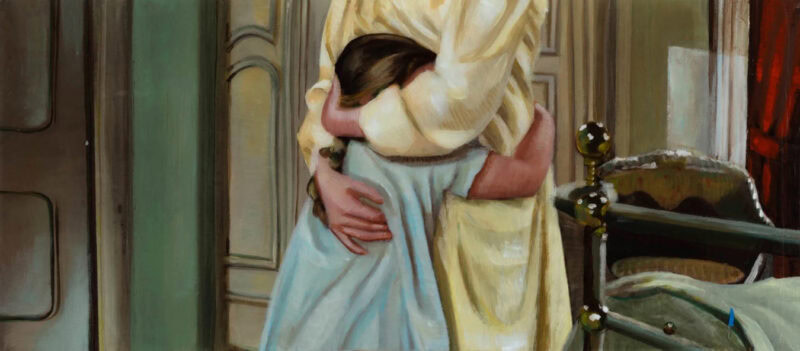
‘You’ll Be Taken Care Of’, 2023
“I find his ability to suggest entire stories within a single frame compelling… The way Leonard approaches Americana nostalgia is familiar territory for everyone, yet he somehow makes it feel entirely fresh,” says Danny Lamb, founder of the influential ADZ Gallery in Lisbon and the Painters Painting Paintings Instagram account and online gallery, which presented a show of Leonard’s work in 2023. “There’s an authenticity to his vision that avoids slipping into pastiche. His cinematic sensibility creates carefully composed moments that function almost like stills from a film you know well but are seeing again for the first time.”
When asked why visual culture so deeply informs his work, Leonard says, “I think it’s this queer notion that we see ourselves in polished stories – be it pop songs or niche cinema… It’s cathartic to have a physical manifestation of what you’re feeling inside.” Indeed, when he moved to New York, he worked at the renowned Metrograph cinema, which he says is “[one of the] best in the city, as they sink a lot of money into afternoon showings of 1930s black and white films where no one shows up”. I’m curious about what draws him to make a painting. “Seeing heartbreaking scenes play out on the screen. It’s like that exists in me so warmly, I have to make it official by putting it on a surface.”
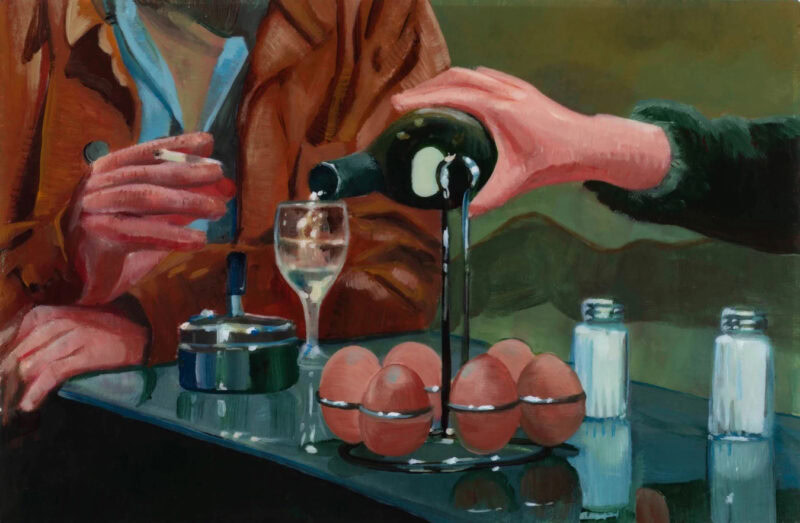
‘Borrowed Relief’, 2023
I ask if there are any styles or periods he returns to. “It’s usually mid-century, mostly European, but I also like American [films], like the Rock Hudson and Doris Day stuff; they’re really funny,” he says. “I’m drawn to European dark psychological stuff in a way that’s still funny, but not slapstick… to this depiction of painful feelings wrapped in, like, hokey lighting and bad costuming.”
And any particular directors? “The directors I like the most, I find the hardest to paint – I love Ingmar Bergman and Robert Bresson. Weirdly, I am mostly inspired by [Federico] Fellini or the more highbrow mid-century directors. I guess Jean-Luc Godard is a good middle ground because he is doing highbrow stuff in a more pop art-like, candy way. I always try to return to a Bresson-style composition but for some reason it’s difficult, so I end up painting something more like a Hitchcock, where it’s lower-hanging fruit.” Leonard has also previously cited Lars von Trier’s Melancholia and Disney’s The Princess Diaries as “consistent companions”, and painters ranging from modernist master Édouard Manet to contemporaries Anna Weyant and Kyle Dunn as important influences.
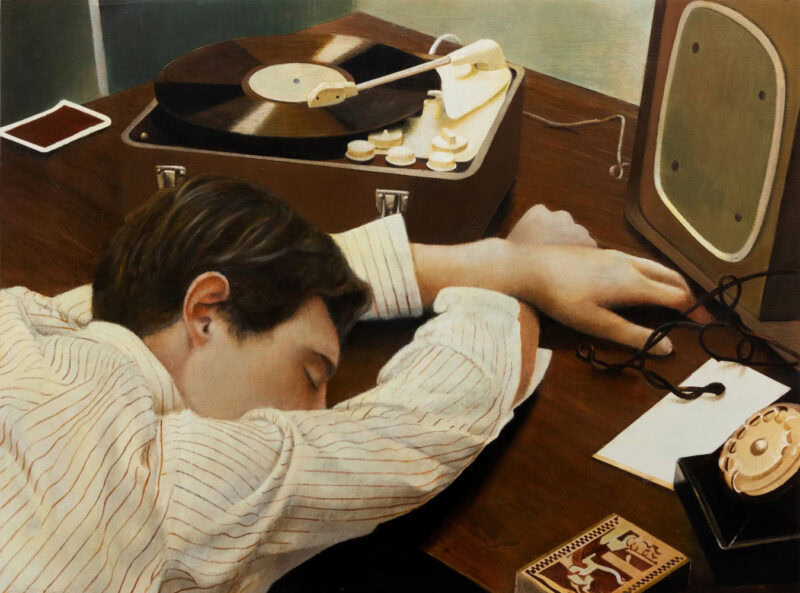
‘I Won’t Wait Up For You to Ask Me If Something’s Wrong’, 2025
Self-taught and with no formal art school background, Leonard began painting during the pandemic and has since shown in New York, Los Angeles and London, sustained by a growing art market increasingly fixated on young artists. Lamb adds: “We saw interest from both seasoned collectors and first-time buyers, which is relatively rare. We are always on the hunt for artists whose work can speak to multiple audiences without compromising its integrity, and Leonard fits that mould perfectly.”
For the first few years, he was intentionally invisible, yet Erin Goldberger, director of NYC’s Half Gallery, observes that the “autobiographical aspects of [his] work have been growing steadily”. This culminated in Half Gallery hosting The Babys, an exhibition in which Leonard, for the first time, reflected on his extreme Christian upbringing. Unusually, the accompanying text was a single line: “I grew up queer in an environment that told me that was gross. This body of work is about the angels that carried me through that time.”
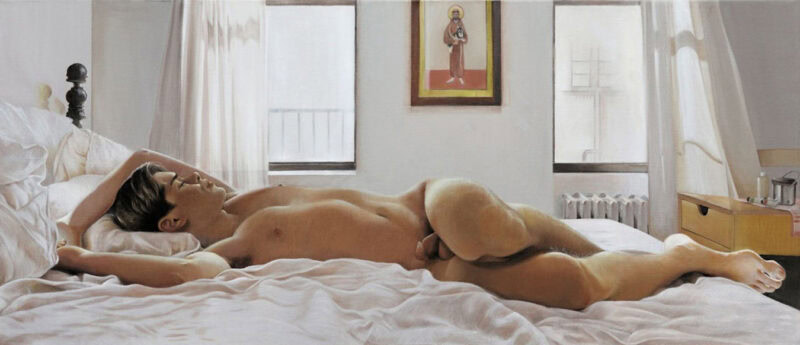
‘Girlfriend’, 2025
Leonard was raised attending a fundamentalist mega-church in Colorado Springs, where queerness was persecuted, isolated from other communities. He was explicitly taught being gay was a sin, discouraged from playing with “girls’ toys” and subjected to conversion therapy while at school. Although his parents separated when he was young, his father went on to become Director of Family Formations at the fundamentalist, homophobic organisation Focus on the Family. The Babys used traditional religious tropes like family portraiture to claim ownership of this period while ultimately paying homage to his sisters, who he describes as “angels” for their loving support, and who he depicted in Four Sisters. The exhibition did not shy away from trauma. In his first self-portrait Lucretia as a Boy, Baby posed topless and pierced himself with a knife, laying bare the reality of his suicidal thoughts during adolescence.
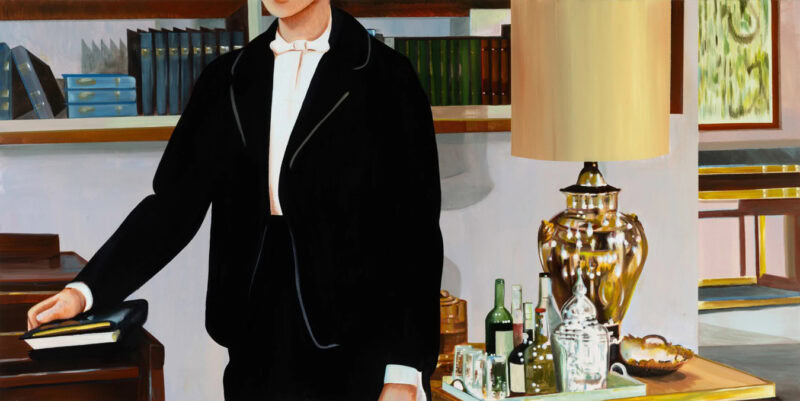
‘Leave the Light On For Me’, 2023
“We push people to deeply feel that there’s no other option and we shame them even after they’re gone,” Leonard remarked in an interview with Emma Cieslik for Whitehot Magazine about the exhibition. “It’s disgusting. Depression is a disease and, instead of figuring out a way to cure it, we live in a society run by men who do everything in their power to make that disease accelerate and grow.” Indeed, during a presidency where same-sex marriage is under attack from lawmakers, and where a policy blocked transgender and non-binary people from choosing passport sex markers that align with their gender identity, this is a subject of grave importance in an increasingly violent climate of queerphobia. The exhibition made a lot of noise and received major press coverage. I ask how he continues after exposing himself so profoundly. “I’m just pulling myself out of the vulnerability. I’m obsessed with my sisters and they’re the most important people to me. I knew I had to paint them. It was a progression: I was painting, and then that show was like my directorial debut. That was my film.”
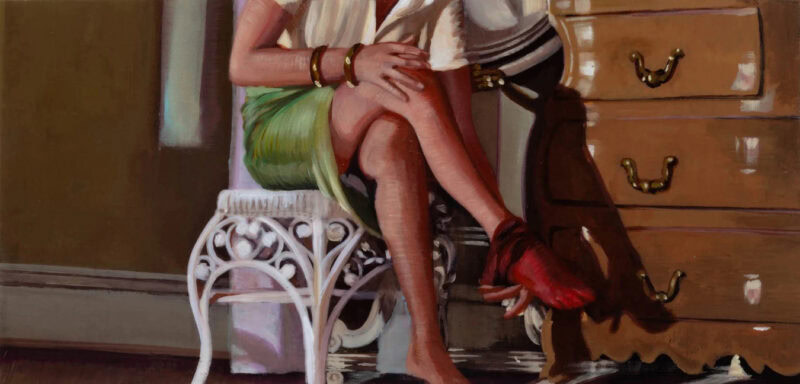
‘Tin Roof’, 2023
I ask if he would consider making a film of his own. “Yeah, definitely. I’m thinking about developing a performance in which I am almost like a sculpture for my next exhibition. In my mind, I’ll direct a film when I’m, like, 50. The financing feels too daunting, but it will definitely happen.” And where is the next show? “Right here in Los Angeles. It’s at a hotel, the Villa Carlotta, during the Frieze Art Fair. It’ll be five paintings and a sculpture – potentially this live-sculpture piece. I’m excited.” With Vanity Fair describing the famed Spanish colonial-style hotel in Tinseltown, previously home to actors, writers and even gossip columnists, as “Hollywood’s, hottest, seediest address”, it seems a fitting venue for his next thrilling move.
Imagery courtesy of Half Gallery and Leonard Baby. Taken from 10 Men Issue 63 – CLASSIC, CRAFT, NOSTALGIA – out NOW. Order your copy here.