November 19, 2026 |
Sometimes every line of enquiry in perfume leads to another question. Or another area that needs to be studied. Iris, for example. Most of us are aware that iris is a historic perfume ingredient. And we might associate it with powder. But if you research iris then you will learn, as I did, that it is known to have a violet note. At which point I realised I don’t know violet. I have never studied the violet flower. But I have been asking myself if certain perfumes, which are known to be iris perfumes, have a violet note? Even though, as I said, I don’t know violet.
Chanel’s La Pausa has a floral element. The perfume has a radiance that I associate with flowers. It comes away from the skin in the same beautiful manner that fragrance comes from a flowering bush that you might pass by in real life. There is an amazing imitation of the ways of nature. But, I was thinking, as I studied the perfume, that I did not recognise the flower. And it was not pretty or sparkling like so many real-world flowers. If I had to give this floral note a colour, I would ay it was a darkened red. Perhaps I should just say in all probability that it is a touch of violet.
Chanel describes La Pausa as “a contrasting fragrance that explores the delicate and powdery nuances of the precious iris pallida, heightened with pink pepper and vetiver. A radiant accord.”
This ‘contrasting’ description is fitting because the perfume has a dynamic that makes it slightly unknowable. Sometimes I recognise it as a powdery fragrance, although the powder is subtle. And while the perfume has some of the radiance of a natural flower, it is also withdrawn and detached. It is not as outgoing or giving as nature. If I concentrate on the powder then I can detect a subtle, blissful quality and the perfume no longer feels restrained. This perfume has different faces. It is a little unknowable.
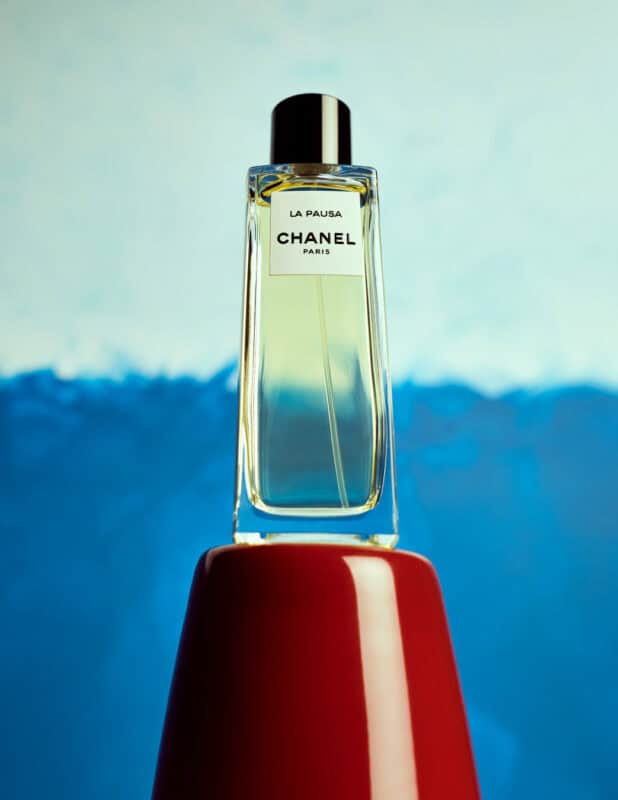
Les Exclusifs de Chanel La Pausa Eau de Parfum by CHANEL
The iris flower has no scent. I visited two London florists and one, at least, was insistent. In many years of being a florist, he said, he had never smelt a scented violet. There may be one or two varieties that carry a scent but they are not well-known and there is no floral iris extract that I have heard of used in perfume. Perfumers have always used the root of the iris, which has to be dried first. And there is nothing new about using the iris root. I went through one of the academic databases in the British Library and there are references to it as far back as Greek and Roman botanical texts in the works of Galen, Theophrastus and Pliny (none of whom I have ever read). Slightly more up to date, I found one sentence in the journal Economic Botany, from 1948, helpful. And somehow, it’s evocative.
“Fresh orris (iris) rhizomes have an odor suggestive of the potato, and the fine violet odor develops slowly after harvesting, sometimes attaining its maximum only after several years.”
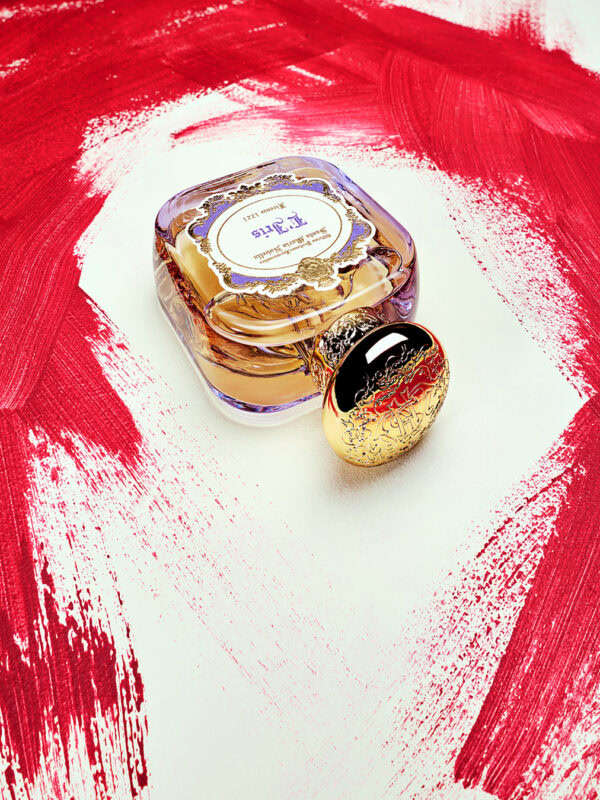
L’Iris Eau de Parfum by Officina Profumo-Farmaceutica di SANTA MARIA NOVELLA
Iris was used as a perfume for linen as far back as the 15th century, according to Kew Gardens’ Bulletin of Miscellaneous Information from 1930. “In the Georgian period it was a common constituent of hair powders and when mixed with starch, constituted what was known as violet powder,” it said. Chanel’s La Pausa vanishes onto the skin. It is not a perfume with a dramatic trail. And I don’t notice an obvious base in it so much as a subtle perfume that ends with an image of itself. Similarly, perfumer Steve Guo’s Iris for Chloé’s Atelier des Fleurs collection was released in 2021 (it has just been discontinued but you can still find bottles). This iris is punchier than the Chanel in terms of its green or violet notes (if that is what they are) but also chooses to become increasingly fragile and transparent. In the past, iris had a heavier presence in perfume and culture. It was a feminine ‘signifier’ in the 1870s when Gustave Flaubert, in his novel Sentimental Education, noticed that the carriage of Madame Dambreuse was scented with iris. And iris literally flew, according to Flaubert, from the wig of the courtesan Mademoiselle Rose-Annette Bron when she danced. A century later and iris is a memory. In Aldous Huxley’s Antic Hay, published in 1923, iris is the perfume he remembers when he thinks of his mother…
“Her dressers, when he had leaned his forehead against her knee… were always black in the evenings, and of silk, and smelt of orris root. Chloé’s Atelier des Fleurs Iris feels more ‘green’ to me than La Pausa to the extent I was thinking it reminds me of Chanel’s No19. Originally released in 1971 and created by Henri Robert, No.19 has a much bolder powder than these recent perfumes and goes out of its way to advertise its status as a perfume. It is never so green that it could be mistaken for nature. La Pausa, in contrast, has the same radiance I would notice if I stopped to pay attention to a bush that was covered in flowers. It is closer to an idea of nature than No.19, which in every respect is like nothing in nature. And you can almost sense the precision of its construction in the way the powder stretches to embrace and blanket the other notes. Chanel’s own notes on the perfume are interesting because they are almost technical. I think they want us to be aware of the technique and the making.
“A daring floral-woody-green fragrance that plays with contrasts. A perfect balance between the vibrant, green notes of galbanum and the soft, powdery notes of Iris pallida. A rich, smooth variation with a greater floral dimension, heightened by ylang-ylang, lily-of-the-valley and rose.”
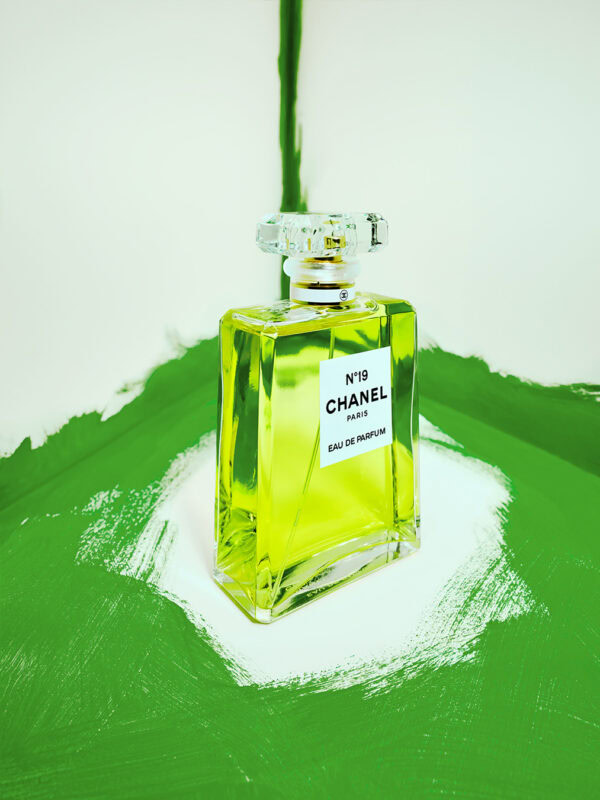
19 Eau de Parfum by CHANEL
I thought I might order some iris absolute to see what perfumers work with. Then decided there was no point. I doubted I could find anything close to the quality of the material available to the fragrance houses. And the different varieties of iris may have different scent profiles. Steve Guo said he was inspired by an iris x germanica from Morocco. Chanel uses iris pallida. And returning to the ever-helpful Kew Gardens’ Bulletin, the writers discuss the qualities of iris grown in Morocco, Kashmir, Tuscany and Florence.
“Great care,” they note, “is exercised in the type of soil chosen for the cultivation of orris root, for soil conditions are liable to have a profound bearing on the nature and quality of the roots. With very rich or heavily manured soils, the roots, though well developed, are prone to possess little or no fragrance and to shrivel considerably on drying, which renders them almost valueless. In very loose sandy soils the roots are found to be lacking in compactness and to possess less odour. The stony mountain soils of Florence are well adapted to the successful growth of the crop.”
In modern perfumes, iris is usually described by its reviewers as delicate and powdery. None of the fragrances I have been looking at are heavy-handed. Perhaps the most vanishing or glacial iris is Santa Maria Novella’s L’Iris, which was first released in 1901 and is quietly persistent for a cologne. I have also read that iris, as in the ingredient, is not just powdery. It may also be starchy, violet-hued, sometimes green and even earthy.
I have little doubt that iris perfumes and iris-scented linen of the past were heavier than modern perfumes. It seems iris has always been used in perfume, but as flowers go it is not particularly floral or florid. It has become more subtle in the contemporary perfume landscape. I love the way these modern iris perfumes are careful not to add heavy or overwhelming base notes or dry-downs. I think it has become an espionage note and refuses a simple reading. It is not skittish and does not want to be liked. I really should get the image of Flaubert’s powdered Madame and her carriage out of my head – iris now plays a very different game.
Photography by Rikki Ward. Issue 77 of 10 Magazine – FUTURE, LEGACY, HERITAGE – is on newsstands now. Order your copy here.