November 4, 2026 |
Jeweller and photographer Alexei Hay’s first love was poetry. “Nobody understood anything I wrote. I don’t even think I understood what I was writing – and nobody was reading anyway. Photography seemed like the next best thing,” he says, dialling in from 47th Street in Midtown Manhattan, dubbed the Diamond District and the city’s jewellery hotspot.
While poetry and photography are two totally different mediums, self-expression has always been at the core of Hay’s storytelling, even as a kid. “I wrote a haiku for my mother. It was about love,” he says. How does one make the pivot from words to pictures? For Hay, it was looking on the streets of Manhattan, where he was largely raised. He’d easily find willing subjects because photography wasn’t “as accessible as today, and everyone wanted to have their photo taken”.
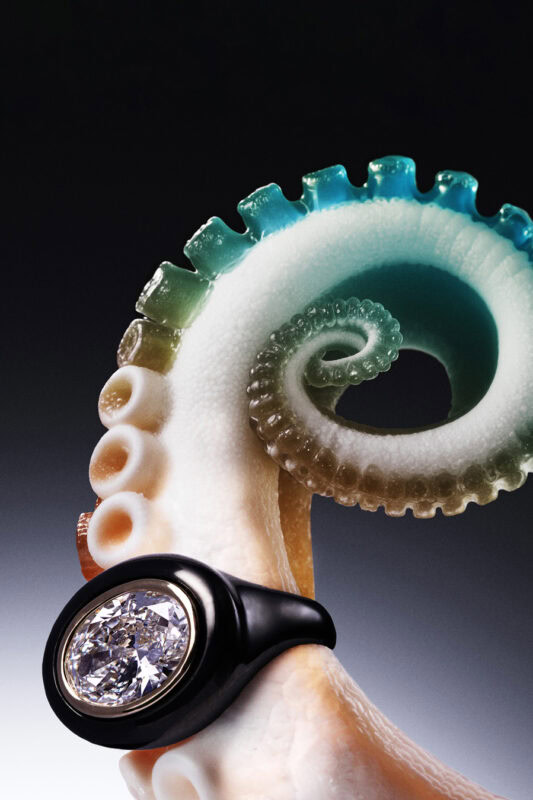
Pneumatic pinky ring in 14k gold and ceramic with three-carat oval-cut diamond by ALEXEI HAY
Over the phone, Hay, who grew up in a secular Jewish family in Long Island and Manhattan but has become more observant in recent years, speaks about the craft as though he picked up a camera just yesterday. There’s still a sense of urgency, excitement and awe. Starting out, he never looked at photography as a career goal but he was certain it would remain a part of his life, he says. “I never questioned whether I could do it long-term. It was just something I liked so much. Being in New York, I got to work with the people who were my heroes in college,” he says. As well as admiring Steven Meisel and others in the image-making world, one of the people who helped Hay sharpen his art was the New York-based documentary photographer Philip-Lorca diCorcia, under whom he snagged an apprenticeship. “While I was working for him, I would also work for other photographers. He encouraged that kind of stuff,” he says.
Hay is still learning – now with a second career as a jewellery designer. That same innate curiosity which ensured he picked up a camera and directed his point-and-shoot towards strangers on busy Manhattan streets drove his next work pivot. “Going to Paris three times a year for over 15 years and documenting looks for the stylist Alberto Zanoletti was an amazing exercise for me, because up until that point I was a photographer, not a fashion photographer. I really paid no attention to the clothes,” he says. What piqued his interest was how jewellery was often an afterthought on shoots – he noticed it was “hardly touched”.
In his decades-long career, Hay has continued to invoke a sense of rebellion and subversion in his work, whether that’s shooting provocative Gucci campaigns with models clad in skin-tight boxers, lensing hyper-masculine men draped in fur or capturing a couple simulating oral sex. There’s always a sense of radicality in his approach. With two decades spent shaping fashion editorials, and a direct line to the industry through his wife, fashion designer Batsheva Hay, many might question how Hay made the pivot to jewellery design. He did too.
A chance opportunity caught his attention, and gradually his vision shifted toward another medium that was capable of illuminating its subjects in a new way. “I had an offer to do the branding for what was [going] to become a big, institutional, lab-grown diamond brand,” he says. “I went to India to meet with the labs there and spent a lot of time immersing myself in the technology of how to make diamonds, and what it means culturally.” Hay’s journey was cut short after the client decided not to move forward with making lab-grown jewels, but his wife encouraged him to continue nurturing his newfound interest. “In a way, lab diamonds occupy the same space that photography did back in the late ’90s, because it’s something that threatens the whole value system of the luxury world,” he says. Much like in the fashion sphere, Hay noticed that imitation was rife in the jewellery sector, specifically in the non-lab-grown diamond world. “Technology has made it so easy to make things that we have a surplus of everything. If you have something that involves just a stone and metal, it can be copied within two or three weeks,” he says.
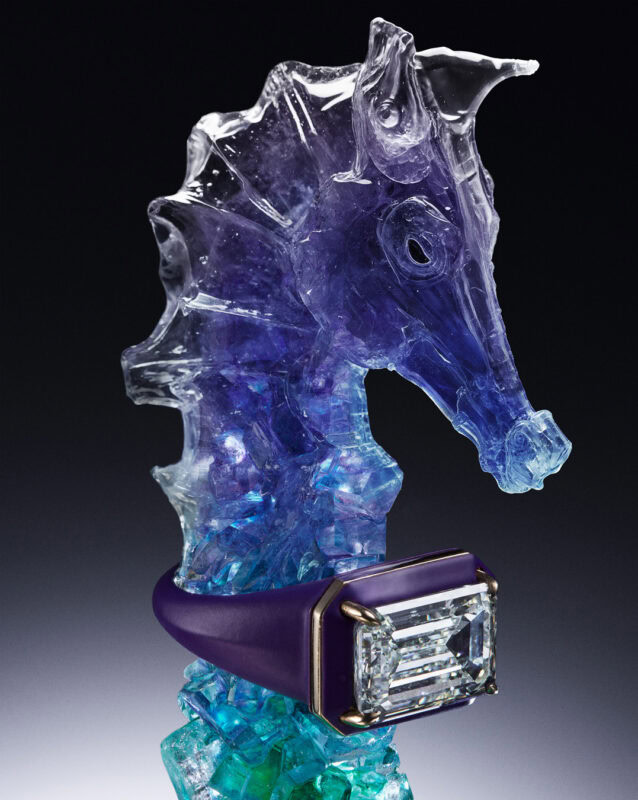
Purple pinky ring in 14k gold and ceramic with four-carat emerald-cut diamond by ALEXEI HAY
Hay’s approach to creativity and lab-grown diamonds is rooted in the same philosophy: there’s power in transformation, encouraging curiosity and depicting an object we put on a pedestal in a more grounded, thought-provoking way. “If you were to take a picture of a celebrity and show this person in a very human way, that was something I got excited about at the beginning of my career. It [comes from] the atavistic drive that I was born with,” he says.
Three years ago, the designer made the foray into fine jewellery, but his interest was never to create ‘pretty’ or ‘polished’ pieces. From the off, his ideas were far from conventional and included “punching holes through big stones that people worship in a perverse way”. He gleaned inspiration from the enduring minimalist necklaces designed by the late model and activist Tina Chow and studied the work of Harry Winston, otherwise known as American jewellery’s King of Diamonds. And while his designs swing the pendulum between traditional and not quite – you can add to cart a pacifier pendant or a classic three-carat round diamond ring, co-designed with tastemaker and writer Leandra Medine Cohen – the messaging is all the same. “Diamonds are something that have been locked away for most people. Democratising them is an important project. They shouldn’t just be for the appreciation of a select few,” he says.
There’s a reason that the adage diamonds are a girl’s best friend is often tossed around: the stones hold such prestige and a glamorous reputation. For Hay, when you have the ability to make smarter and more conscious choices, with similar results, why wouldn’t you? “Whether you make stones, freeze them in the pond, take frozen water out of a lake or take it out of your fridge, it’s still a diamond. That’s something that I get sick of saying, because I say it every day, but people need to understand it,” he says.
The process itself is far from simple, Hay says. “It’s like making a fashion campaign. You pull some references, discuss it, talk about how to make it more ‘today’ and then we’ll have a CAD [computer-aided design] made, which means I’ll do a 3D rendering,” he says. From there, it’s down to the client to decide on the metal: they’ll choose a certain caster, polish and setting. Lab-grown diamonds have been the prime mover in pushing the needle forward in the jewellery world. Unabashed fun is the MO, and he tells me how Jessica McCormack – who most recently collaborated with Zoë Kravitz, sending the internet into a tailspin about her rumoured engagement to a certain English pop star – is an innovator right now. “When you see how her new lines are mixing diamonds with semi-precious gems, you have to acknowledge something’s going on that’s not ever been allowed in the luxury world,” he says.
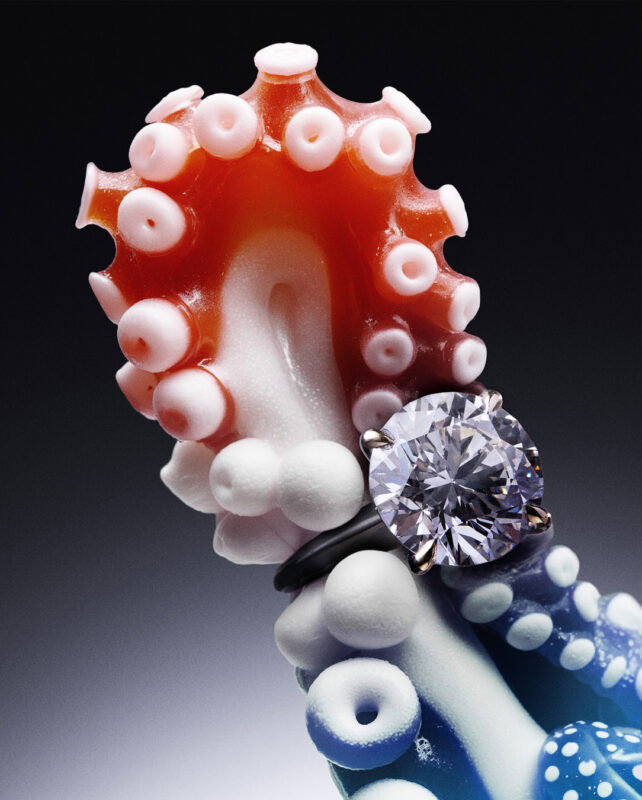
Blackened engagement ring in carbon-blackened 14k gold with three-carat diamond by ALEXEI HAY
With pretty much a direct hotline to fashion designers at the tip of his bejewelled fingers – and in his own home – a collaboration with a fashion pioneer was always going to pavé the way for disruptive jewels. And who better than the woman who made a career out of sidestepping the ordinary than the original Man Repeller, Medine Cohen? “My wife made the introduction to Leandra, and she immediately understood the potential of how lab-grown diamonds could reimagine the whole luxury landscape,” he says. They workshopped ideas and metals “some would turn their noses up at”, and the result? Striking three-stone colourful cuffs with varying stones from onyx to emerald, ruby and diamond detailing, in addition to singular diamond cuffs and the aforementioned ring. In short: it’s exactly as colourful and riotous a collection as you’d imagine from a pair of jewellery nonconformists (after all, Medine Cohen made toe rings du jour last summer). “She understood the potential for it to be mixing diamonds, gold, silver and semi-precious things. It’s everything all at once and I always think of her as the Paloma Picasso of our generation,” he says.
His work is presented in a way that challenges and twists the lacquered, glamorous surface of fashion into something more. “My work shifted to actually trying to make people feel good about themselves, rather than exposing the weirdness [of fashion],” he says. Batsheva, who he has been married to for 13 years, is often the muse of his work, which he states as “the most rewarding” experience. Similarly, she plays an important role in bouncing ideas around, and Hay often floats concepts past her. “I always give her pieces to try on. I can tell immediately, when she puts it on, if it’s successful or not,” he laughs.
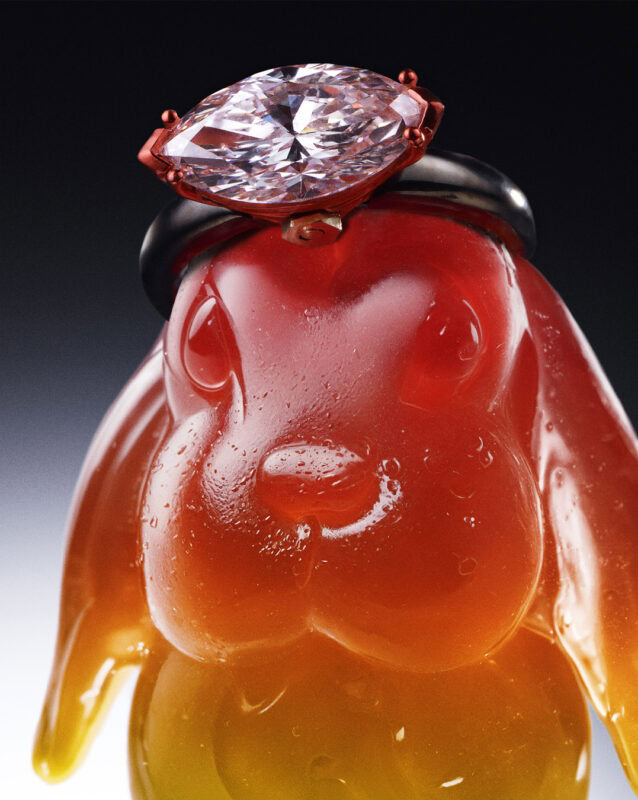
Marquise ring in 14k gold, carbon-blackened band and ceramic with three-carat marquise diamond by ALEXEI HAY
Stars such as Sarah Jessica Parker, Gigi Hadid and Miranda Kerr are all flocking to his workshop for custom pieces. With models, Hollywood stars and trendsetters on his client list, Hay deliberates over which designs tend to attract them like magpies: “It’s sort of accelerating to that point where people constantly need new designs and materials, a rotation to feed the animal desire for all this stuff. Sometimes it’s chunky, then thin and light or textured,” he says. Still, he knows he’s on the right track when he gets an A-list co-sign on the small screen. “The most encouraging moment in what I’ve been doing is that SJP wore some of my pieces in And Just Like That… She bought stuff after she was done filming – including a punch diamond she wears regularly – then announced she’d be the global creative director for a lab-grown brand [Astrea].”
There’s no shortage of customers looking for bespoke lab-grown diamonds, but what’s fascinating to the jewellery designer is how the most decadent pieces – the kind that would make Elizabeth Taylor’s eyes water – are now attainable for more people. “People accept the reality that lab-grown diamonds are diamonds,” he says, while acknowledging in the same breath the scepticism around print advertisers eschewing them, and his next thought lingers in the air for a moment or two. “The question is whether the exclusivity of natural diamonds was what made them desirable?”. He’s not quite figured that one out yet.
Hay has grasped that conventional, meticulously planned jewellery drops simply aren’t the way to scaling his business. “Traditionally, you’re supposed to come out with a line that has earrings, a necklace, a ring and a cuff or something,” he says, noting that it’s a business model he finds outdated. Instead, Alexei Hay finds joy in making the custom route the blueprint. “Each client has such highly evolved tastes that every time I collaborate with them on these jobs, I learn something,” he says, before heading back to make more pieces for some of NYC’s finest. Hay admits there’s a thrill in rustling a few diamond chokers. “The jewellery world has been so stuffy, guarded, exclusive – it’s easy to push things around and rattle a lot of places. Making people question what, why and where their jewellery comes from is the most fulfilling part.” It’s his time to shine.
Photography by Sebastian Mader. Issue 77 of 10 Magazine – FUTURE, LEGACY, HERITAGE – is on newsstands now. Order your copy here.