November 3, 2026 |
“It’s not dance, and it’s not theatre,” says Dimitris Papaioannou on a video call from his flat in Athens. “It’s not performance art either.” The cult choreographer and movement director is sitting at his desk, the Grecian spring pouring in from outside. He pauses and squints slightly, visibly struggling to define his practice, which has – for the past four decades – defined the bleeding edge of Greek performing arts.

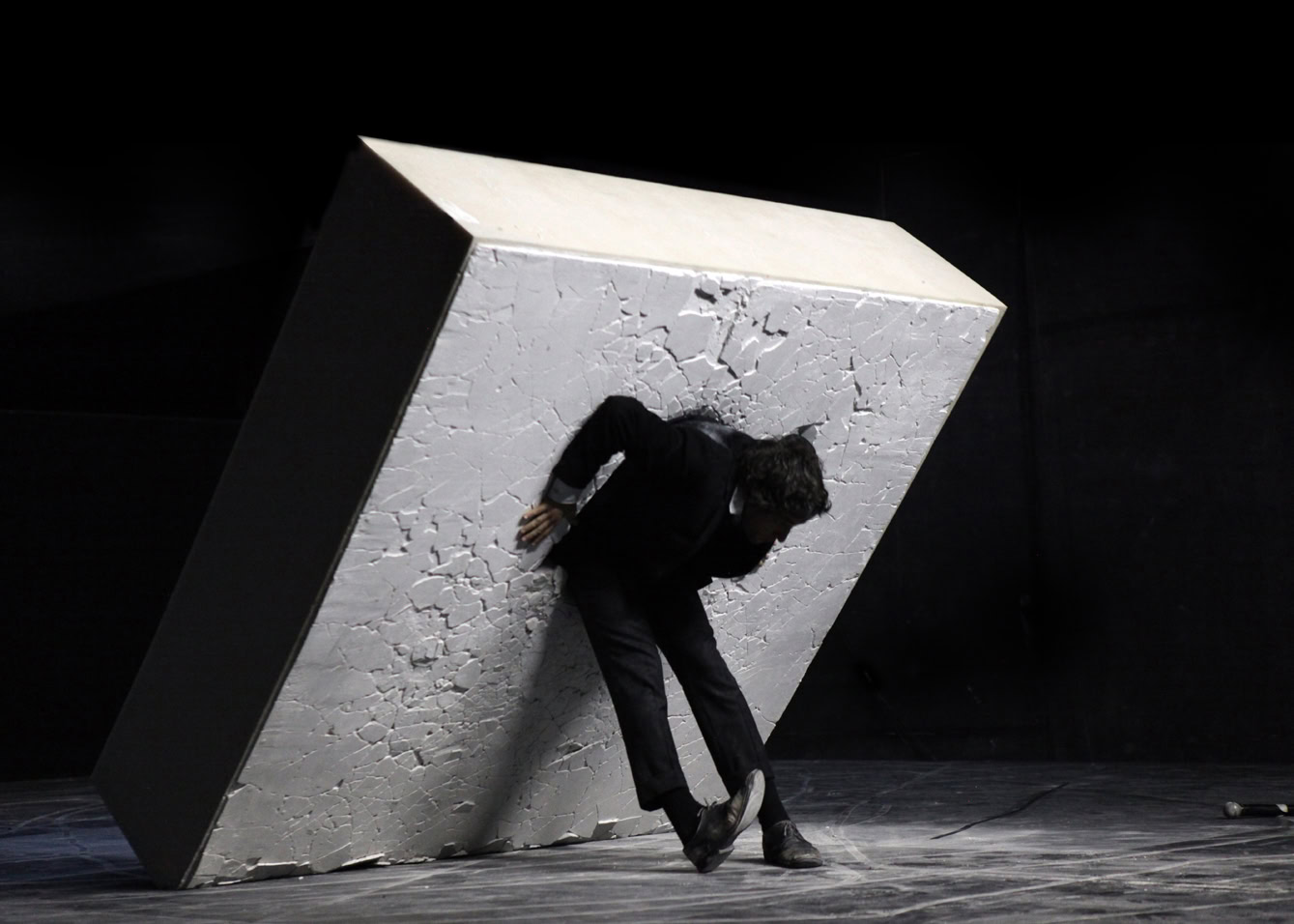
‘Primal Matter’, 2013
His frame is lithe, his beard lightly greying and his gestures elaborate. Perched on his nose are rectangular, white-framed glasses and behind him are a selection of choice belongings: tender portraits of male figure she’s drawn over the years, “cheap” Le Corbusier-esque furniture he’s reupholstered and a very Greco-Roman bust beside a small kitchen-diner.
Currently, Papaioannou, who is in his early sixties, is editing a film documenting his show from October last year, This That Keeps On, a chimerical study of the human form, sensuality and kinship comprising 30 performers. Originally, it was commissioned as a one-off fundraising event by the local Museum of Cycladic Art, but the choreographer wants it to live on digitally. Soon, it is clear that Papaioannou is a polymath of sorts, a man who is adept in various disciplines and styles. As well as being an avant-garde fixture, he has cemented his name with the success of his big productions globally and domestically.
Indeed, in March this year, when Spanish pop star Rosalía began the tour for her album Lux, scenes of an intricate choreographic sequence he designed for smash-hit track La Perla spread across social media. In it, the singer gyrates slowly as multiple white-gloved arms wrap around her. For those who know Papaioannou’s work, it was immediately redolent of 2006’s award-winning production 2, where the same illusory technique was used to form what he describes as “a shirt of lovers”. He explains that it was a broadly archival commission for Rosalía, with “new versions of inventions that I have done for many years now”.

Dimitris Papaioannou
So the story goes, Rosalía had seen Papaioannou’s work online and slid into his DMs to propose a collab. Two years later, they eventually co-ordinated schedules to meet. He showed her some images taken during a two-hour studio session with various performers and the concept was firmed up. It’s a major coup, but Papaioannou plays it cool. “It was just one song. I find her talented and super sweet, and the way she approached me was also nice,” he says. “But I’m telling you, it’s just a deviation. I like pop culture and I like my art to be popular, but my home is my art.”
To his credit, Papaioannou has lived and breathed the underground since he was young, proudly marching to the beat of his own drum. At age 17, infatuated with painting, he made the brazen decision to visit the late artist Yannis Tsarouchis – a canonical figure in the history of homoerotic Greek art – in a bid to get his work noticed. Convinced, Tsarouchis mentored Papaioannou, serving as a secondary father figure when Papaioannou’s biological father, a plumber, took issue with him being gay. “[Tsarouchis] accepted me at his house as a disciple and he also supported me psychologically,” remembers Papaioannou, who then fled the family home aged 18 to live as an out and proud artist. He went straight to the centre of Athens and joined a squat, a defining decision in his life. To get by and pay his way through Athens School of Fine Arts, which he attended against the wishes of the revolutionary Tsarouchis, he would paint portraits of rich people’s children, illustrate magazines and design the interiors of big nightclubs.
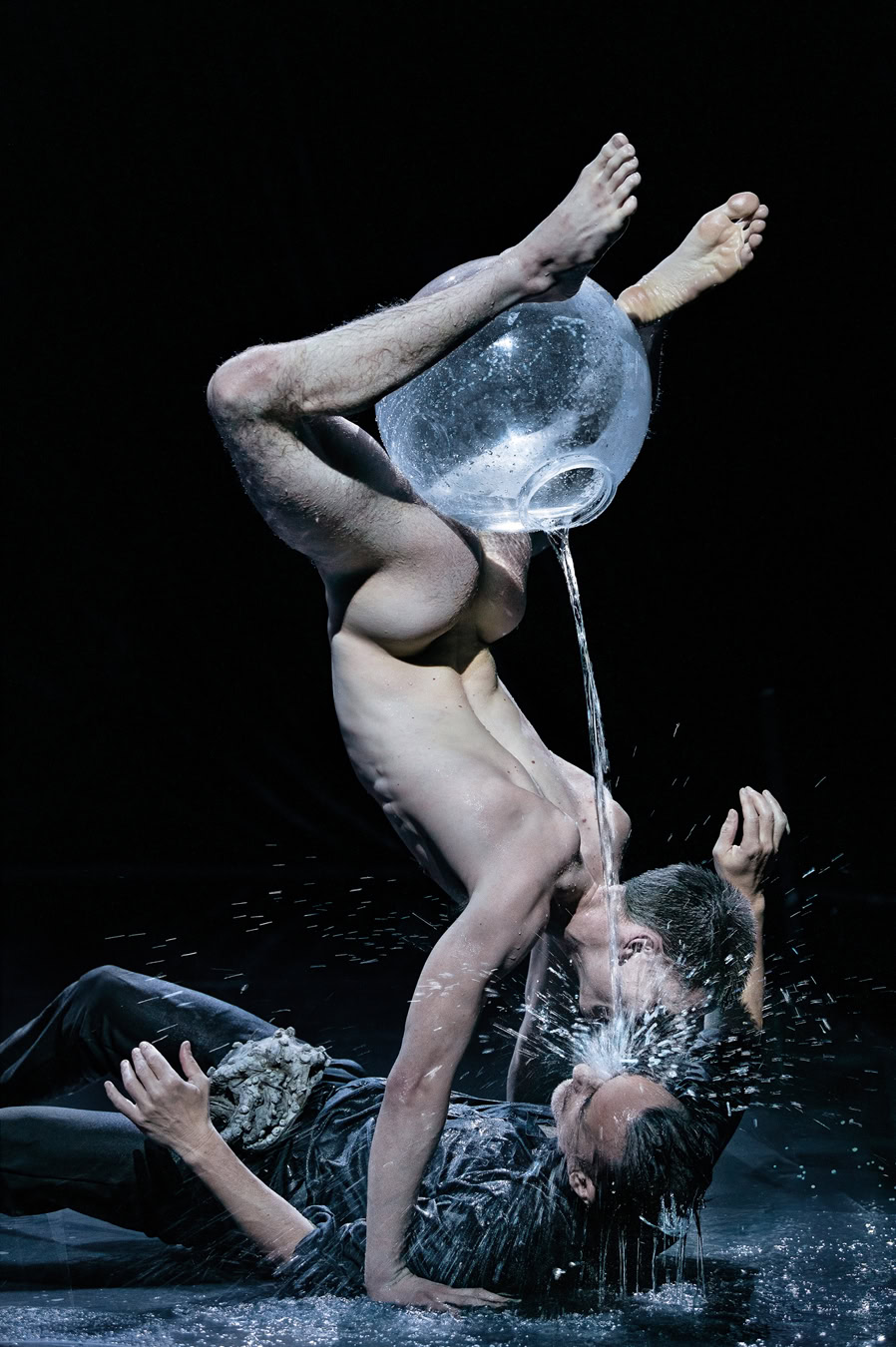
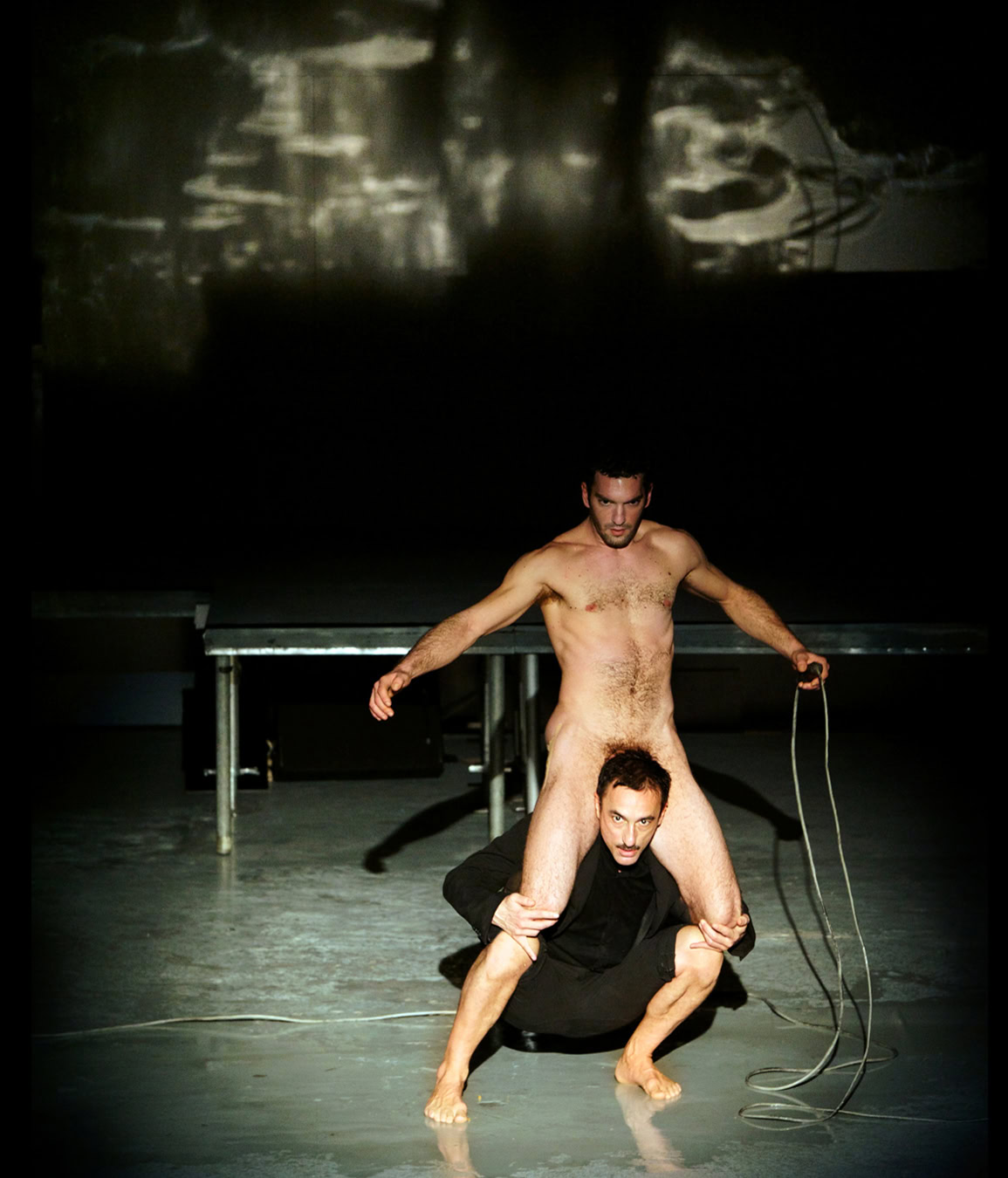
From left; ‘Ink’, 2020; ‘Primal Matter’, 2013
Life on the margins brought him to choreographer Mary Tsoutsi in 1982, his first proper introduction to performance and movement. She ran a radical dance company called Analia and, because it was difficult to find boys who wanted to dance, invited Papaioannou to her classes. He impressed her and quickly started dancing in her productions, then designing costumes, make-up, lighting and sets. After cutting his teeth with her over a handful of years, he decided it was time to go it alone.
To 1986, enter: Edafos, a company that Papaioannou and dancer Angeliki Stellatou ran from a squat that was responsible for a roll call of highly referenced productions that fall under the anti-tradition of Tanztheater (dance theatre, a German Expressionist invention). Employing a performance style that prioritises the evocation of feelings and concepts over clear plots and narratives, the company ran for 16 years. In that time, Papaioannou’s immersion in subcultures meant that he was also flexing his skills in other arenas, making homoerotic comics and graphic novels, and working as the co-publisher of Kontrosol sto Chaos, a queer post-punk title that he illustrated and headed up the art direction for. (“Kontrosol” is a term from the gay slang language kalairà – think the Greek version of Polari – and means, roughly, “kiss on the mouth”.)
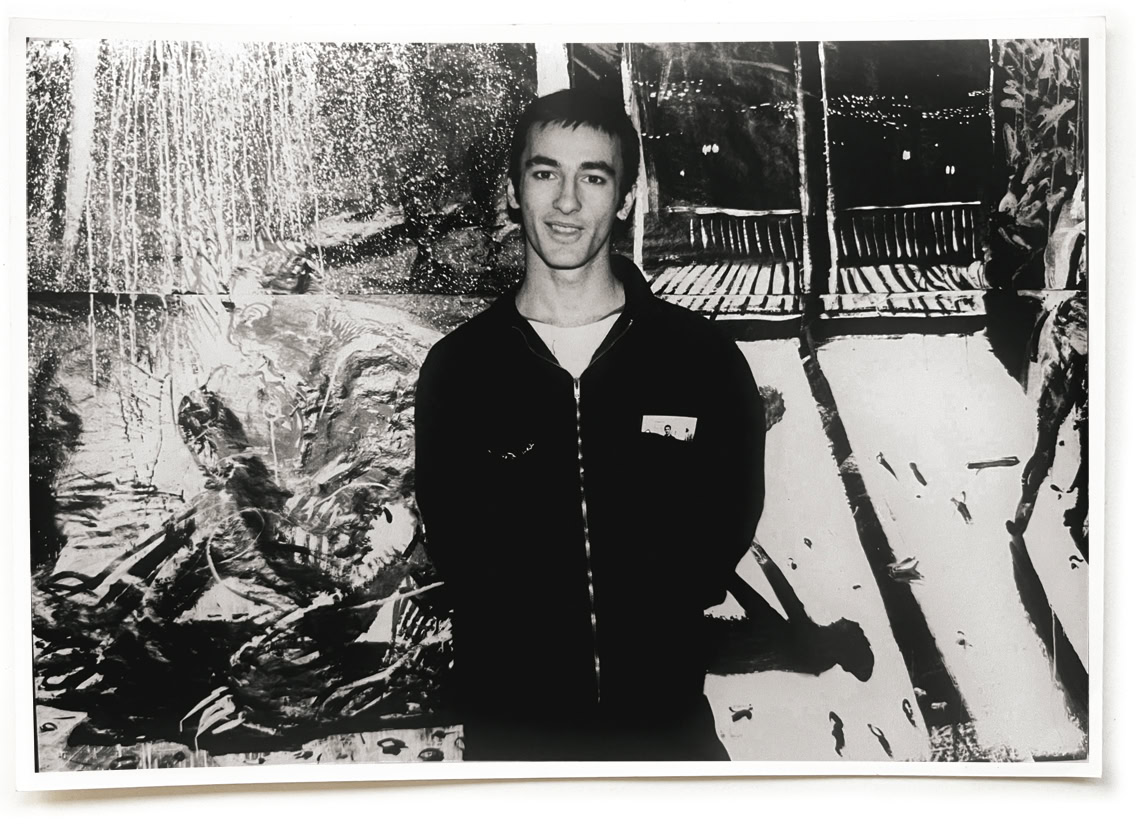
From left; A young Papaioannou at the Athens School of Fine Arts; ‘Still Life’, 2014
Despite everything on his plate, the artist never spread himself thin and has left an indelible mark on culture, not least through Edafos, which became a phenomenon. Early productions like The Raincoat and The Mountain (1987) and Room I and Room II (1988) represented Greece in the third and fourth Biennials of Young Artists from Europe and the Mediterranean. He cites his first critical breakthrough, however, as The Songs (1991), a trilogy of performances that was chosen to represent Greece at the sixth iteration of the aforementioned fair.
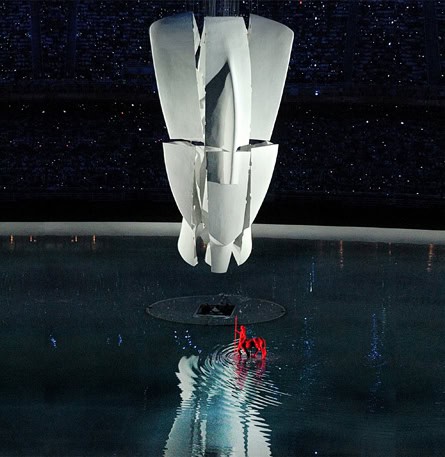
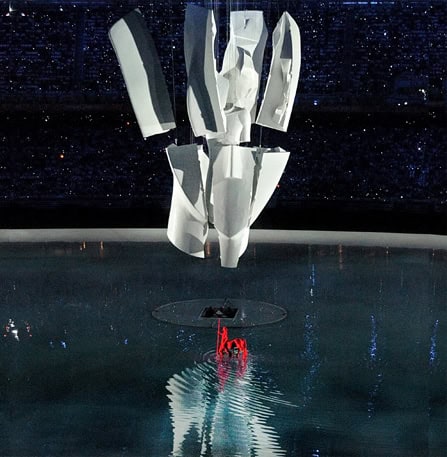
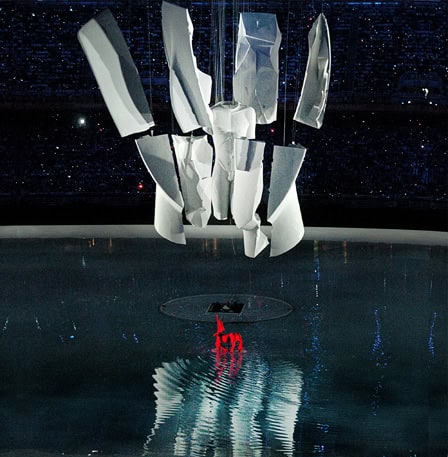
Opening of the 2004 Olympic Games in Athens
“It was a revolution. You would see a small, illegal squat packed with all the art celebrities in Athens,” he says. Then came Medea (1993), a work marking his crossover into major stage productions. The spooky black and white-costumed piece unfolded in slow, deliberate motions akin to Japanese Butoh dance and has been re-staged across the world.

‘Transverse Orientation’, 2021
Over time, he built a unique, albeit Bauschian – after his idol, German dance-theatre legend Pina Bausch – aesthetic that’s now unmistakable. Primal Matter (2013), his own favourite, is a good place to start. It follows the journey of two male performers – Papaioannou, dressed in a suit, and movement artist Michalis Theophanous, starkers – playing out a perturbing series of awkward geometric contortions and jostles. It’s refreshingly pared back and closes with the sight of a sweaty Papaioannou, his head wedged under Theophanous’s groin.

Creating the concept for ‘La Perla’ on Rosalía’s ‘Lux’ tour, 2026
Or try Ink (2020), a production that sees Papaioannou (again, dressed) and dancer Šuka Horn (naked) slip and slide through a series of tussles, all the while an irrigation device soaks them and a prop that looks like an octopus is thrown around. The meaning? He cites implicit themes of fatherhood, sexuality, creator and creation, but ultimately rejects any fixed interpretation. As he sees it, his works are the metamorphosis and transformation of bodies and images, which dissolve as soon as they appear. “Sometimes they create emotions and impressions. I don’t know how to explain it, and it’s not my job to do that,” he affirms. He’s always preferred “energy over meaning”. He spells this out for me: “There are millions of messages that pass through a caress, but you cannot decode them logically. I think art works this way.”
Despite Papaioannou’s reticence to be pinned down, there are throughlines in his art. His inspirations – Jannis Kounellis, the Greek-Italian figurehead of the arte povera movement, Federico Fellini, director of La Dolce Vita, and painter René Magritte – are apparent in the oddball gestures and on-stage mirages that make it hard to distinguish bodies from materials, and his signature juxtaposition of sacred and profane symbols. Fittingly, the Renaissance, Byzantine art and Greek mythology nourish his practice.
Consider Transverse Orientation (2021), where we witness his Botticellian Venus and ingenious, Chaplin-coded shadow dancing. He highlights the latter and fellow film pioneer Buster Keaton as recurring references, particularly the way their work balances cartoonish appeal with a penetrating, subconscious darkness that appeals to high and low culture. This goes some way to explaining how, long before the Rosalía gig came along, he landed the job as artistic director for the 2004 Athens Olympic Games’s opening and closing ceremonies. The result was a Greco-Roman medley mining the history of the nation from Minoan to modern times with centaurs, a huge, temporary artificial lake that took six hours to fill, human-size paper boats and a Björk performance of her bespoke track, Oceania. In 2015, he took on the same role for the opening ceremony of the inaugural European Games in Baku, Azerbaijan, a seismic production made up of a Lady Gaga performance, high-speed folk dancing and a volcanic display.

‘The Great Tamer’, 2017
Again, he is keen to brush all of these remarkable achievements off. “These are the super commercial sides of my work and I’m very proud of them,” he says. “But I’m mainly proud of what I do that has nothing to do with assignments.” So, what does he want to be doing most right now? “Well, in a broad sense, I’m centralising the body of my work,” he says. “I want it to be experienced outside the theatre and for my visual artist self to walk hand in hand with my performance self.” In practice, that means a big exhibition next year – the rest is hush hush for now.
He’s grateful for his journey so far. It’s a career that has peaked at different intervals, carrying him from legend status in Greece to worldwide appeal. The past 12 years have been especially significant, with Papaioannou picking up a bevy of international co-productions, including Since She (2018), the first time an artist has directed the Tanztheater Wuppertal since its founder, Bausch, passed away in 2009. “I became super young again. It’s like those years gave me things that I’d already accepted I would live without,” he says.
In knitting together the visual and choreographic elements of his practice, he has also spent much of the past five years returning to serendipitous life by making drawings on nudist beaches. Papaioannou sketches fast, but finds the process meditational. Every summer, he goes to Anafi, an island in Greece’s Cyclades region. “I am partially responsible for its rise in gay crowds,” he says, laughing, but half serious. As he sees it, it’s impossible for him not to do something. Theatre forces him to communicate and collaborate with others, easing him away from his naturally solitary nature. When he’s alone, all he needs is a pen and paper.

‘This That Keeps On’, 2025
Seen from outside, Papaioannou has lived a rich and challenging life. As well as fending for himself from the second he became a legal adult, he also lived through the Aids crisis when friends and his community were dying right in front of him.
His haunting work Requiem for the End of Love (1995), created with composer Giorgos Koumendakis, serves as a testimony to this time. In it, bodies tumble in unison down a staircase while a soprano singer takes centre stage. Performances were originally held in a huge deserted power station in the suburbs of Athens, forcing the cultural literati to traipse through ruins to witness it. Decades later, it was re-envisioned and shown at the Greek National Opera this January.
Fortunately, Papaioannou was able to rekindle his relationships with his parents before their deaths. “My mother never rejected me,” he says. “It’s more the case that I rejected her to run away from my oppressive father.” His dad eventually apologised. “We found our love again.”
At this point, the upcoming exhibition feels like both a milestone and a survey of all that he’s achieved and weathered. He’s excited but also highly nervous. A perfectionist through and through, Papaioannou immediately turns critic on himself the moment his work airs. Yes, he might be married to the underground, but like everyone, he wants validation. “I hope that my work will be loved,” he says. Of that we have no doubt because, clearly, the man is doing something right.
Photography Courtesy Of Dmitry Dubinsky, Julian Mommert and Miltos Athanasiou. Issue 77 of 10 Magazine – FUTURE, LEGACY, HERITAGE – is on newsstands now. Order your copy here.