July 2, 2026 |
There’s no shortage of creative talent spilling out of fashion studios around the world. Most of it comes from a handful of fashion schools whose professors and practitioners are responsible for hand-picking and nurturing the graduates who will help to shape an industry equipped for an increasingly uncertain future. It’s challenging. The professors we talked to for this feature – from Antwerp to Johannesburg – share similar concerns, such as fashion degrees not being sufficiently funded or taken seriously, despite the industry’s importance both culturally and economically. They worry about students losing the ability to touch, in a literal sense, having information overload and not having spaces to express their creativity after they graduate. And there is also the issue of finance.
A master’s in London costs between £30-40,000 per year once you factor in the fees, living costs and materials. That’s why the Royal College of Art introduced a one-year master’s course in 2023. Some academic institutions in Europe are more accessible. The University of Vienna, the Royal Academy of Fine Arts Antwerp and the Berlin University of Applied Sciences, aka HTW (Hochschule für Technik und Wirtschaft), are all free or you’ll pay minimal fees to attend, with extraordinary educators and practitioners at the helm. Imagine! At HTW, you could be taught by Professor Hussein Chalayan. At the University of Vienna, Prof Craig Green will be guiding you through your fashion design tutorials.
“My area of specialty is innovation, sustainability and cultural identity,” says Chalayan, who has been at HTW Berlin since 2019 teaching across its BA and MA courses. “Right now, there are great state universities in Europe,” he says. “Lots of students who don’t have money deserve a place but can’t afford to study. The best art, music and fashion never came from money.” In London, the course leader for MA Fashion at Central Saint Martins, Fabio Piras, says: “The struggle is part of artistic practice.” But he questions why the industry isn’t more supportive of the education of the talent it ultimately benefits from. CSM’s MA course currently has just five scholarships, down from 12 pre-Covid.
As an academic myself, responsible for the BA Fashion Communication Journalism pathway at Central Saint Martins, I can vouch for the fact that working in creative education is an education in itself. Despite the 16 years that Liliana Sanguino, of the Parsons School of Design, has spent at the forefront of fashion education, she is still learning. As a Colombian who has built a career in London and now New York, and who collaborates with Indigenous trans communities in Colombia, she says she needs “a definition of fashion that is wide enough to hold all these worlds. I encourage students to do the same: to question, to expand and to define fashion through their own perspective, culture and lived experience. Without that, creative education risks producing designers who can replicate existing systems but not imagine new ones.” Here, Sarah Hermez, founder of Create Space Beirut, has her say.
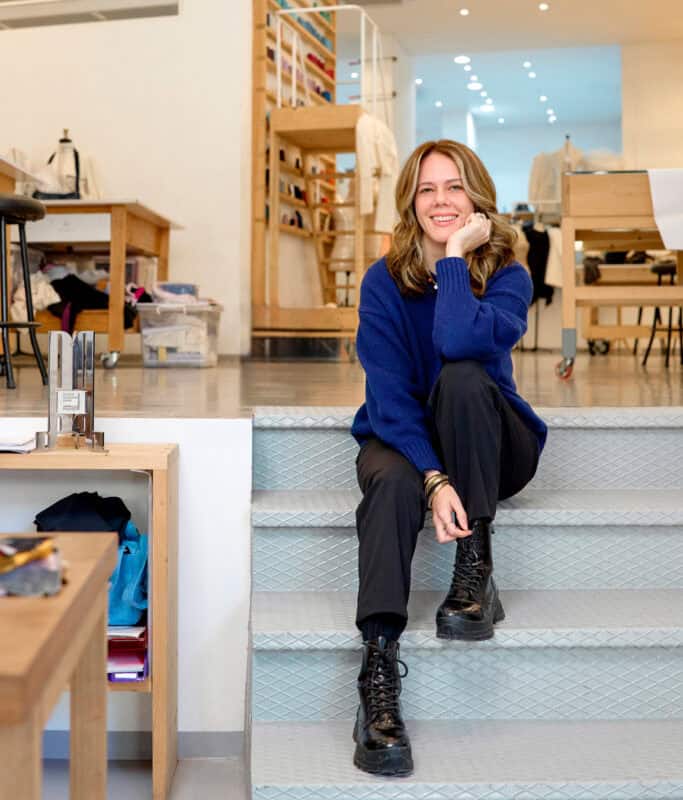
“We emphasise storytelling through design, by translating lived realities into creative form. While students’ outputs vary widely, what unites them is a spirit of experimentation, craftsmanship and authenticity” – Sarah Hermez
Sarah Hermez, founder of Creative Space Beirut
Sarah Hermez was born in Kuwait, is of Armenian-Lebanese heritage and studied fashion design and media studies at Parsons. Through her love for creativity and a drive for social justice, she founded Creative Space Beirut in 2011 as a design school offering free education to students from a range of backgrounds.
What is the aim of your course?
To break down barriers in the creative industries and uplift young talents through our three-year intensive programme in fashion design. The programme is built on the belief that access to quality education should not depend on privilege. Our aim is to provide free, high-quality training to talented individuals who might not otherwise have the means or connections to enter the industry. We combine hands-on, experiential learning with a strong foundation in design, patternmaking and garment construction.
How many students on average are in a cohort?
Out of around 300 applicants, we take 10 students per year.
What are the qualities/skills you look for in your students?
We look for openness, students who are eager to learn, experiment and collaborate. Skills can be taught; what matters most is their perspective, resilience and willingness to challenge themselves.
While on the course, do your students develop an aesthetic, style or way of designing or thinking?
There isn’t one aesthetic we teach, but rather a way of thinking. Students are encouraged to develop their own voices by drawing from their personal experiences, cultural heritage and environment. We emphasise storytelling through design, by translating lived realities into creative form. While their outputs vary widely, what unites them is a spirit of experimentation, craftsmanship and authenticity.
How do you equip your students for the rapidly changing world we live in today in terms of economic, climate and political uncertainty?
Our students live in a context where uncertainty is constant, and political instability, economic collapse and environmental strain are part of daily life in Lebanon. This makes them incredibly resilient, resourceful and adaptive. The programme teaches them to design with limitations, think critically about materials and sustainability, and collaborate in ways that mirror real-world challenges. They leave not only with technical and creative skills but also the mindset to navigate instability with creativity and strength.
Photography by Gina Kazzi and production by Sonya Mazuryk. Taken from 10 Magazine Issue 76 – CREATIVITY, CHANGE, FREEDOM – out NOW. Order your copy here.