


What you first notice when speaking with Mahnaz Ispahani Bartos, founder of the Manhattan gallery Mahnaz Collection, is the joy she has for her subject – an eye-sparkling, encyclopaedic knowledge of the craft of jewellery design and its makers. Her ebullience immediately draws you in, allowing you to see the world through a lens of jewellery and the stories it tells.
As a child of cultures “infused with jewellery from a very young age”, Ispahani Bartos’s collection of rare modernist, vintage and contemporary jewellery spans as many countries and continents as her biography – from India to Iran, Pakistan, London, New Mexico, South America, Europe and New York. Born in Dhaka, then the capital of East Pakistan (now Bangladesh), to parents of the prominent Perso-Bengali Ispahani family, she explains that “jewellery is given to daughters as one of the only assets they can inherit”. She remembers marking the most important milestones of life with a trip to a family jeweller, where she had a set of three enamel Meenakari bangles commissioned over dark tea. Pieces are also passed down from mother to daughter, becoming part of their shared history.
At 10 years old, her Persian, India-born grandmother gifted her a pair of Victorian emerald-bead and seed-pearl earrings, which she put in her doll’s ears, as she was too young to wear them. The doll and the earrings were later lost at sea, along with many of her family’s belongings during the revolution of 1971 and the violent conflicts that preceded the secession of East Pakistan and the creation of Bangladesh. Political history told through the lens of jewellery is a through-line in Ispahani Bartos’s life.
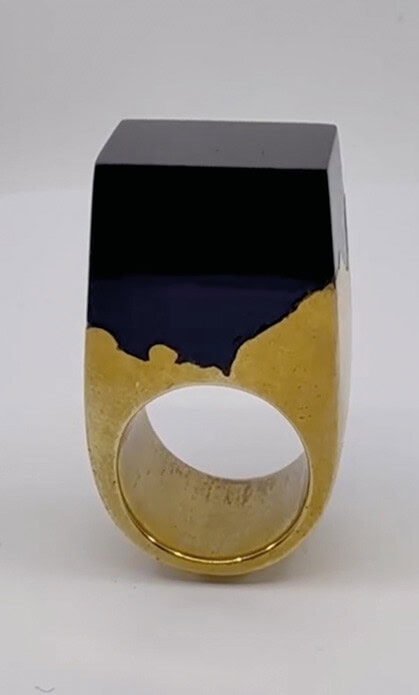
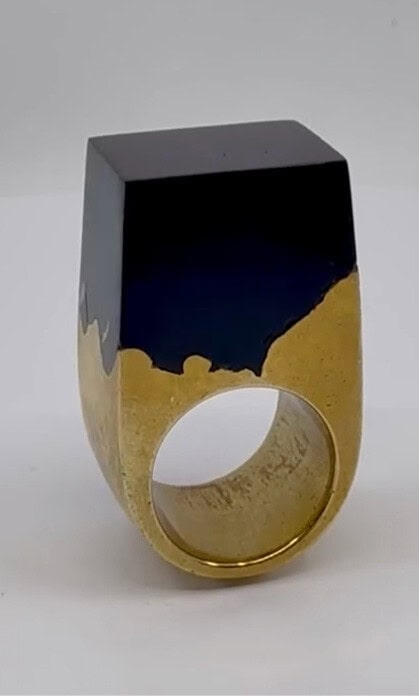
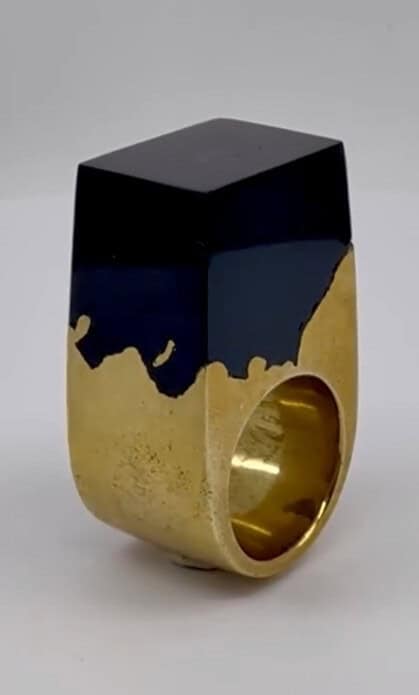
bronze and resin Montana ring by Carmen Tapia
An unlikely start for a jewellery collector/gallerist, Ispahani Bartos began her professional life as a foreign policy expert. Perhaps unsurprisingly, given the political upheaval she experienced at an early age, she started at the Woodrow Wilson International Center for Scholars in Washington D.C. and later spent 10 years at the Ford Foundation Center for Social Justice in NYC as a senior fellow at the Council on Foreign Relations. During her travels to Nigeria, Guatemala and the pre-Perestroika Soviet Union, where she was unable to wear jewellery due to the nature of her work, she began collecting interesting sculptural objects, such as wooden dolls depicting colonial figures from Senegal, or Russian nesting matryoshka dolls portraying political figures. Her anthropological curiosity about objects was there, just with a different focus: “When I get attracted to something, I want to know all about it, where it came from, what the culture is. I have to handle things, especially jewellery. Until you hold a piece, you really don’t know the world it lives in.”
Her time spent trying to improve the world through public policy led her to realise the importance of the human capacity for beauty and self-expression to “give us strength” to deal with the rest of life. At around the same time, she and her husband of 33 years, photographer Adam Bartos, tried unsuccessfully to find a replacement for her cracked engagement ring, which led her to dive deeper into the world of jewellery design, specifically 18th- and 19th-century Indian Mughal jewellery. This was a turning point, with Ispahani Bartos deciding to open her gallery in 2013.
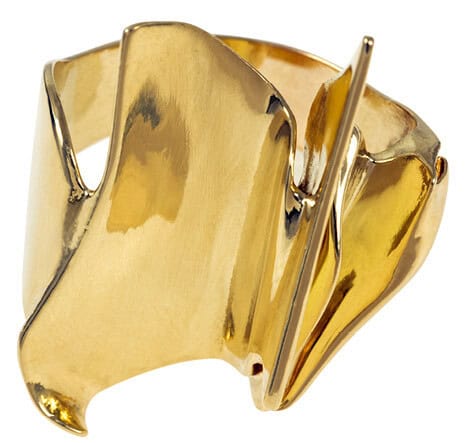
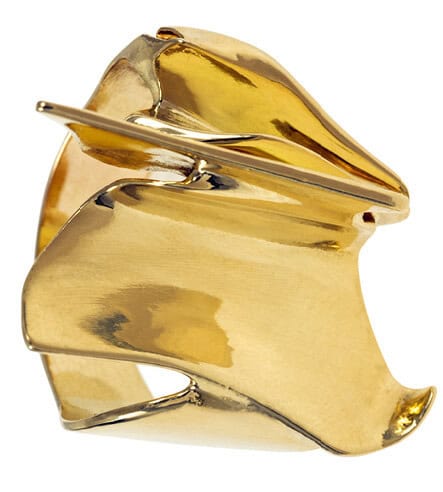
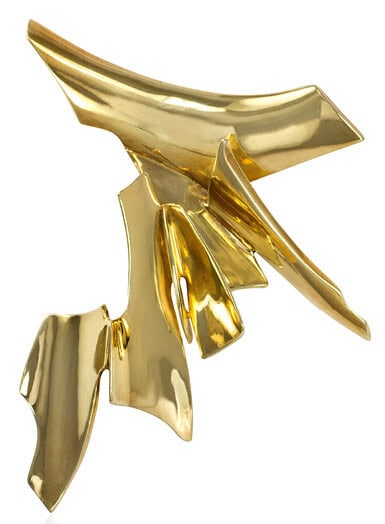
from left: 18k yellow gold ring and brooch by Alicia Penalba
She credits her mother for her innate sense of style and love of jewellery, remembering her as “a woman of exceptional style”. A collector of jewellery herself, she travelled extensively with her husband. On a trip to Mexico, Mrs Ispahani wore an elaborate emerald necklace with big Mexican costume earrings. “She looked fantastic. I wouldn’t have thought the combination would work if I had not seen her wearing it. It gave me a true sense of what style was,” says Ispahani Bartos. Her mother, who lived much of her life in London, introduced her to the British modernist jewellery designers of the 1960s, popularised by Princess Margaret and her then-husband Lord Snowdon. Soon after, Anglo-Italian designer Andrew Grima gifted her a black-and-gold Omega De Ville watch. “My mother lived in London for many years, so the sculptural London-based designers really came to me very naturally and left a profound impact on me.”
When asked why jewellery designers who rose to prominence in the 1960s, ’70s and ’80s – including Italian modernist Giorgio Facchini, Scandinavian minimalists Nanna Ditzel and Vivianna Torun Bülow-Hübe for Georg Jensen, and British sculptural designers such as Grima and Gerda Flöckinger – are rising in popularity with younger audiences today, Ispahani Bartos has a couple of theories. Aside from the powerful political and cultural transformations that defined these decades, jewellery designers began to move away from conventions, preferring to let the materials dictate design: “What they did with gold was so transformative in that period. They textured it, they hammered it, and did anything they could to work the gold in unique ways and with techniques that still captivate today.”

18k vintage French bracelet with art deco-inspired geometric detailing
Perhaps because of her background in “rich yellow-gold culture”, she has since built her collection around these styles. The independent jewellery advisor Joanna Hardy credits Ispahani Bartos for her eye, for championing craftsmanship and “bringing attention to the wonderful designs of First Nation jewellers of North America, elevating their work alongside names more familiar to the market”. Among those championed by her Mahnaz Collection gallery, include the virtuosic work of masters such as Charles Loloma (a Hopi Native American artist), Jesse Monongya (Navajo/Hopi) and Richard Chavez (San Felipo Pueblo, New Mexico). Before long Covid complications made flying impossible for Ispahani Bartos in 2020, she had travelled to New Mexico every year, getting to know these designers. “Most importantly, I was able to go to the studios of some of the jewellers and get to know, for example, Charles Loloma’s niece, Sonwai [the artistic name of Verma Nequatewa] who is a master in her own right and the first and only female master goldsmith, a tradition usually passed from father to son.” For the award-winning young master bead artist Elias Jade Not Afraid (a member of the Apsaalooké, Crow Nation), the Mahnaz Collection not only provides a platform, but also acts as a patron by commissioning his work.
Ispahani Bartos worries that there “are so many lost masters out there”, making it her mission to track down unnamed pieces using the Goldsmiths’ Company Assay Office in London, which has been testing and hallmarking precious metals and makers’ marks for more than 700 years. This also puts her at the forefront of noticing trends – for example, the first piece of Cazzaniga jewellery she bought was unnamed, and far less expensive than the most recent piece she’d acquired, as dealers are quick to catch on when names are rediscovered. Her research led her to learn that the Roman jewellery designer Angelo Giorgio Cazzaniga was revered in his time, alongside peers including Bulgari and Buccellati.
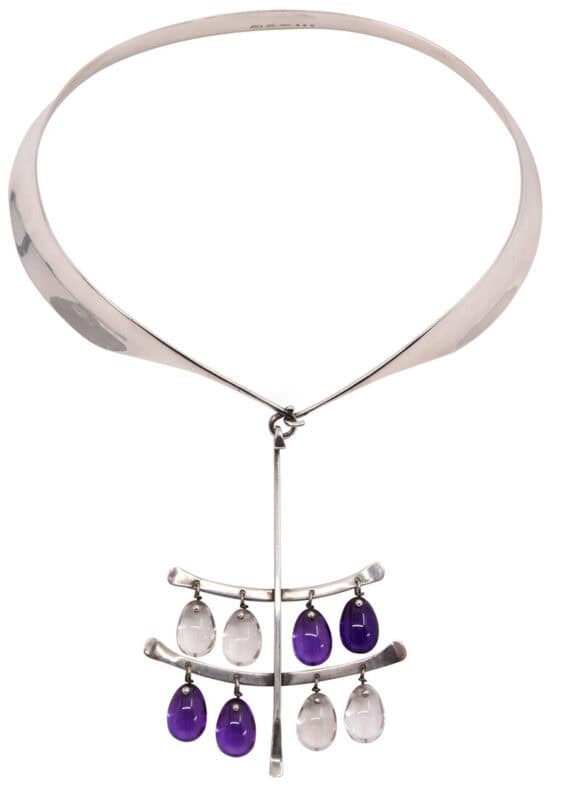
amethyst, rock crystal and sterling silver collar necklace with pendant by Vivianna Torun for Georg Jensen
Ispahani Bartos speculates that the reason Cazzaniga didn’t reach the same success as the other two Italian brands may be because the designer had two sons, and only one who stayed in jewellery, compared with the larger family businesses. She takes great pleasure in restoring such lost masters and seeing so many people rediscovering their work.
At Mahnaz Collection’s bright Madison Avenue gallery space, clients can attend exhibitions or make private appointments to see a broad range of designers. While you’ll find well known names like Cartier, Van Cleef & Arpels and Chaumet, the focus is on what’s rare and often vintage. The advantage of investing in new designers or vintage pieces with provenance is that you can find higher quality craftsmanship at a better price in both. These pieces tell a story, not just that of the stone or design, but the hand of the designer, and history playing out at a small scale. Ispahani Bartos’s advice for would-be collectors? It’s simple: “Buy the highest quality you can afford.”
Photography courtesy of Mahnaz Collection. Taken from 10+ Issue 8 – FUTURE, JUBILEE, CELEBRATION – out now. Order your copy here.
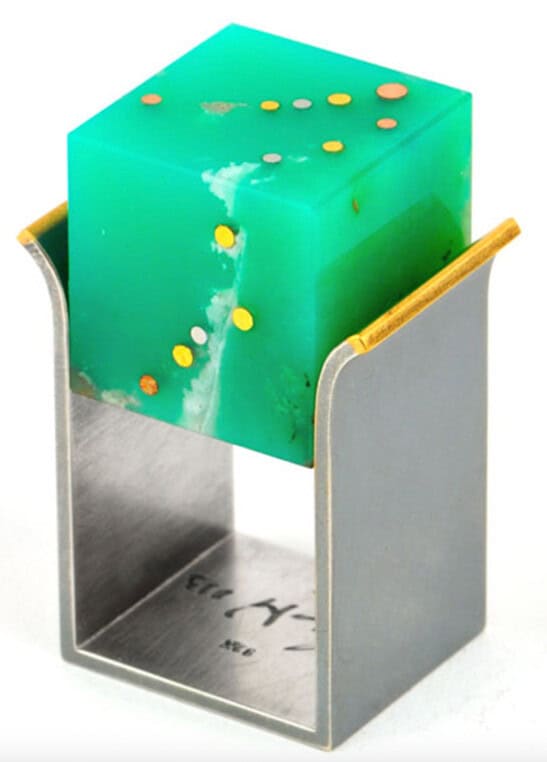
chrysoprase modernist ring sculpture by Helfried Kodré


