Latex tops, pretty boys shielded by baseball caps and a couple of hundred condoms. You’d think I was having quite the jolly in some gay club’s darkroom – I’ll save those naughty details for another time. What I’m actually describing is the graduate collection of Ennis Finnerty Mackay, whose savvy tailoring and technical prowess (more on the johnnies later) made him a standout at this year’s Central Saint Martins MA show.

For his graduate collection, Ennis Finnerty Mackay looked to how addiction can be hereditary
Mackay and fellow student Maxina Brewer were awarded the L’Oréal Professionnel Creative prize at the annual show, chosen by 10’s very own Sophia Neophitou-Apostolou. The pair are in great company, joining a prestigious lineage of designers who picked up the same gong upon finishing their own studies, including Grace Wales Bonner, Mary Katrantzou, Stefan Cooke and Richard Quinn. “It was quite surprising. I had complete goggles on and was just focusing on getting the clothes finished and the models down the catwalk,” says Mackay of his win. “It was an amazing moment to celebrate and reflect. The MA was something I wanted to do for myself, more than for career goals. I feel like I had a lot of creative growth in my storytelling, and the fact that it resonated with other people was the icing on the cake.”
It’s nearing the end of the working day one Friday in April when Mackay calls me from Schiaparelli’s HQ in Paris. The faint sounds of workstations being packed away, and plans being made for a quick glass of vino en route home, can be heard in the background. Barely a few weeks after finishing university, Mackay has relocated to Paris to undertake a six-month internship at the maison’s couture atelier at 21 Place Vendôme, working under creative director Daniel Roseberry.
The team have been chipping away at what will become Schiaparelli’s couture AW26 collection, which was unveiled in July. A week in, he is yet to find his go-to spot in the city but has been enjoying the late-night café culture. A young Mackay wouldn’t ever have pictured himself landing at a couture house. Matter of fact, he wasn’t remotely into fashion growing up – running to the corner shop to grab the latest issue of Vogue each month he was not. To this day he hates shopping: “I still wear the same clothes that I’ve had for God knows how many years.” He’s not bothered about which celebs are wearing what, to where, either.
However, you could say he was always destined to do something artsy. “I come from a very creative family, all dyslexic, none of us can read or write well,” he says. His father is an architect and raised the family in a flat inside a high-rise at the Barbican, where his studio also was. His mother, who passed away when Mackay was 18, was a knitwear consultant-slash-designer. His older sister is a graphic designer, his stepmum an interior designer and his aunty used to work in the art world. “We’ve all been able to find our own little creative pockets without stepping on each other’s toes,” he says.
Mackay didn’t enjoy school, finding the lessons generally difficult due to his dyslexia, but remembered looking forward to art class each week. He signed up to do an art foundation at Kingston University, originally thinking he would go into product design. “I quickly found that fashion was a bit more of a happy medium for me,” he says. “You have your technical aspects, but you also have quite a lot of storytelling, which I struggled with when it came to products.” He stayed on to do his BA in Fashion Design, but his learning was partially stifled due to Covid, with restrictions only fully lifted once he got into his final year.
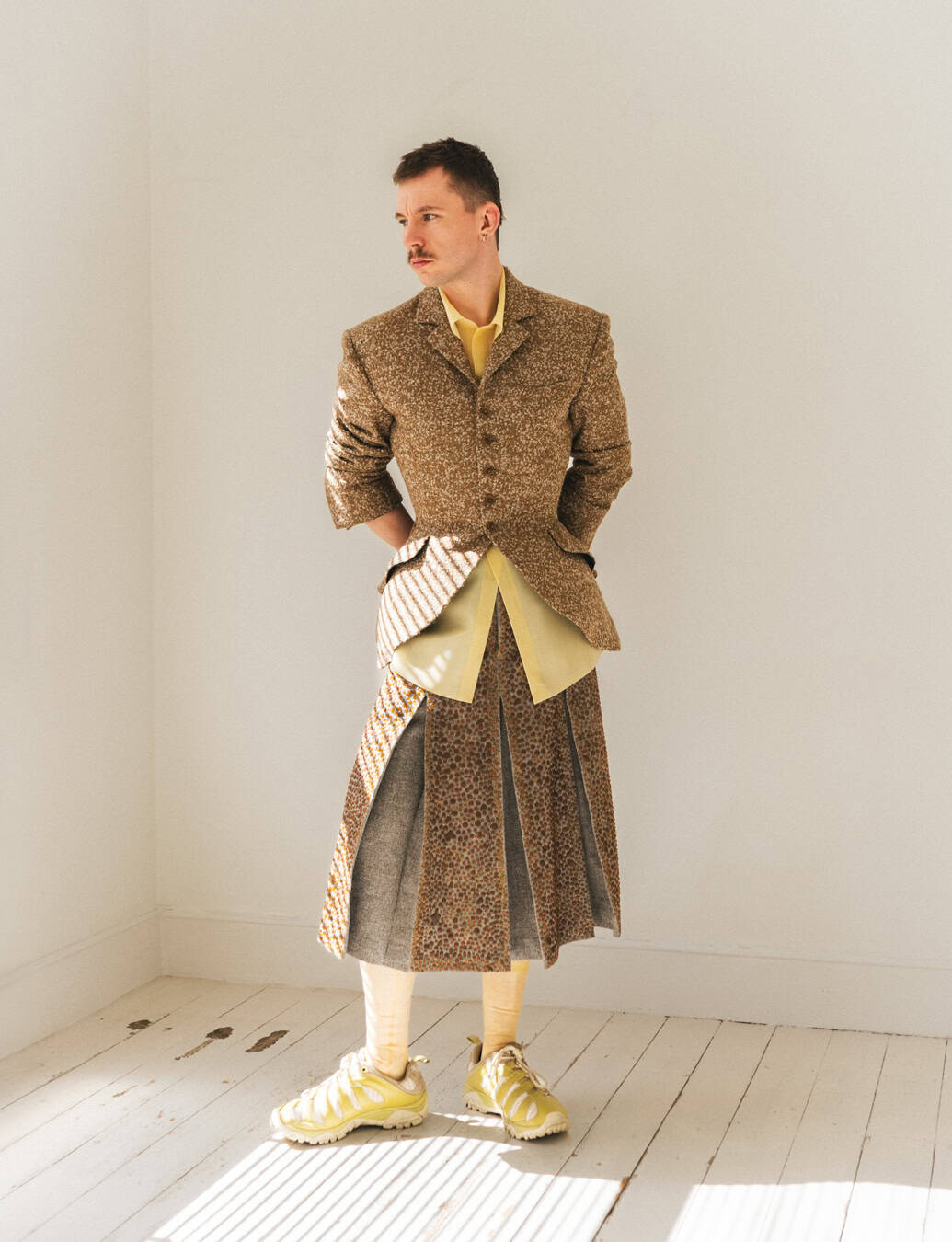
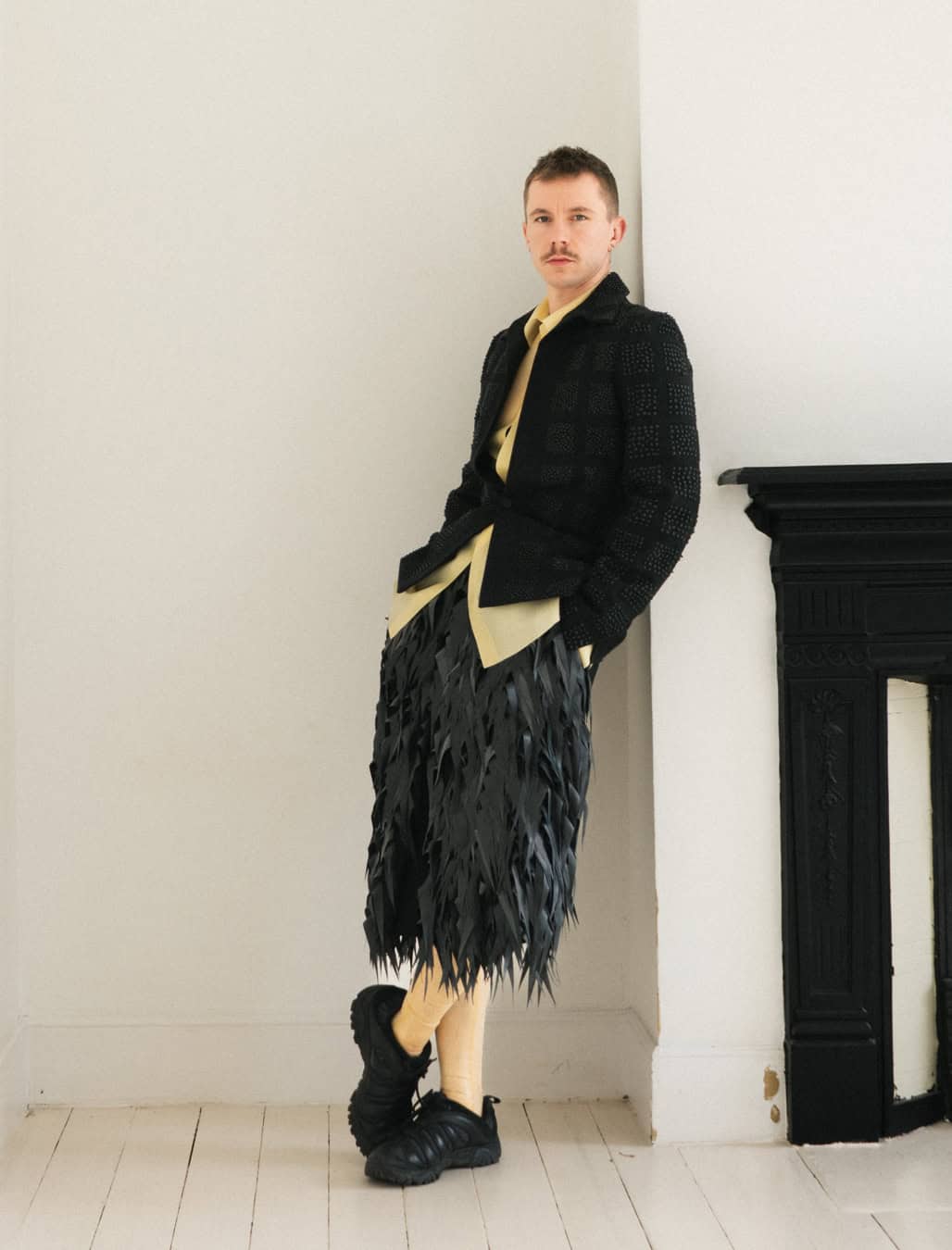
From left: Mackay cleverly pipes liquid latex onto woollen tailoring sets to create an almost reptilian print that gradually turns a honey bronze after solidifying, In exploring latex as a euphoric fabric, he mixes it unconventionally with more formal pieces
The pandemic didn’t stop him from getting stuck in, though. In 2021, he secured a place on Harris Reed’s team working on the designer’s first collection out of Central Saint Martins. He remembers cutting up fabric and sewing looks together, sat on the floor of a suite inside The Standard, which was loaned to Reed while the hotel in King’s Cross was mostly empty. The following January would see him temporarily move to Paris, where he interned as part of Ludovic de Saint Sernin’s design team. “It was a lovely experience, very atelier-based and very hands-on,” he says. He returned to the brand intermittently to help out throughout the rest of his time at uni.
His most formative experience, however, came far away from the catwalks of Paris, when he became submerged in London’s kinky underbelly. In between placements, Mackay would help out at his family friend Tish Weinman’s fetish company, earning a bit of extra cash sewing leather outfits. As well as specialising in bespoke rubber and leather garments, Weinman is a drag artist called Letitia Delish and a self-titled “kink educator”. “I’ve always thought London had a bit of a scene, especially being a gay man, but I never really found it,” says Mackay. “Working (for Tish), everyone on the team was part of nightlife and were very kind and sort of adopted me.” The troupe would bring a wide-eyed Mackay to goth nights like the queer-led Inferno in East London, as well as kink-specific nights at the Electrowerkz club in Angel. “It was really fun for me, we got to dress up, and we looked like absolute children in these venues,” he says. “To this day, I am best friends with all of them.”
What was fascinating to Mackay was getting to meet people who have such a specific connection with clothing, “which I really don’t think we get anywhere else”, he says. “In the kink scene, what you wear is important to who you are as a person. There are rules to how you interact with others through clothing and that’s quite interesting.” While he’s not submerged himself into the fetish world fully, latex became a central component to his MA collection – he used it to craft shirts worn beneath structured blazers nipped in at the waist. He also cleverly piped liquid latex onto woollen tailoring sets to create an almost reptilian print that gradually turned a honey bronze after solidifying.
Dipping his toe into the fetish world has also pushed Mackay to think in-depth about how our bodies touch and connect to our clothing. His BA collection, made in 2023, drew on how, physically, our skin is almost always in contact with some sort of fabric. “When you’re born, you’re put in a towel; when you pass away, you’re buried in clothes. Like even when you go to bed, your skin is touching fabric,” says Mackay. He began to warp how clothes are anchored to the body: skirts that snaked down the leg, jackets that accentuated the form. One pair of trousers, which sensually revealed slivers of the pelvis, could be completely dropped to below the knee while still joined to the form with a fastening that resembled an anal hook sex toy. Kinky indeed.
This exploration of the body came at a moment when Mackay felt most disconnected from his own. Halfway through the final year of his degree course, he ended up getting a bad stomach virus which triggered a rare reaction that gave his body arthritis, leaving him semi-paralysed and bed-bound for three months. Recovering slowly but surely, he applied for the Master’s course at Central Saint Martins but was rejected. In the interim, he had a short stint as a pattern cutter at McQueen, working on Sarah Burton’s final collection as creative director, before returning to Paris once more for an internship at Mugler.
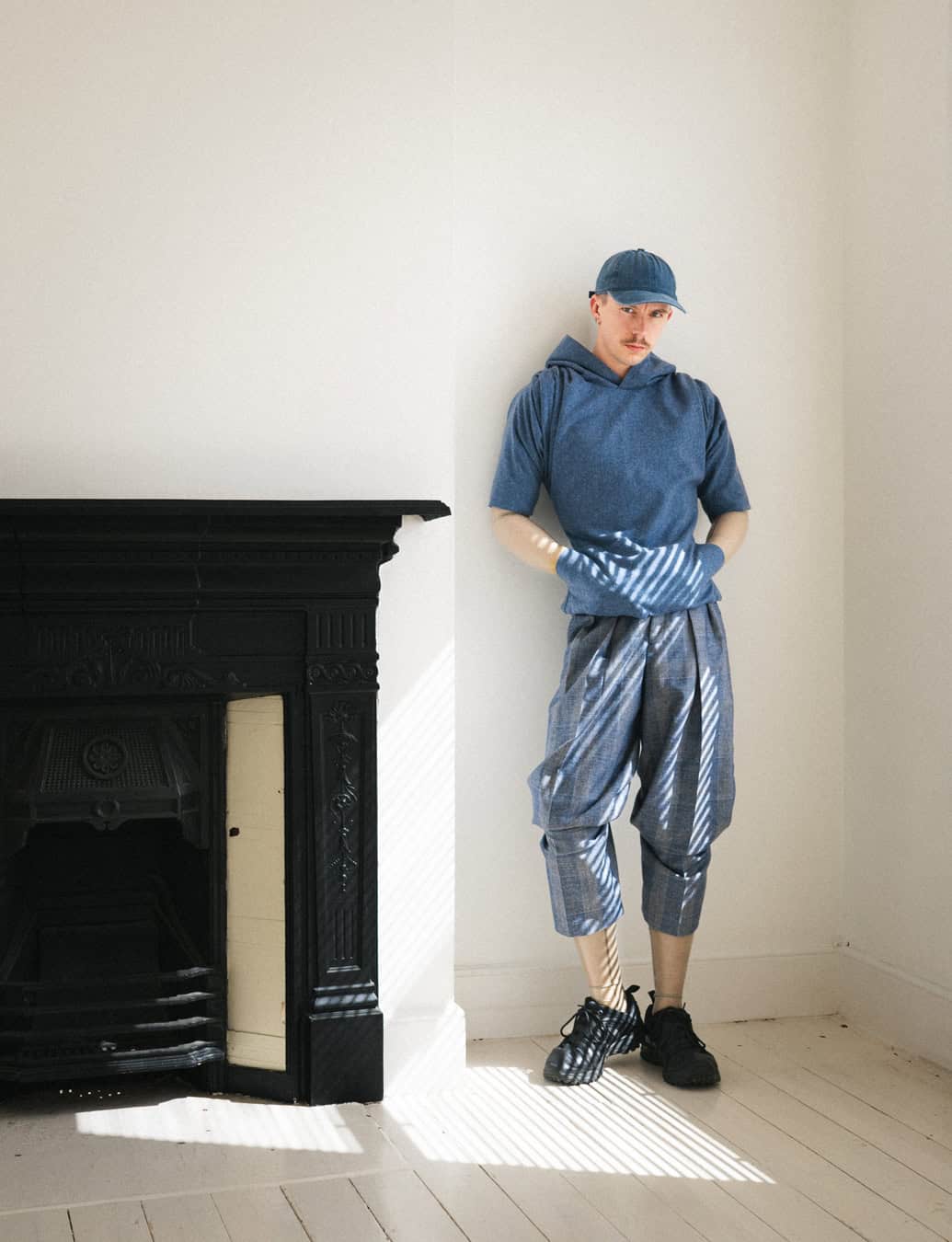
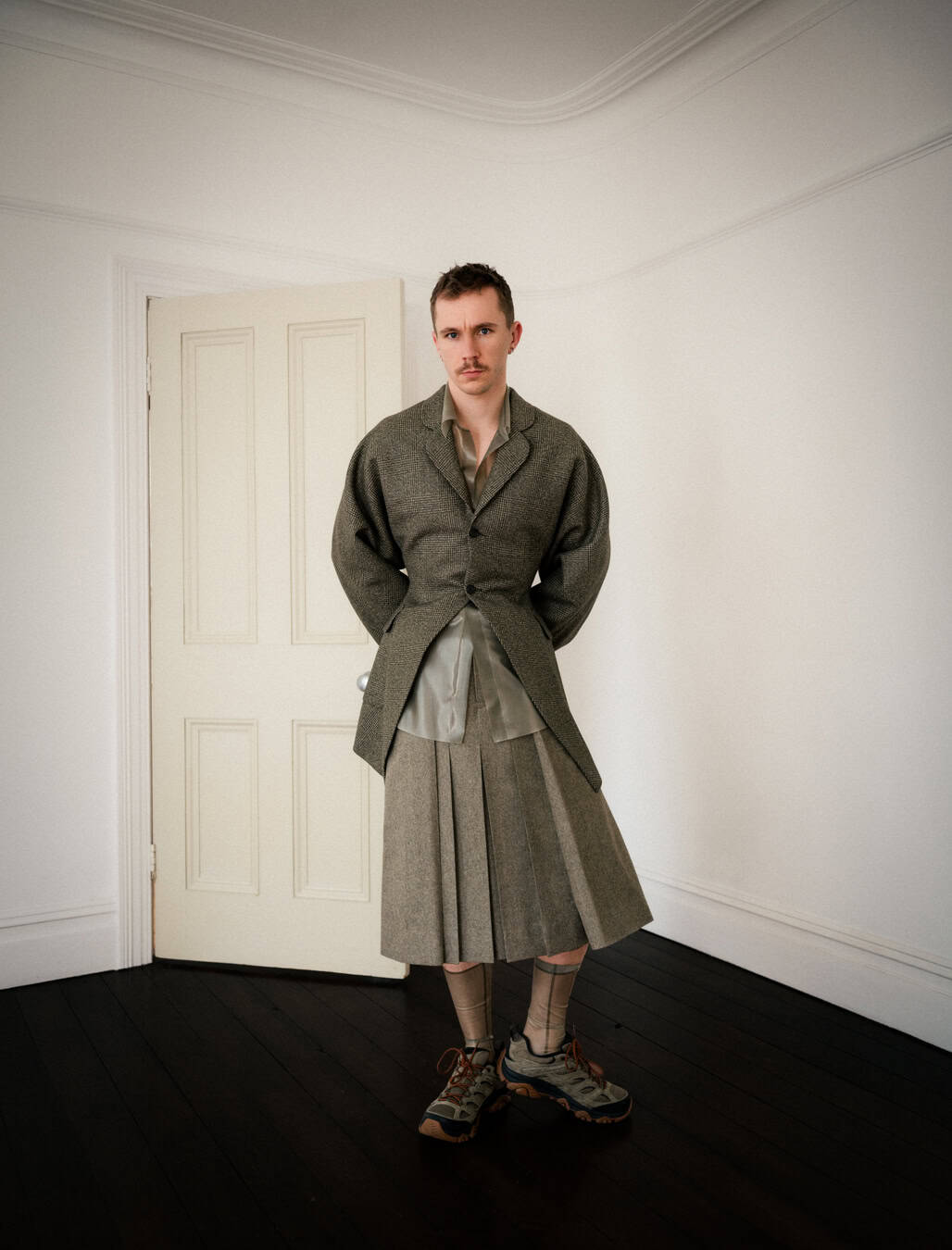
From left: Giving the appearance of denim, this look is actually made of wool, Pleated shorts are paired with a nipped-in suit jacket cut with kimono-style sleeves
Getting into CSM on his second try, he used the course as a creative outlet to address his mother’s passing, which was due to alcohol abuse. “At first, I tackled it quite directly, but then I came to the conclusion that it was too autobiographical,” he says. He began to focus on how addiction can be hereditary: “Like clothes are passed down, not only do we wear what our parents wore, but do we have similar interactions or the same sensibility about life that they did?” He raided his family’s wardrobes, dressing up in his mum’s old clothes, as well as those belonging to his dad and his grandparents. “That’s how the silhouettes, volumes and drapes came about,” says Mackay, who riffed a shirt on one owned by his dad in the ’80s and based a shrunken tailored jacket on how one of his grandmother’s from the ’50s fitted his frame. “She was so tiny that I had to corset myself to get into the clothes,” he says.
A big focus of Mackay’s research was addiction in the LGBTQ+ community, where adults are up to twice as likely to develop substance use disorders compared with straight people. He broke down his research into four stages of an addiction cycle: control, euphoria, hysteria and melancholy. In exploring latex as a euphoric fabric, mixing it unconventionally into tailoring practices, he turned his attention to condoms. “Nowadays at majority gay male events, condoms are handed out as a reaction to the Aids crisis,” he says. “But because of DoxyPEP and PrEP [STD prevention medication], they’ve become completely disregarded.”
Mackay reached out to event organisers to retrieve condoms that had been thrown in the bin, then contacted sexual health charities, which donated condoms that had expired. He would wash each one by hand to remove the lube, then put them on racks to air dry before covering them in talcum powder so they didn’t stick and, instead, became silky. He would use around 500 of them to create fringing across a skirt that moved like an elegant chiffon. “At the time I was living with my dad, who ended up complaining a few times because the kitchen was just being covered in condoms drying everywhere,” he says with a laugh.
“Condoms used to represent care in our community,” he continues. In using them in his collection, he was trying to “restore their value, in one way or another”. His approach to design is equal parts sophisticated and innovative, and puts him beyond his years. But he says he doesn’t think he’s “in the headspace or financially able to start my own brand. There’s definitely so much still out there for me to experience. Right now, I’m focusing on trying to get into a haute couture house, paying my dues and learning from being a small cog in a big machine.” It’s only a matter of time before Mackay’s career in design suddenly accelerates. Watch him burn rubber.
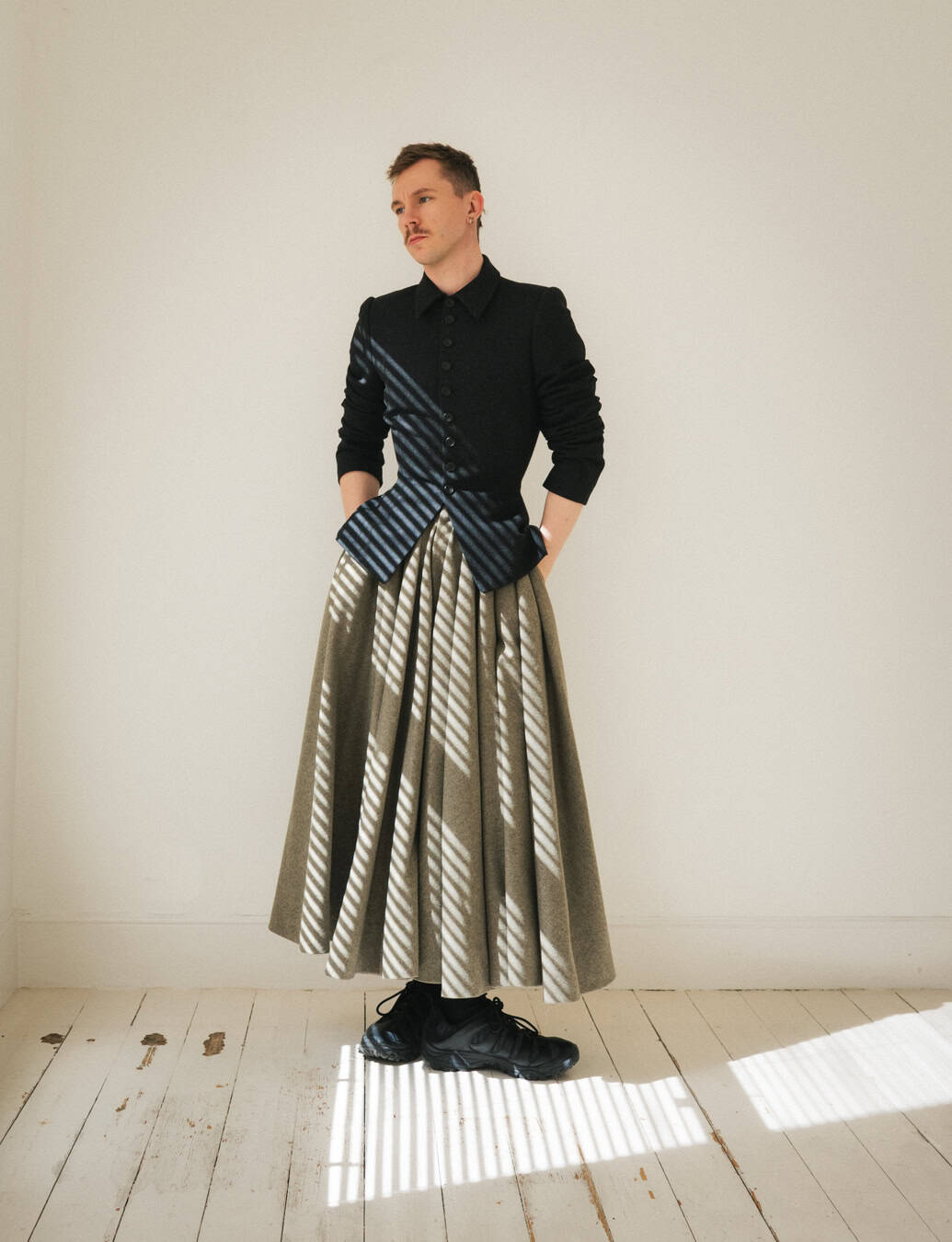
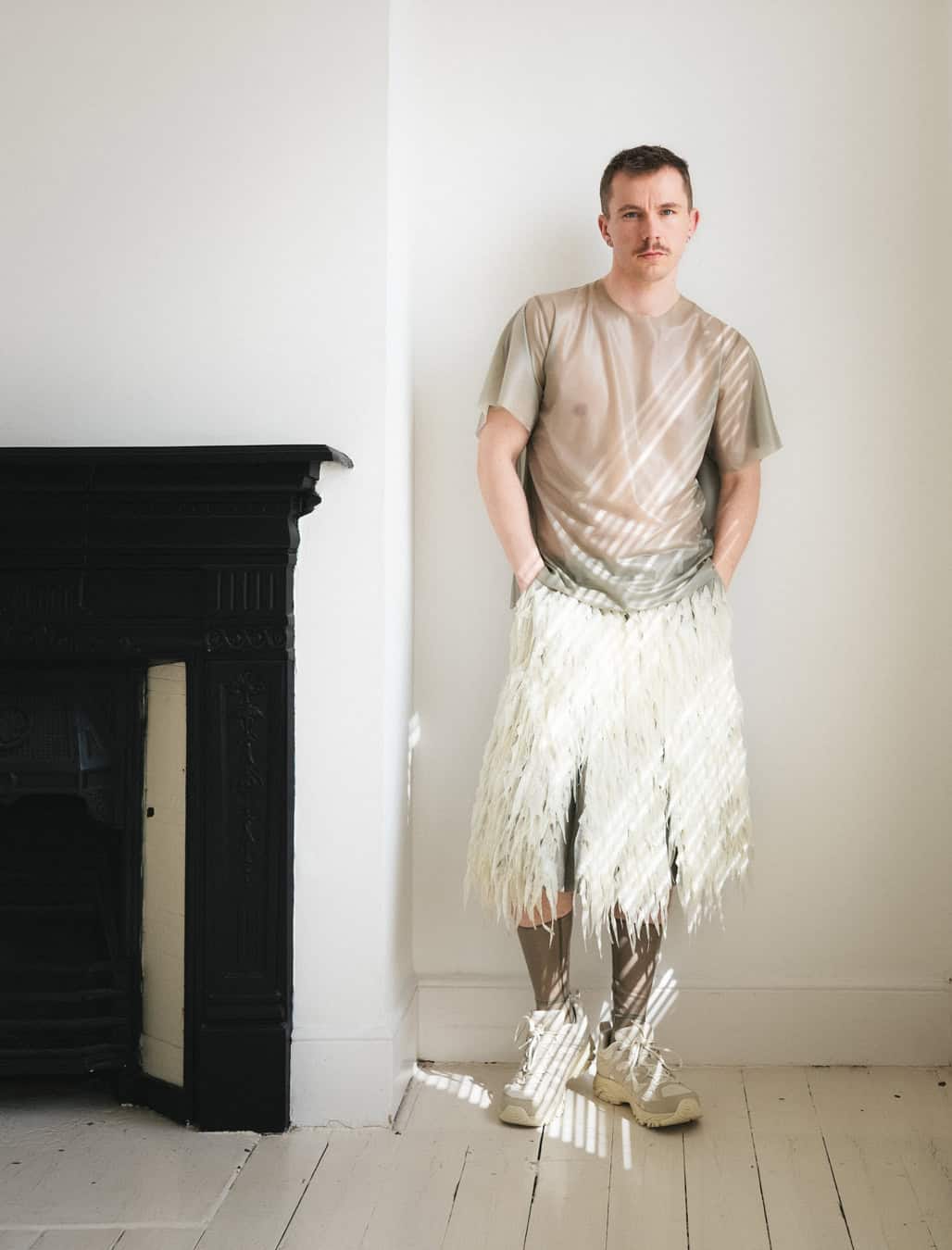
From left: Mackay raided his family’s wardrobes to inform his silhouettes; the shrunken jacket here is inspired by one of his grandma’s from the 50’s, Pleated shorts are paired with a nipped-in suit jacket cut with kimono-style sleeves; Giving the appearance of denim, this look is actually made of wool.
Photographer and Talent ENNIS FINNERTY MACKAY
Text PAUL TONER
Issue 77 of 10 Magazine – FUTURE, LEGACY, HERITAGE – is on newsstands now. Order your copy here.