


January 3, 2026 |
Actress, antiques dealer, wife, mother, grandmother, charity organiser, Doctor Who and Hammer horror icon, true style original and collector, socialite and interior designer with a life in Ibiza/London/Paris/Los Angeles, and anything else you care to mention. Virginia Bates, 82, has sold original Vionnet dresses to John Galliano and installed Naomi Campbell’s dressing room at the V&A in London.
There’s only one difficulty in talking to a multifaceted globetrotter: sticking to the subject at hand. As we swerved through a series of questions and topics the picture became clear. Virginia’s life has never been mundane or one-dimensional, and our conversation revealed the energy that multiple reinventions demand.
Do you think of your life as glamorous or ‘just a life’?
I think of it as an extraordinary life. I don’t think of it as glamorous. I think how lucky I am that I can walk around in my gym suit or a pair of old espadrilles and do the garden. I’m always dragging bits of furniture around and still scratching around flea markets. I can’t help it, it’s in my DNA. If I pass a skip, I must look in it. I cannot help it. But then I can wave a magic wand – I call it going into hair and make-up – and do a number and put on a wonderful gown, a sequin-beaded coat, lamé jacket and then get on the 94 bus and go off somewhere. I think it’s hysterical, it’s funny.
You’ve been in A Clockwork Orange, Hammer films like Dr Jekyll and Sister Hyde and you battled the Daleks in the second ever episode of Doctor Who. With all the things that you’ve done becoming cult, you’re famous now with a lot of fans…
It’s extraordinary. Back in the day your agent would call up and say, “I’ve got a booking for you, I don’t know whether you want to do it.” It means you’re going away to Cornwall for three weeks and it is a good crowd doing it, so why not? The money’s okay or the money’s not great, and you’d look at the script and think, oh my God, this is absolutely appalling, but no one will ever see it. We’d all go off and do it and have the most wonderful time, the best fun, and afterwards forget about it. Then I’d go off to [do a play at] the Royal Court. And then do [the BBC anthology series] Play for Today on TV, some pretty good serious stuff. Or go out on tour, wonderful. Today, nobody gives a shit about any of that. I am only known for Clockwork Orange, and my tits in Clockwork Orange, Hammer horror and various other horror films, and Doctor Who. They know a bit more now because of Instagram, where of course I’m Virginia Bates, but in my acting world I’m Virginia Wetherell. I have to remember when I’m signing, “Who am I today?”
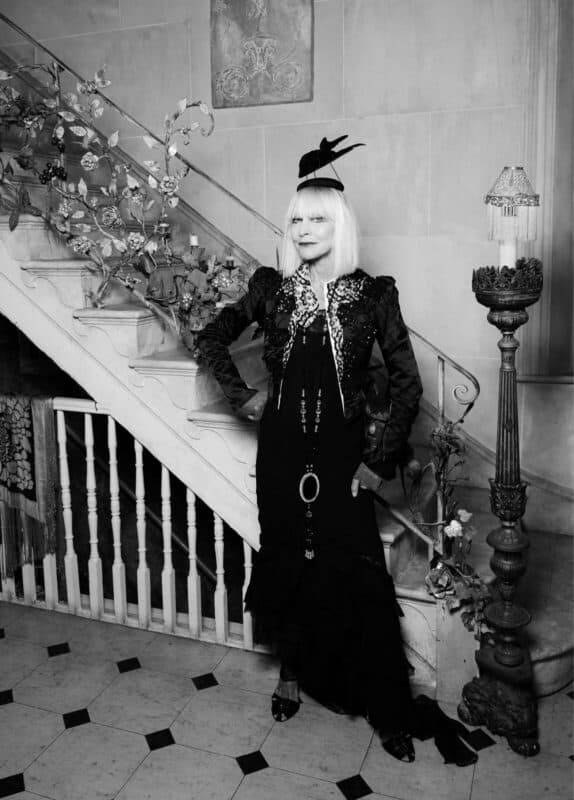
Virginia wears vintage Victorian mourning jacket, 1930s dress, art deco diamanté and jet necklace, and vintage hat by Stephen Jones – Hawk from the Carte Blanche collection, SS14
Virginia, the fabled store, was an experience, not a boutique or a shop. It was more of a mise-en-scène one entered where you might rub shoulders with Barbra Streisand, Helena Christensen or a museum curator. How did that happen?
I was living in the most amazing flat in Holland Park [west London] and in those days it was really a no-go area. I remember my mother saying to me, “Oh darling, it’s such a shame you’re living on the wrong side of the park.” And it was. A friend knew about this empty shop that had just been sold and we were all rather riveted as to what was going to happen. Anyway, this guy came in who I had worked with on adverts and he said, “Oh, I’m living across the road, come over and have a coffee?” He said there was a lady opening an antique shop who was about to have a baby and wanted just to rent it for two weeks, then asked me if I knew anybody? I said, “What’s the rent?” And he said, “Twenty quid a week.” I said, “Well, I’ll take it, I’ll do two weeks.” My parents had just sold their house in Hampstead because, weirdly, they’d just bought a place in Ibiza, which is now my second home. Of course I had all this junk in their garage and thought I must be able to make 40 quid in two weeks, so I took it. That was 1971, and I stayed for 43 years. My shop hours were two in the afternoon until 10.30 at night. I had the mornings to go to auditions and, of course, I got a job straight away, on Demons of the Mind, a Hammer horror film.
How did your childhood and upbringing influence you?
Don’t forget I’m a war baby [born in 1943]. In the beginning, after the war, my mother was the first woman make-up artist to be employed in the UK. So, I was brought up in a total fantasy world at Pinewood Studios. While she was on set, I’d be running up and down the make-up department and then falling in love with Maggie in the wardrobe department. Something obviously got into my little brain and I thought, this is a life for me. Can you imagine? All those frocks and period costumes and going on set. Then my mother remarried, or in fact didn’t… Whatever, we moved to Mauritius, which nobody had heard of. A dot in the Indian Ocean. God knows how many flights it took to get there. I mean, it was a day and a half to get to Mauritius. I was a wild child living in the tropics, a little tomboy person in a pair of shorts and a little cotton top. We went from my mother cycling every day to Pinewood Studios and me hanging on the back lot to 11 servants, gardeners, a sewing girl and maids. I was taken to school, which was actually a wendy house in somebody’s garden, and they brought over this wonderful old French governess from Paris who taught the children. That was my schooling.
Then I was sent to this incredibly strict boarding school in Buckinghamshire, which I loathed, and was so unhappy. There was no communication, of course, no phone. I’d get a few letters and then nothing for three months. I tried to run away with my friend Melanie and got as far as Great Missenden station, where I was arrested by the police.
How old were you when you went to drama school?
Inevitably, I was going to go into the acting game because I had been brought up with it, seen it and worked and mixed with it. I was 17 at drama school, which was full of the most precocious boys and girls.
Was your mother a collector? Was the home full of stuff?
Not at all. My observation of stuff, I guess, came from watching period films being made and seeing props. I met a fabulous guy who showed me that there was something amazing about buying or finding an old gothic chair, which had never occurred to me before. My mum had sensible things because, after London, they moved to Paris, then Rome. By then I had my own place just off Portobello Road.

Virginia wears vintage Victorian mourning jacket, 1930s dress, art deco diamanté and jet necklace, Biba leggings, Gucci shoes by Tom Ford from Vestiaire Collective
Tell us about your style choices.
My thing is that I can make a piece of junk look amazing. It was same with clothes. I couldn’t afford nice, sensible clothes like my mother or her friends or even my friends wore. I could see the advantage of wearing a little ’40s crepe dress that I could find for literally shillings in those days. I found Victorian petticoats for a few pence and I would wear those teamed up with a cami top. Or I’d go to Horne Brothers, which was a gentleman’s outfitters in Leicester Square. I would buy vests with the three buttons and dye them shocking pink and apple green. That was just typical of my generation, the ’60s girls and boys.
How does your wardrobe change now between London and Ibiza?
There wouldn’t be any point at all taking my antique, gorgeous pieces to Ibiza. They would get wrecked, as it’s a very different life. I am the hippie in Ibiza. I wear cotton sarongs and floaty stuff. It doesn’t work the other way around. I’m playing a part and not in a million years would I walk into Claridge’s like that.
Before social media, what put Virginia, the shop, on the map?
Word of mouth. Stylists would come in and the store was a destination for quite high-profile celebs and magazines. It was near to the BBC [Television Centre in White City], so there’d be costume people around and they would say to me, “Can you find me a Victorian jacket?” and so on. A stylist would come in and go, “Oh my God, I’m doing a shoot with so and so, can I borrow that chiffon dress?” And then a model would wear it on a shoot. I think that’s when my big breakthrough came – word of mouth started and then designers came too. Before all that, the furniture and plumbing became my speciality, because it was so easy to get the stuff as nobody else was doing it. I would go around on my bicycle looking for wonderful big Regency or Victorian houses that were being gutted. I’d see the workmen burning all the stuff and say, “Wait, wait! If I come back tomorrow with a lorry, can I take the bath? And can I have that fireplace? And what about those tiles? Oh, and the railings?” Then I would hire a lorry, load up and buy the guys a drink.
Your husband was the late actor Ralph Bates. His French ancestry, dark good looks, swagger and brillance when wearing period costumes on screen, from Poldark to Lust for a Vampire, and stage made him famous tell us a bit more about him…
In 1971, [the same] year I started the shop, I met Ralph on the film set of Dr Jekyll and Sister Hyde. Two years later we were married. When Ralph was diagnosed with pancreatic cancer in 1990, he had been ill for a while and was performing in the West End. He eventually asked to have a couple of weeks off and had already been up and down Marley Street and they’d not diagnosed it. Finally, when it was diagnosed, and the whole thing was obviously dreadful, they told me that he had only six weeks to live. I couldn’t understand why this hadn’t been diagnosed earlier on when he’d seen top specialists and had all these tests. The day after Ralph died [in 1991, aged only 51], I called Dr John Glees, his oncologist, a wonderful, wonderful man. I went to meet him at the hospital and said, “I just need to understand what went wrong. Could he have been saved?” I knew nothing about pancreatic cancer, nobody did back then. So I started the Ralph Bates Pancreatic Cancer Research Fund. Two years later we put on a Sunday show at the Palladium called Dear Ralph on Valentine’s Day. It was phenomenal. All the people that knew him participated – we sold it out and it also gave me an excuse to of a lot of PR. I was on Good Morning Britain, Pebble Mill, you name it. I had no idea producing something was so hard, as we had to find advertisers and programme people. Anyway, we’re still doing [the fund] and it’s very hard, fundraising, especially now because nobody’s got any surplus money. But we have a laboratory at St George’s Hospital in Tooting, south London. We’ve got three people that we employ and a PhD student. It’s incredible.
You have a wonderful family – please share.
Daisy is an actress and producer. She has two stunning sons, whom I obviously adore. My son Will, is in LA and he’s a composer. His production company is called Fall on Your Sword. He is up to his eyes, off to New York tomorrow for a premier of The Better Sister, which is on Amazon Prime. He doesn’t stop and has his own studio. His wife Sarah Bereza, has written and produced a horror film and, of course, I admit it, Im playing a vampire in it. It’s called Forever Sucks. Once an actress, always an actress.
What is your secret to all this energy?
I’ve always lived on the edge. It’s like being on the edge of fire and it’s great. I like having a project, even if it’s a bad project or, you know, it’s the gas bill this week and then the school fees next. It’s annoying, but it’s what motivates me. If I had tons of money and an easy life, I’d be lying in the garden instead of digging the garden.
Photography by Darren Gerrish. Taken from 10+ Issue 8 – FUTURE, JUBILEE, CELEBRATION – out now. Order your copy here.


