


December 9, 2025 |
When Roland Mouret, beams onto my screen he is video-calling in from his art studio in Farringdon, central London. A little late, he apologises profusely. A warm and fuzzy presence, he’s wearing a paint-splattered jacket and sporting a trimmed beard. He’s, well, not what I expected.
When I researched Mouret, the findings conjured someone who had spent a career nipping and tucking women into expertly tailored dresses, named things like Galaxy and Titanium, that flattered and distorted. He designs clothes that are meant to be slowly and seductively unzipped.
His interest in textiles was sparked, rather surprisingly, by watching his butcher father fold his bloody apron after a day’s work. Usually I go into an interview with a plan, a list of questions and a desired outcome, but this was a bit of a leap of faith. We weren’t here to talk about Mouret’s fashion career, we were going to talk about his artwork, which is an unknown entity – I am the first person, aside from friends, he has spoken to about this new line of work.
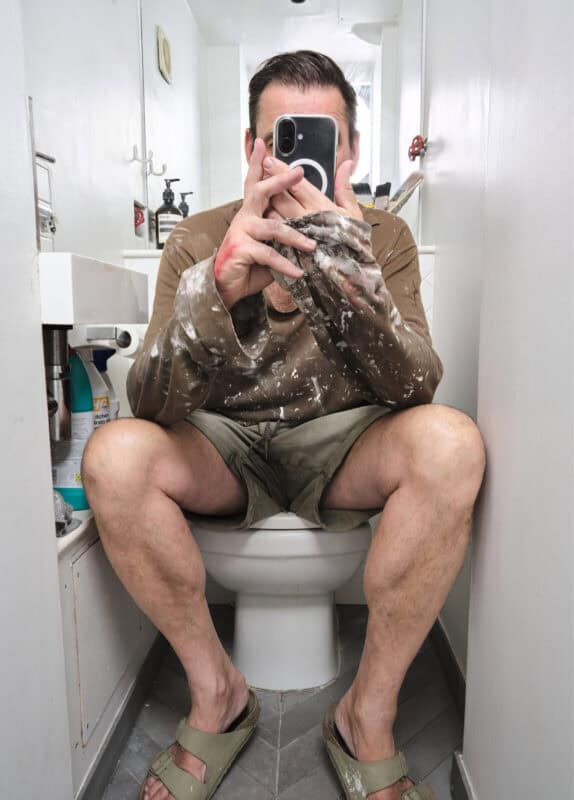
Roland Mouret in the lavatory of his North London art studio; the next chapter in his long creative career is as a painter
Mouret was late because he had, figuratively, lost himself in painting. How incredible, I thought, to find something you become so wholly engrossed in that you forget where you are, who you are, the time, the day and where you’re meant to be. The tone of our conversation is immediately open and has a rawness known to people who have been through something. With Mouret’s company going into administration and his marriage breaking down over the past couple of years, he began to paint. Why did he start, I ask? “One day I was very depressed at home. I woke up with anxiety. I have a tendency to pick things up in the street, things people throw away. That day I picked up some sort of art board and started painting it white. I had just moved to my new place and I’d started to paint white on white. To me it symbolised rebirth and it gave me a moment of, I won’t say revelation, but perhaps something similar, and from that day on I realised I needed to paint.”
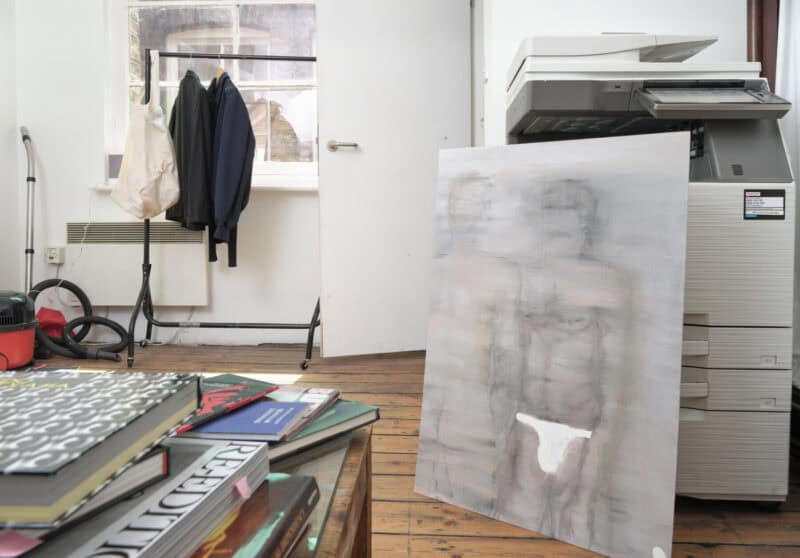
The work he has been making is painted feverishly, the colours blending together softly, caressing each other, with water drips adding movement and emotion. The men featured express codes and tell tales about gay life, representing different parts of Mouret himself and the world of his imagination.
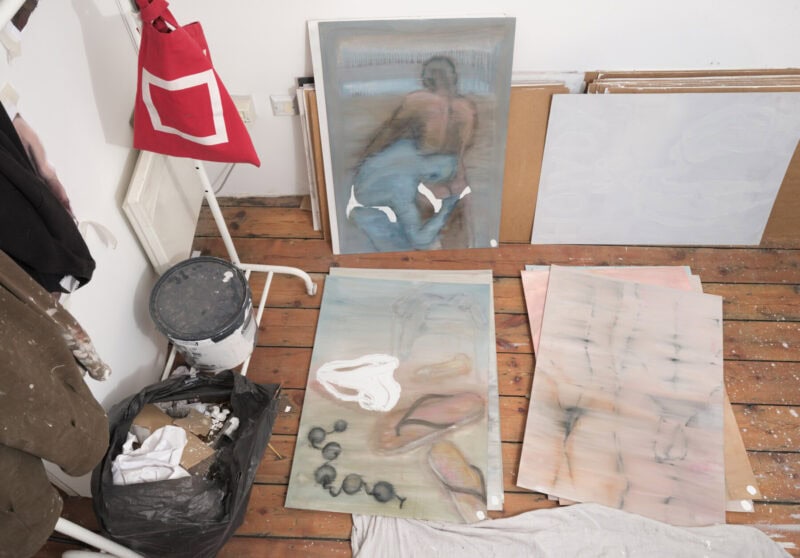
Mouret’s paintings explore codes and tell tales about gay life
In one work, two men tussle on a beach and you can’t tell where one body ends and the other begins. In another, you see the imprints of the bodies left behind in hastily removed socks and the accoutrements of everyday modern life – you can feel the heat of the moment radiating from the surface. “It’s frightening in a way because I never know what is going to define the ending,” he tells me. “I want to involve myself, I start with myself. The work is a bit figurative, of characters interacting in intimacy, of private moments.” To him it’s about an emotional journey he takes with his sexuality and internal approach. He adds, “I approach all kinds of masculinity, even femininity, in the paintings.” The process has been fast and involved, and over time he has seen a move towards slowing down. He likens the outcome to making a bridge to himself and does the paintings to explore what touches him. He spends three intense hours a day in his studio, creating whatever comes up in the moment.
Margaret Naumburg, who is known as the mother of art therapy, once said, “I could say things with colour and shape that I couldn’t say any other way – things I had no words for.” In her work she pioneered the release of spontaneous imagery that, she believed, acted as a way to connect with the unconscious mind. It strikes me that may be what Mouret is doing, connecting with a deeper part of himself – one that doesn’t have words and can’t be explained. But something that seems to have shifted is that it isn’t about external validation. After spending his life in fashion, where validation is sought and milestones have to be met, this work signals a new universe of possibilities for him, something that is all his. For the first time, he doesn’t care what we think.
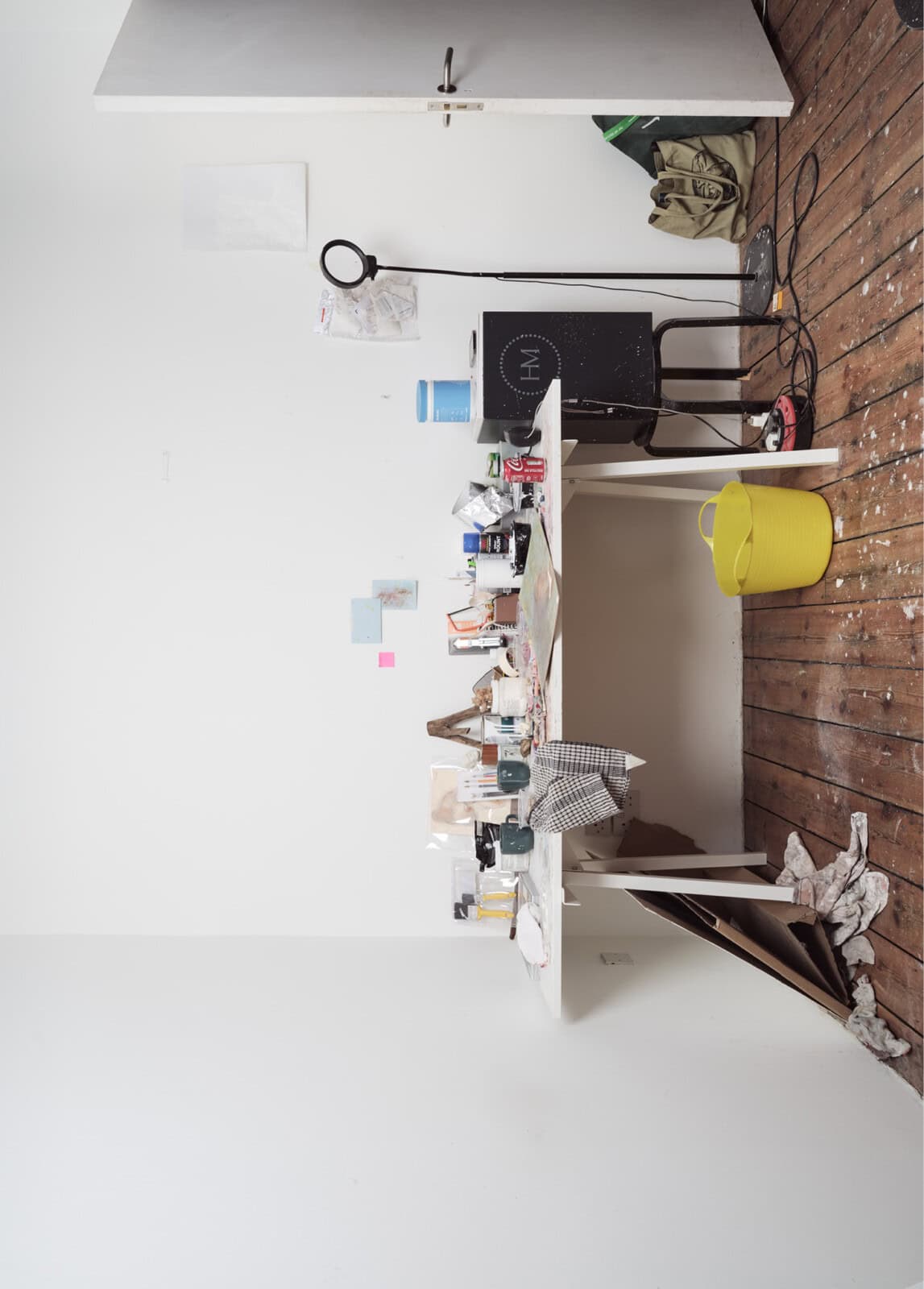

After finding an artist’s board left on the street, he began to paint white on white; “To me it symbolised rebirth… From that day I realised I needed to paint,” he says
Yet this move to painting has had a sizable impact on his life. Although he perhaps wasn’t consciously seeking it at first, he tells me that since he started painting a year ago he hasn’t had sex. Before he began this journey he was looking for something in someone else, and hooking up with them was often done in the hope of connecting with himself. This process of creating art has meant he can pay attention to his internal self in a different way, a new way. He explains, “In those moments of loneliness or searching for something we are all selfish, we all have a selfish way of loving. When I paint I am essentially achieving a connection in painting – I’m touching someone I don’t know, but it’s something I knew in my head. That’s what changed. And I’m surprised because it was with no expectations at all.”
He speaks about his work peeling and changing over time. This is not the art of perfectionism. The board gets wet as he layers on the brushstrokes of paint, as it curls and augments to his will. He talks about the blood – he is the son of a butcher after all – coursing through the veins of his subjects. This is important, as he paints flesh with attention and interest. In some works the skin is burnt after a day of being caressed by the sun, while in others the skin is pale and translucent. There is a viscerality to the outcome – the figures are beating and pulsing as if they are alive. Mouret has spent his career designing for women and worked to reflect the ways they wanted to be seen in his designs. Now he is predominantly painting men, but to him gender has become unimportant in this work, as he doesn’t see it in a binary way. In one image a trans man lies back, naked, next to another body.
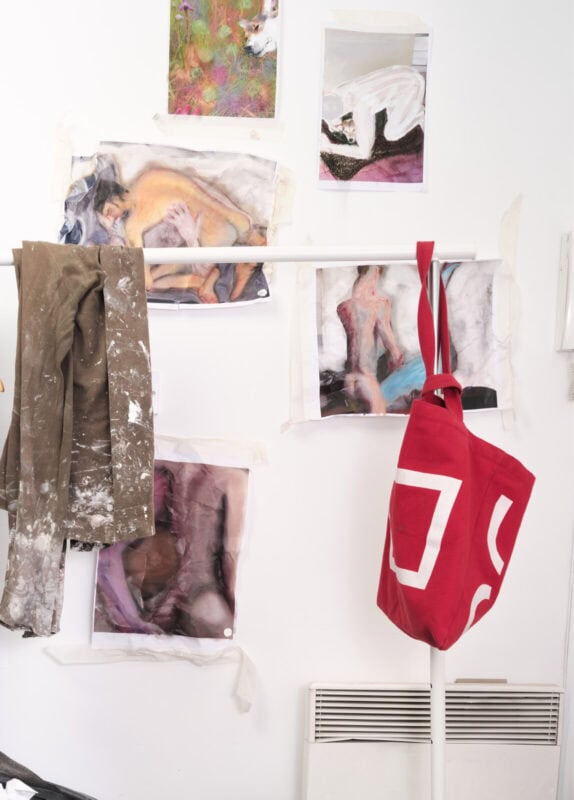
He paints flesh with attention and interest; in some works the skin is burnt after a day of being caressed by the sun, while in another it’s pale and translucent
Painting in and on white evokes a symbolism of rebirth and in his recent works there has been a recurring theme of a stark, block white. Men’s underpants stand out, joltingly, among softer, watery blues, greys and greens. To me it seems as if there is something to say about this, but I wouldn’t want to guess. I feel tentative about tying it all up with a neat bow, because it seems to me to be deeper than that and still forming. Art pieces are so often about how the artist’s experience connects with the viewer. Mouret’s work, still unseen in that respect, is an unknown quantity. How will people make sense of it? That is not a concern he shares. He is making this work for him, not anyone else. But he does tell me that white is very important to him and his references are rooted in nods to masculinity, in pants, socks and hats. He talks more about his references: he pulls influences from the 1940s, from a book of illustrations, from summers spent in the South of France.
“It’s a sense of freedom,” says Mouret of his transition from fashion to painting. “I understand peace in my dualities. I understand what I need to do again, as that’s another kind of room when I don’t know what’s going to happen. I’m simply accepting the experience of it”
I come away from the conversation with such a sense of inspiration and enthusiasm. To make work that is solely for you is no small feat, and in turn that work can give you something of yourself. It can teach you something about a disowned or dislodged part of yourself that has been there all along. Mouret tells me, “It’s a sense of freedom. I understand peace in my dualities. I understand what I need to do again, as that’s another kind of room when I don’t know what’s going to happen. Where I have no problem sitting in it and going through the experience – I’m simply accepting the experience of it.” This is somewhat of a holy grail in an industry like fashion where the fear is you can lose yourself to other people’s opinions of not only your work, but of yourself. It makes me think about a wave of famed designers who are finding new avenues through making artwork. We end by talking about Luella Bartley and Christopher Kane, who have both turned to painting and sculpture in recent years. There is a sense of camaraderie and excitement that fizzes up when Mouret talks about their work and how great he thinks it is. It is as if they are all at art school, where the work is full of hope and meaning.
Photography by Vianney Le Caer. Taken from 10+ Issue 8 – FUTURE, JUBILEE, CELEBRATION – out now. Order your copy here.


