


January 2, 2026 |
Hajime Sorayama, a virtuoso of contemporary art, continues to paint whatever his heart desires, starting with his Sexy Robot series, which depicts alluring female androids. In recent years, the 78-year-old illustrator has also gained attention for collaborations with a wide range of fashion brands, from Dior to A Bathing Ape.
Interviewing Sorayama is writer and photographer Kyoichi Tsuzuki, his friend of many decades who is known for his own boundary-defying creative pursuits. What insights will this dialogue between the two individuals reveal?
Kyoichi Tsuzuki: You’re currently holding a major solo exhibition, Desire Machines, at the Museum of Sex in Miami.I understand you’re seen as one of the pioneers who brought eroticism into contemporary fine art.
Hajime Sorayama: Bridging the gap between fine art and eros is my life’s work. After all, appetite and sexual desire are fundamental, right? Yet even now, some people react negatively to just seeing the term ‘sexy robot’ in my presentation materials. Some perverts are allergic to the word ‘sexy’.
KT: [Laughs] I’m not sure if they’re perverts…
HS: From the perspective of a normal person like me, anyone with that kind of allergy is a pervert.
KT: The fact that such people ask you to work for them is a mistake.
HS: The sculpture I’m working on right now is based on the concept of ‘The Goddess Who Couldn’t Become a Tachyon’. A tachyon is a hypothetical particle [that would be] faster than light. To give the piece a sense of speed, I’m working with a sculptor to create the flowing lightness of the hair because sculpted hair tends to look heavy and static. But whenever I mention ‘sexy robot’ in my explanation, those guys just latch onto that word.
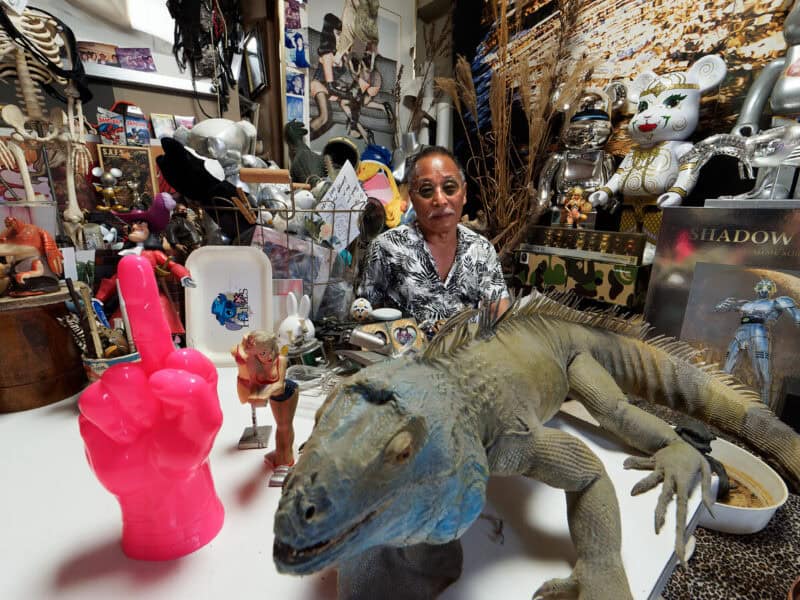
The artist, Hajime Sorayama, in his studio
KT: You know, with those guys, ‘erotic’ is a no-go, yet ‘eros’ is somehow accepted.
HS: But they’re basically the same thing, right? Once, for a solo exhibition, I tried to put a seven-metre-tall ‘sexy robot’ in front of the entrance of the building. Even then,I had to get permission from the city office because of fire code regulations, and that was a huge hassle. They just passed me around everywhere. The worst part was that it sometimes ended with just one comment: “It’s naked, isn’t it?” [Laughs]
KT: Even though it’s a robot, they still call it naked.
HS: My solo exhibition, which was held in Shanghai recently, is going on a tour around China. Shenzhen’s venue, for instance, is a national art institution, which means that even the Chinese Communist Party approves of the naked stuff that I make!
KT: Your work has always had an erotic element, right?
HS: Erotic, and only erotic. [Laughs]
KT: No, it’s not just that.
HS: Whether it’s people or animals, the essence of infusing eros, or infusing life − that hasn’t changed at all since the beginning.
KT: When did that sense awaken for you?
HS: What I remember is that I was a middle-school student and was taking an exam. The bra strap of the proctor [invigilator] sitting in front of me was visible through her blouse, and I just kept staring at it the whole time.
KT: You were a problem child, weren’t you? [Both laugh]
HS: No, but call me a boy who was honest about what interested him.I think that’s individuality or talent, but teachers don’t understand that. All they see is grades going from two to four on a five-point scale. They can’t grasp anything outside the norm, like minus-two or eight.
KT: That’s definitely true.
HS: When I was in middle school, I lived in the countryside with almost no entertainment, so I watched movies all the time. But even with films like The Graduate, I had zero interest in romance. My eyes just kept chasing after the mature woman, namely Mrs. Robinson [Anne Bancroft], who tried to seduce the protagonist [Benjamin, played by Dustin Hoffman]. Scenes like her putting on the black stockings or saying, “If you won’t sleep with me… I want you to know that you can call me up anytime you want.” It made me think, “Wow, that’s so cool!”

‘Untitled’, 2023, acrylic, digital print on canvas
KT: The black stocking scene was used on the poster, so I’m sure many people still remember it.
HS: For Sunset Boulevard, I loved the scene where the legendary actress Gloria Swanson descends the stairs wearing a sexy dress. For Dr. No, I loved it when Sean Connery is with Ursula Andress. Anyway,I was totally into mature women. But only one or two boys in my class would get that kind of thing.
KT: So you were already awakened by middle school?
HS: I just didn’t realise it myself. I remember looking around in high school and suddenly realising that I was a minority.
KT: It’s a bit fetishistic, different from ordinary eroticism.
HS: Maybe so. You can see it in the title of my Shanghai solo exhibition, Light, Reflection, Transparency. These are my core themes.
KT: Could it be that the origin of your work is the proctor’s see-through bra?
HS: That’s pretty much how middle-school boys are, right?
KT: Is the fetishistic sensibility that was awakened during puberty the same as the female image you want to paint?
HS: They share common ground, but they’re actually different. Because in reality, there are no women with perfect looks, but what I’m painting are perfect goddesses.
KT: So that’s your mindset. Just yesterday, I was writing about the gay artist Tom of Finland, and he said, “If I get a hard-on while drawing, that means I’ve drawn it well.” Do you have the same kind of feeling?
HS: No, not at all. I never get hard-ons while drawing. Whenever I’m drawing, the goddess tells me what to do, so I just follow her instructions. I’m her slave. She says, “Fix that spot, it’s uncomfortable”, or “Your drawing is a mess, you amateur! On behalf of the Moon, I will punish you!”
KT: The goddess is unforgiving.
HS: Yeah, but now I try to work on about four pieces at once. If I focus too much on just one, I get completely absorbed and my perspective narrows, I start thinking I’m a genius! So I go home to cool down and regain my social skills.
KT: So you’re not like Tom. You don’t try to satisfy your pleasures that you can’t get in reality through art?
HS: No! Because the goddess is not an object of sexual desire. Sexual desire and goddesses are different. Would you ask a goddess to sleep with you? You’d be punished! What I’m painting is a flawless, perfect goddess, so I don’t feel any eroticism toward her. I’m trying to depict a truly refined, perfect woman.
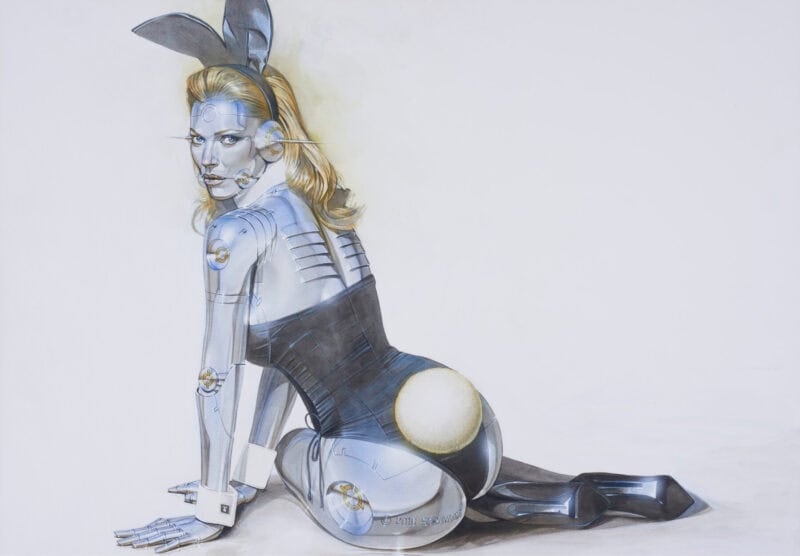
‘Untitled’, 2016, acrylic on illustration board
KT: I used to like paintings depicting imperfect women, the ones drawn by erotic artists of the bygone days. But they’ve almost disappeared lately.
HS: Their market has shrunk, after all.
KT: What those artists drew wasn’t perfect goddesses, but women they themselves wanted to embrace.
HS: I don’t understand why they drew like that. I suppose their technique wasimmature and they were just following the editor’s instructions. But what’s fun about drawing something like that? I don’t get it at all. Like the paintings from the culture museum collections, those paintings have this humid feeling.
KT: I do like those paintings.
HS: Not me. I observe and research them out of pure interest,but I never want to paint them myself.
KT: You’ve never thought about painting a woman who stimulates your own desires?
HS: Back in middle school, I used to doodle in the margins of textbooks, but not since I started painting goddesses.
KT: When did the goddess descend upon you?
HS: I can’t say when, but the archetypes were probably Mrs.Robinson and the mature women in movies. Looking back, I feel like that’s when I veered off the straight and narrow paths.
KT: When you first became an illustrator, you took on commissioned work, right?
HS: Of course. But whether it was for a magazine cover or an article, I drew what would sell as art. For example, when I was asked to draw a cover of a novel, the editor would tell me all about the protagonist’s personality or the setting, though I was like, “Yeah, but who cares about that?”
KT: Most people can’t pull off that kind of attitude, especially when they’re young.

‘Untitled’, 2024, acrylic, digital print on canvas
HS: But you have the right to say it. Back then, I had this confidence − this unfounded confidence − that I could just push through!
KT: Where did that come from?
HS: Well, I had what I wanted to draw inside me, so everything else didn’t matter. If I couldn’t make a living, then fine, I’d listen to the editors a little bit.
KT: Freelancing is a constant battle like that.
HS: But if you do solid work, the offers keep coming. It was also an era when jobs with fancy foreign-sounding titles like art director and copywriter started getting hyped up.
KT: I don’t want to just brush that off as ‘thanks to the era’.
HS: Neither do I, but saying it out loud is kind of tacky, don’t you think?
KT: But not everyone can be as bold as you.
HS: Well, that can’t be helped. Not everyone has the talent. The reason why people try to work hard is because they don’t have the talent! If you have a decent amount of talent, you don’t need to work that hard.
KT: No, you work hard too.
HS: I’m just doing what I love. You don’t need [to make an] effort to do something that you love. If you start thinking of it as effort, that’s the end of it, isn’t it?
KT: And thinking that the more effort you put in, the better you get, is a mistake, right?
HS: You don’t! You really don’t get better. As long as you think of it as effort, it won’t work.

‘Untitled’, 2022, acrylic, digital print on canvas
KT: But you have always drawn the pictures you wanted to draw as an illustrator, and at some point, people started calling you an artist.
HS: That’s just society arbitrarily changing, isn’t it? When you get to my level, people ask you for recommendation comments from all sorts of places. When that happens, I call myself ‘Sorayama, The Mad Old Man of Painting’, just like Hokusai, the ukiyo-e [woodblock prints] artist.
KT: Do they actually use that title about you?
HS: Of course! I tell them if they’re not going to use that title, they can’t use my recommendation comment at all!
KT: But when you go overseas, people introduce you as an artist, right?
HS: Right, a painting artist. But Japanese art and overseas art operate in different territories. If you call yourself an illustrator in America, they’ll totally look down on you like,“You’re a commercial artist?” So in America, we call ourselves an artist without exception. There’s no point worrying about that.
KT: The reason why I started talking about titles is because you’re highly recognised in today’s art world.
HS: No, it’s street. Street art.
KT: It might have strong roots, but I see it as fine art. You’re holding exhibitions in major museums around the world. Still, the essence of what you create hasn’t changed since your illustrator days, has it?
HS: I’ve been sowing seeds since way back. Now, it’s harvest time, and I’m reaping the rewards.
KT: What do you mean?
HS: Even though I wasn’t making much money, I’d duplicate my paintings using 4×5 positives [which are used in a slide projector]. This was before digital cameras, so it was all film. It cost a fortune. But when a publisher approached me about publishing my collection, I’d just hand over those positives. That made their work easier, so commissions kept coming in. That’s why I’ve got about 30 to 50 books out now. Some are cheap editions like the ones from Taschen, but those were flyers for cash-strapped students. It had a kind of imprinting effect − Kim Jones and Stella McCartney, who grew up seeing those flyers, are now coming to me for collaborations.
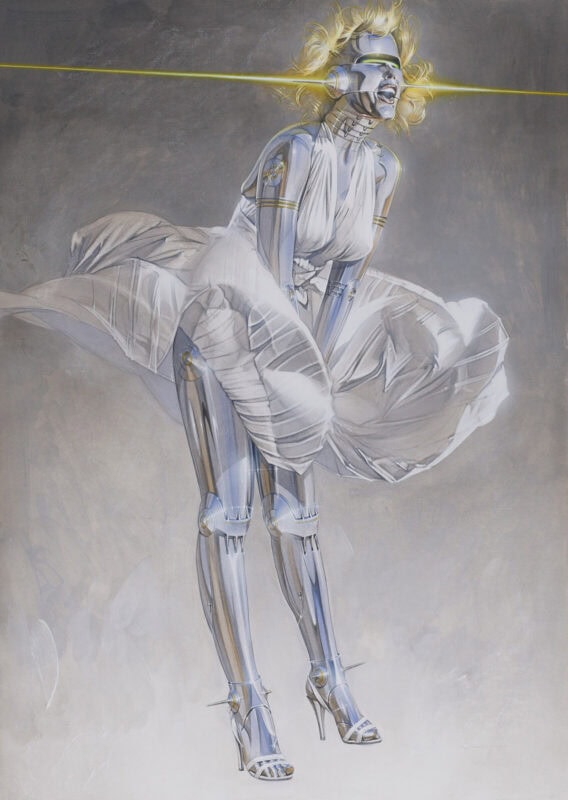
‘Untitled’, 2015, acrylic on illustration board
KT: That’s a well-oiled system. But even as society and fans change, and I know I sound repetitive, the essence of your drawing hasn’t changed.
HS: That’s true. I’m still haunted by that see-through bra! I just paint whatever I want and I paint because it’s fun. That’s why, even after a painting sells, if something bothers me, I’ll print out the image and keep tweaking it. For me, nothing is actually completed. That’s what painting means to me.
KT: I think this is what people often misunderstand. It’s not that you moved closer to the art world, it’s just the perception of society that changed.
HS: In my view, calling myself an ‘entertainer who entertains oneself’ fits best. I paint to entertain myself. I’m grateful when people like my work, collect it or ask for collaborations, but that doesn’t mean I change anything. I don’t think of it as effort; I feel there’s a single, consistent thread running through it all − just for the sake of fun.
KT: I think consistency is what’s important.
HS: That’s something I realised when I look back on the past during interviews. Otherwise, I never look back at all. I’m absorbed in painting and there’s so much I want to do, yet the time left keeps getting shorter and shorter.
KT: It makes sense when you put it that way. But this is something you discovered after doing it for a long time?
HS: Yes. That’s why when I hear the younger generation talking about slumps, I think, “What are they talking about?” It’s not like you can’t draw when you’re doing something you enjoy. If you have the time to worry about it, just keep creating! If it’s something you truly love, you can keep doing it forever.
Photographer and editor Kyoichi Tsuzuki. Taken from 10+ Issue 8 – FUTURE, JUBILEE, CELEBRATION – out now. Order your copy here.

‘Untitled’, 1981, acrylic on illustration board


