December 29, 2025 |
On a traffic island in former West Berlin – flanked on each side by the A100, Messedamm and Neue Kantstraße – the now 46-year-old retired Internationales Congress Centrum, more commonly known as ICC Berlin, emerges like an alien raft, suspended as if moments from ascension.
At more than 300 metres long, the building’s aluminium façade and geometric levels project a ship-like silhouette onto the land-locked capital’s skyline. Considered the blueprint of modern conference centres globally, ICC Berlin became the career-defining project of husband-and-wife architect duo Ralf Schüler and Ursulina Schüler-Witte and exists as a haunting ghost of the dreams of the Federal Republic of Germany. A behemoth of high-tech architecture, its construction costs amounted to almost one billion marks, making it the most expensive building ever built in West Germany at the time of its opening in 1979 (that’s around £1 billion in today’s money).
Offering the capacity to seat 14,500 guests across 80 versatile rooms, this monumental conference centre attracted visitors from around the world, inviting people to gather on a previously incomprehensible scale in a building that boasted some of the most innovative technological features of the era. This included 8,000 conference-room chairs with integrated interpretation equipment for up to eight languages – a symbol of Berlin’s desire to be known as a leading international economic hub.


from left: a section of the building’s 300-metre aluminium façade; the main auditorium, with seating for up to 5,000 people
Schüler and Schüler-Witte’s design for ICC Berlin was born of a unique political climate that required things to be bigger in order to be better. Tourism experts of the late 1960s predicted a steady increase in the number of international conferences set to take place, and so a mammoth centre built to cater for these moments could be just the thing to draw the world and its wallet to West Germany. With a capacity of only 1,200, the Kongresshalle in Tiergarten park was now recognised as being too small to meet the demand (the building has since been reimagined as Haus der Kulturen der Welt, referred to by some as “the pregnant oyster”). And so in 1966 AMK (Ausstellungs-, Messe-, Kongress-GmbH) held a competition to design a multi-purpose hall with a maximum capacity of around 4,000 people. The winning design eventually came from Schüler and Schüler-Witte, at the time an unknown duo, but city officials soon put a halt to the project before it could begin, claiming that it would not be a suitable antidote to the challenges of the future. It simply wouldn’t be big enough.
And while this exercise in urban planning was taking place west of the Wall, East German architect Heinz Graffunder and the Building Academy of the German Democratic Republic were finalising plans for parliament’s new home, the Palast der Republik. The most ambitious building in the fledgling history of the GDR (East Germany) was scheduled to break ground in 1973 and open in 1976, just three years before ICC Berlin’s completion. Conceived as a glistening beacon of self- proclaimed prominence and power, the plans utilised architecture’s ability to communicate bold societal sentiments, such as protection, unity and strength: a language both parts of Germany were fluent in. And the emergence of these plans undoubtedly started an architectural race to proclaim both their dominance.
Once again, architects Schüler and Schüler-Witte were commissioned to build a conference centre, but this time they designed a beast that was too bold to be stopped: 313 metres long, 89 metres wide and 40 metres high.
Evoking simultaneous feelings of transit and transcendence with its cavernous halls and sprawling mezzanine levels, the sensation of navigating the interior of the building swings between walking the decks of a ship and moving between the platforms of a train station.
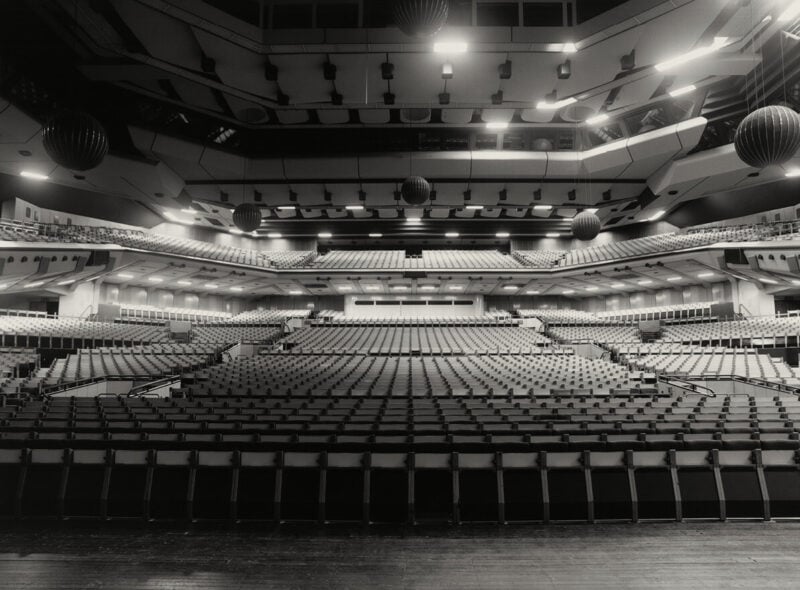
The presenter’s view of the main auditorium
Elegant and intentionally designed intermediary spaces feel pause-worthy, inspiring presence and conversation, while terminal-like staircases and escalators guide visitors to expansive rooms dedicated to presentation and discussion. The largest of the spaces – the main auditorium – seats up to 5,000 people, while Hall 2 provides space for up to 4,000.
However, after the fall of the Wall in 1989, the fate of these architectural behemoths became starkly contrasted. ICC Berlin has sat almost entirely untouched since 2014, when it was deemed too costly to maintain as an active conference centre, but the building has retained much of its majesty, with only certain technological integrations considered dated or redundant.
Meanwhile the Palast der Republik was demolished in 2008, despite much controversy. Many people, particularly those hailing from the former East Germany, saw this act as political vandalism – a violent attempt to dampen the cultural and architectural legacy of the GDR.
In 2019, ICC Berlin was awarded a lifetime of protection in the form of listed building status, meaning it can never be demolished or redeveloped in any architecturally damaging way. In late 2024, a tender opportunity was opened by the local government, kickstarting what will be the most transformative era of the building’s existence in an effort to remedy the cost of the building sitting empty, paused and muted on its Charlottenburg traffic island. Potential investors around the world are invited to submit proposals for future iterations of this remarkable, unavoidable, magnetic building, with the winning submission to be announced in 2026.
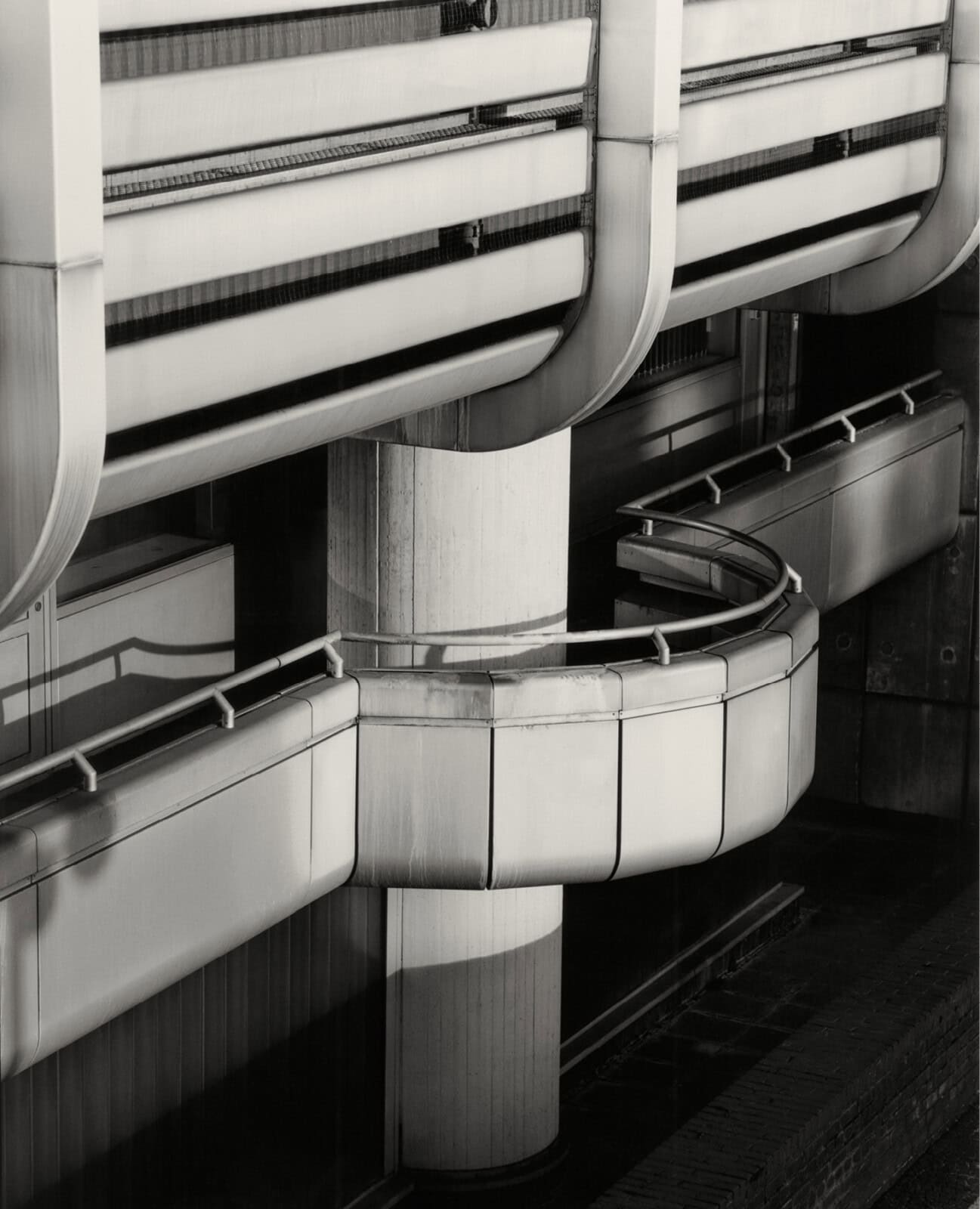
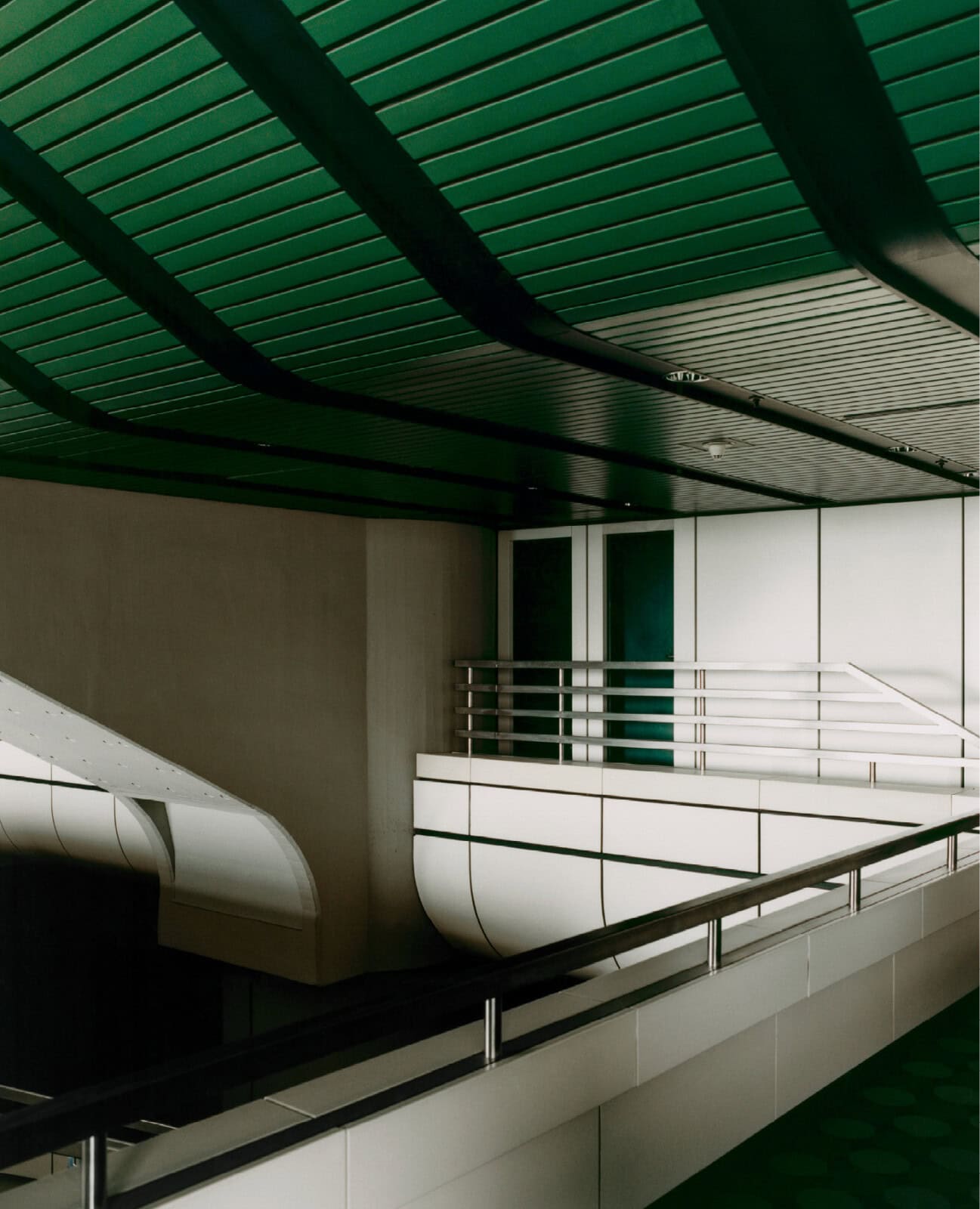
from left: one of the building’s external walkways, connecting levels and halls; internal stairways and elevated walkways, connecting levels and halls
Matthias Kuder, who is press spokesperson for the Senate Department for Economic Affairs, Energy and Public Enterprises and also deputy spokesperson for the Berlin Senate, explains the decision. “This is one of the most important buildings of post-war Germany, and that is why it is listed,” he says.“We don’t want to lose this treasure, but we also don’t want to have it sleeping for the next 20 years. It costs us €2m [£1.7m] per year just to have it asleep, and we want to wake it up. But of course you need a much bigger amount of money to make that happen.
“As a state, Berlin currently does not have that funding available, so that’s why we’re looking for investors,” he continues. “If they present a concept that is convincing, both in terms of what they want to do and that the state would not be required to provide additional funding to make it happen, this would then secure this idea of waking the building up and making it accessible for the public to enter again on a regular basis for the next 99 years, at least.”
Berlin is not generally considered one of the world’s most conventionally beautiful cities, but its wealth of architectural landmarks is known internationally, and it is the German people with whom they resonate most intimately. The city’s streets, waterways, transport connections and buildings tell stories of conflict, industry, division, oppression and unity, but in a city committed to both commemorating and learning from its past through preservation and memorialism, why are some buildings protected and others discarded?


from left: floor, ceiling, window and wall details converge at the top of a stairway; the neighbouring Funkturm Berlin (Berlin Radio Tower) shares the skyline with ICC Berlin
Architecture critic Ada Louise Huxtable’s 1965 essay ‘Lively Original Versus Dead Copy’ perfectly encapsulates the challenges faced by modern city governments. She writes: “Preservation is the job of finding ways to keep those original buildings that provide the city’s character and continuity and of incorporating them into the living mainstream. This is not easy. It is much simpler to move a few historical cast-offs into quarantine, putting the curious little ‘enclave’, or cultural red herring, off limits to the speculative developer while he gets destructive carte blanche in the rest of the city.” While the historic, cultural and aesthetic values of the demolished Palast der Republik and surviving ICC Berlin would have ranked similarly to each other, perhaps the opposition of their fates was the result of a lack of resources, vision or willingness to redefine the former’s purpose and function. Many voices – both on the street and in official spaces – reflect on the building’s death sentence as regrettable, with a caveat of resigned inevitability. As Lutz Henke, culture director of the German capital’s official tourism platform VisitBerlin, states, “The Palast der Republik is like a phantom pain – you’ve cut off a limb, but you still feel it exists.”
With the demise of the Palast der Republik went its spectacular interiors, now limited to being experienced through grainy scans of old photographs spewed up by an online search engine. It is likely that the grief of this loss contributed to the decision to assign ICC Berlin its life-saving listed status, particularly given that one of the building’s most mesmerising features is a multi-level interior lighting and sculpture installation by local artist Frank Oehring.
Illuminating the building’s wayfinding system with all the charm of a fairground or nightclub, Kreuzberg-based Oehring’s hypnotic 1979 work erupts as a central sculpture titled The Brain, with neon entrails reaching around the lower levels of the building, highlighting walkways and meeting points. This artwork- turned-lighting system is a collaboration between Oehring and the architects, and remains his most prominent work. Prior to the building receiving its protected status, this too could have been lost to loveless redevelopment.
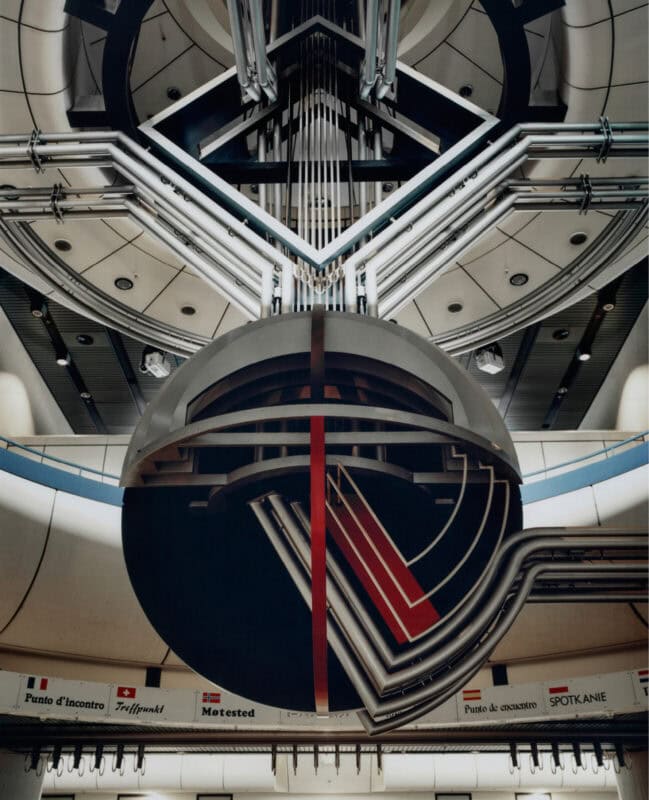
Inside the Internationales Congress Centrum, in Berlin, lighting sculpture ‘The Brain’ by Frank Oehring, 1979
Today, ICC Berlin is frozen in time between its past and its future, but thankfully a future is guaranteed. With it, Henke hopes the city can avoid a case of what he coins “zombie urbanism”. The formal invitation to propose plans for the long-overdue second life of the building comes with a strict stipulation that it should be a place for the public – a space to gather that enriches the lives of locals and visitors alike. Schüler and Schüler-Witte’s original design for the building asks a lot of questions about how we imagine the future, questions which, as Henke states, “were very contemporary even back in the 1970s”. “It’s not only concrete and aluminium,” he adds. “There’s an immaterial benefit. It has decades of people’s lives attached to it.”
Referring to the city’s notoriously stilted bureaucratic decision-making, he finishes: “Luckily, Berlin was too slow to make the mistake of tearing down this building. It still exists. We still have its full potential.”
Photography by Bastian Achard. Taken from 10+ Issue 8 – FUTURE, JUBILEE, CELEBRATION – out now. Order your copy here.
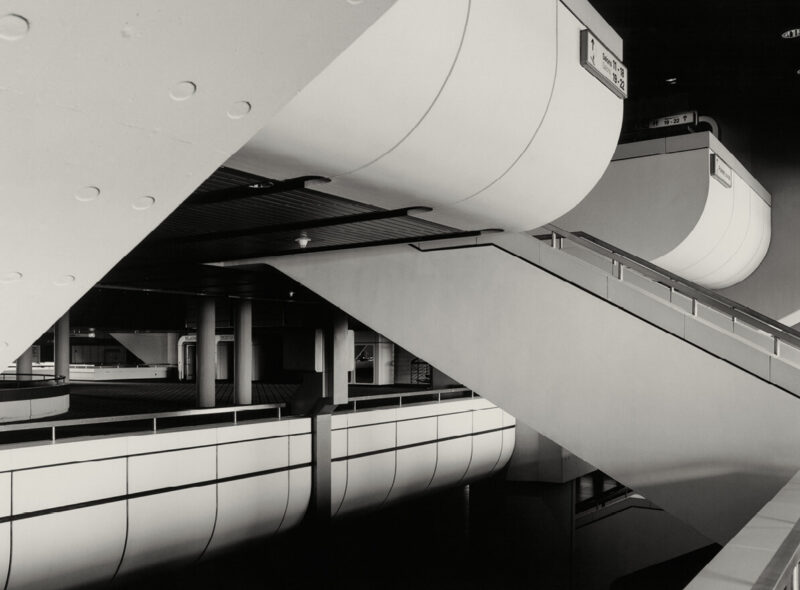
Internal stairways and elevated walkways, connecting levels and halls;